


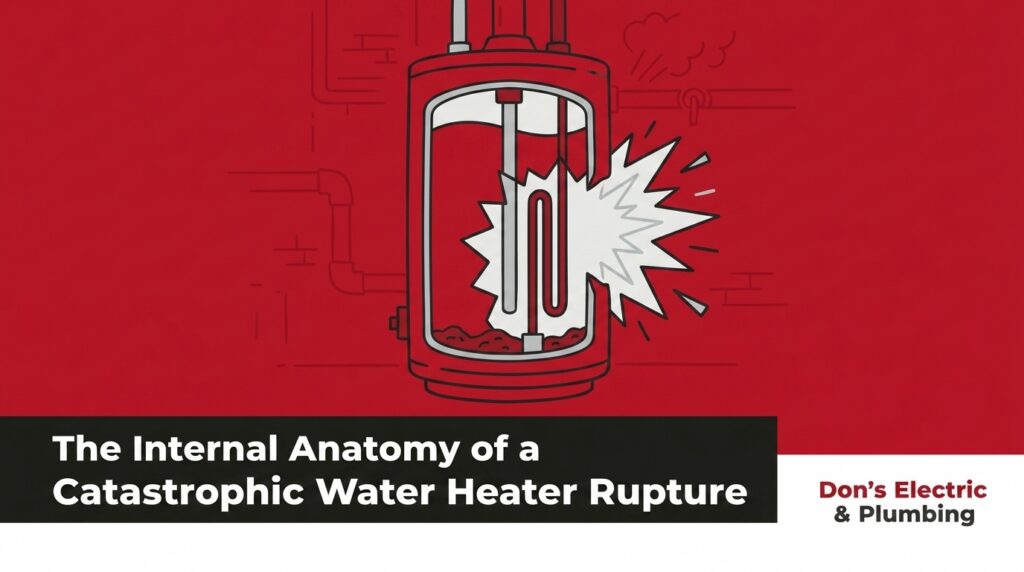
The Silent Countdown to a Flooded Basement
Your water heater looks perfectly fine from the outside, but underneath that metal jacket, the internal anatomy of a catastrophic water heater rupture is already taking shape. In our years serving local homeowners, our team at Don’s Electric & Plumbing has seen firsthand that a tank failure is rarely a sudden, unpredictable event. Instead, it is the final stage of a long, invisible chemical and physical breakdown happening completely out of sight. Because the exterior shell remains pristine while the interior pressure vessel degrades, homeowners often miss the early warning signs until it is too late.
For comprehensive guidance on protecting your home’s infrastructure, read our guide on knowing when to call a plumber, or if you are facing an active leak, seek emergency plumbing repair immediately.
Many homeowners in our area rely on their systems daily, assuming that as long as the water is hot, the equipment is healthy. However, the reality of plumbing infrastructure is much more complex. A water heater operates under constant pressure and extreme temperature fluctuations. Over time, these forces take a toll on the steel tank hidden beneath the insulation. By the time our plumbers are called to assess water pooling on the floor of Canajoharie NY basements, the structural integrity of the tank has typically already been entirely compromised.
Understanding exactly how a water heater fails empowers you to take action before disaster strikes. Recognizing the physical warning signs the moment they manifest is the difference between a controlled, scheduled replacement and costly severe water damage. We will break down the exact forensic timeline of a failing tank, from the initial chemical changes to the final mechanical rupture, so you know exactly what is happening inside your utility room.
The First Domino: Sacrificial Anode Depletion and Galvanic Corrosion
Every standard tank water heater is manufactured with a built-in defense mechanism against water’s natural corrosive properties. This defense relies on a specific chemical reaction, and when that reaction stops, the countdown to a tank rupture begins.
Understanding Electrolysis in Your Tank
Water is often called the universal solvent. When it sits inside a steel tank, it acts as an electrolyte, facilitating the transfer of ions. To prevent the water from rusting the steel walls, manufacturers install a sacrificial anode rod, typically made of magnesium or aluminum. Because these metals sit higher on the Galvanic Series than steel, they are more reactive. Through a process called electrolysis, the corrosive elements in the water attack the anode rod instead of the tank walls. The anode rod literally sacrifices itself, dissolving slowly over years to keep the steel interior perfectly intact.
The Shift to Steel Corrosion
The moment the sacrificial anode rod is fully depleted, the chemical chain reaction shifts violently. With no magnesium or aluminum left to attract the corrosive elements, the water immediately begins attacking the weakest points of the exposed steel tank. Rust forms along the internal welds and the bottom plate, slowly eating away at the structural integrity of the metal. Because this process happens inside a sealed, dark environment, it remains entirely invisible to the homeowner.
The critical takeaway: Inspecting the status of your anode rod is the single most important preventative measure against internal corrosion. However, because dealing with high-pressure, high-temperature water systems carries significant safety risks, accessing and replacing the anode rod requires a licensed professional. Never attempt to open a pressurized tank yourself. If you begin hearing popping or rumbling sounds from sediment trapped under the heating source, our technicians often find it is highly likely your anode rod has already failed and internal corrosion is underway.

The Physics Behind the Noise: Why Sediment Boils
One of the most definitive warning signs of an impending water heater failure is a distinct, rhythmic noise coming from the tank. While many people assume the tank is simply “settling,” the actual physics behind this noise reveal a dangerous mechanical struggle happening inside the unit.
Regional hard water contains high levels of dissolved minerals, primarily calcium and magnesium. When hard water is heated, these minerals precipitate out of the liquid and drift to the bottom of the tank. Over months and years, they accumulate into a dense, rock-hard layer of sediment. This sediment buildup acts as a powerful thermal insulator, effectively blocking the heat from reaching the water efficiently.
Here is where the physics become destructive. As the burner or heating element fires, it must blast through this thick layer of mineral rock. The small pockets of water trapped beneath the sediment layer become superheated. They boil rapidly, turning into steam bubbles that violently force their way up through the mineral crust. The popping or rumbling sounds from sediment trapped under the heating source are actually the sounds of these steam bubbles collapsing and exploding—a process known as cavitation.
Why this matters: Hearing these sounds means the bottom of your tank is actively overheating. The heating source is working overtime, baking the steel plate while struggling to heat the water above the sediment. This extreme localized heat weakens the metal, accelerating the corrosion process. If your tank sounds like a percolating coffee pot, you need to schedule plumbing repair services immediately before the weakened steel gives way.
Thermal Stress: The Invisible Force Weakening the Steel
Galvanic corrosion and sediment buildup are highly destructive on their own, but they are compounded by the relentless mechanical force of thermal stress. Metal expands when it gets hot and contracts when it cools. A water heater tank undergoes this cycle constantly, filling with cold water and heating it to high temperatures multiple times a day.
When a thick layer of insulating sediment covers the bottom of the tank, the burner is forced to run much longer and hotter to reach the desired thermostat setting. This superheats the bottom steel plate far beyond its intended design limits. Meanwhile, the rest of the tank remains relatively cooler.
This temperature differential, known as Delta-T, becomes extreme during specific times of the year. Upstate New York groundwater enters plumbing systems at very low temperatures during the winter months. When this freezing cold groundwater rushes into a tank and hits the superheated, sediment-covered bottom plate, the resulting thermal shock is immense. The steel attempts to contract rapidly against the intense heat of the burner.
These extreme, repeated temperature swings cause microscopic fractures to form in the steel. Because the metal has already been compromised by rust (due to the depleted anode rod), it lacks the flexibility to handle this stress. Over time, these micro-fractures spread through the metal in many Canajoharie NY basements, silently weakening the structure with every single heating cycle until the steel can no longer hold back the water pressure.
Condensation vs. Micro-Leaks: A Seasonal Deception
The transition from a weakened tank to a fully ruptured tank usually begins with a microscopic breach. The very first physical sign of failure is often a pinhole micro-leak, where water barely weeps through the compromised steel. However, seasonal environmental factors frequently mask this critical warning sign.
During the warmer months—especially as we navigate late summer humidity and the busy back-to-school transition—our plumbers frequently encounter a deceptive environment in residential utility spaces. When cold groundwater fills the tank, the stark temperature difference between the chilled steel and the humid basement air causes condensation to form on the exterior of the unit. This “sweat” drips down the sides and forms a small puddle at the base of the heater.
Unfortunately, a puddle caused by harmless condensation looks identical to a puddle caused by a catastrophic micro-leak. Homeowners often dismiss actual structural leaks as mere late summer humidity, delaying critical inspections and allowing the internal rust to spread further.
| Characteristic | External Condensation | Structural Micro-Leak |
|---|---|---|
| Timing | Occurs primarily during high-humidity seasons or heavy water usage | Constant, regardless of weather or recent hot water usage |
| Location | Moisture evenly coats the upper and lower exterior jacket | Moisture originates from a specific seam, valve, or the bottom plate |
| Progression | Dries up when the tank reaches room temperature or humidity drops | Never stops weeping; puddle slowly grows over time |
The rule of thumb: Any unexplained moisture accumulation around the base of your unit is among the plumbing issues you should never ignore. Assuming a puddle is just condensation is a dangerous gamble when dealing with a pressurized vessel.
Structural Fatigue: The Final Stages Before Rupture
When the internal anatomy of a water heater reaches its final stages of failure, the breakdown is rapid and highly destructive. A catastrophic rupture is the result of multiple compounding factors finally overcoming the physical strength of the steel.
Here is the exact sequence of the final mechanical breakdown our team observes in the field:
- The Anode Fails: With no sacrificial metal left, galvanic corrosion aggressively rusts the internal steel walls and bottom plate.
- Sediment Bakes the Steel: Hard water minerals insulate the water, forcing the burner to superheat the bottom of the tank, weakening the molecular structure of the metal.
- Thermal Stress Fractures Form: The constant cycle of extreme heat and freezing cold groundwater creates micro-fractures in the rusted steel.
- Constant Pressure Prevails: Municipal water pressure typically sits between 50 and 80 PSI. This is a relentless, unyielding force pushing outward against the weakened, fractured bottom plate 24 hours a day.
- The Bottom Gives Way: Unable to withstand the 80 PSI force any longer, the rusted, overheated steel tears open.
When the bottom gives way, it does not just empty the 40 or 50 gallons currently sitting inside the tank. Because the unit is connected directly to the municipal water supply, the ruptured tank will continue to blast fresh water into your home at full pressure until the main shutoff valve is manually closed. This is why dozens of Canajoharie NY basements face severe flooding every year. Recognizing the early stages is the only way to schedule controlled residential plumbing repair rather than dealing with an active indoor flood.
Why Safe Replacement Requires a Multi-Trade Approach
When a tank finally fails and must be replaced, homeowners quickly realize that the job is not merely a matter of swapping out a metal barrel. A modern water heater sits at the dangerous intersection of your home’s most critical utility systems: high-pressure water, high-voltage electricity, and highly combustible natural gas or propane.
A rushed or improper replacement carries severe safety risks. If a gas line is improperly threaded during the swap, a silent gas leak can fill the utility room. If the exhaust venting is not aligned perfectly to current safety codes, the new unit can backdraft deadly carbon monoxide directly into the living space. For electric models, failing to ensure the new unit’s electrical load precisely matches the existing circuit breaker and wiring gauge can result in tripped breakers, melted wires, or electrical fires.
Working with our family-owned, multi-trade team means you benefit from the “One Call Does It All” advantage. Because we handle plumbing, electrical, and HVAC services under one roof at Don’s Electric & Plumbing, we ensure the installation seamlessly integrates the water connections alongside any required electrical wiring or gas line work. Professional, multi-trade installation ensures that the complex safety protocols are met, your home remains protected, and the manufacturer’s warranty on the new unit is fully validated against premature failure. Additionally, upgrading to a qualifying high-efficiency model may make you eligible for general utility rebates or federal tax credits, which our experts recommend verifying with your tax professional.
Frequently Asked Questions About Water Heater Mechanics
Why does my water heater make a popping sound?
Popping sounds indicate that a thick layer of mineral sediment has built up at the bottom of the tank. This sediment acts as an insulator, trapping small pockets of water against the heating element or burner. The trapped water superheats and boils into steam, and the popping noise is the sound of those steam bubbles violently collapsing as they escape the sediment layer.
What causes the bottom of a water heater to fall out?
The bottom of a tank falls out due to severe, unchecked galvanic corrosion combined with thermal stress. Once the sacrificial anode rod depletes, the water rusts the steel bottom. As sediment forces the burner to overheat the weakened, rusted metal, the constant 50-80 PSI of municipal water pressure eventually tears the compromised bottom plate open.
How does an anode rod prevent rust?
An anode rod prevents rust through a chemical process called electrolysis. Made of highly reactive metals like magnesium or aluminum, the rod attracts the corrosive elements in the water. The rod safely corrodes and dissolves over time, acting as a sacrificial target so the steel tank walls remain completely untouched by rust.
Can a water heater explode?
While extremely rare due to modern safety devices, a water heater can explode if the Temperature and Pressure Relief (T&P) valve fails while the thermostat malfunctions. If the burner continuously heats the water without shutting off and the pressure cannot escape through a broken T&P valve, the internal pressure can exceed the structural limits of the steel, resulting in a catastrophic, volatile explosion.
Why did my water heater burst without warning?
A burst water heater rarely happens without warning, but the signs are often invisible or misunderstood. The internal corrosion process happens entirely out of sight inside the sealed tank. By the time homeowners notice rusty water, external condensation, or popping or rumbling sounds from sediment trapped under the heating source, the structural integrity of the steel has already been failing for months.
How quickly does a water heater rust once the anode is gone?
Once the sacrificial anode is completely depleted, aggressive galvanic corrosion begins immediately. Depending on the exact chemical makeup and hardness of your local water supply, a completely unprotected steel tank can develop severe structural weakness and micro-fractures in just a few short years, rapidly accelerating toward a full rupture.
Heed the Warning Signs Before Structural Failure
Understanding the internal anatomy of a catastrophic water heater rupture empowers you to act before the damage becomes irreversible. The chemical and physical breakdown of a tank is a predictable, linear process. It starts with a depleted anode rod, progresses to severe galvanic corrosion, accelerates through thermal stress and boiling sediment, and ends with a flooded utility room.
You do not have to wait for the bottom of your tank to give way. If you are hearing popping sounds, noticing rusty water at your taps, or finding unexplained moisture pooling on the floor of Canajoharie NY basements, the structural failure process is already underway. These are definitive, physical signs of internal degradation that demand immediate attention.
Seek a professional assessment from our team the moment these symptoms appear. Addressing the issue early ensures you stay in control of the replacement process. If your tank is already showing advanced signs of failure, do not risk a sudden rupture—reach out for emergency plumbing repair to secure your home’s infrastructure today.