


The Morning Rush: Reevaluating Your Home’s Hot Water Capacity
Your teenager is in one shower, the dishwasher is running a heavy cycle, and you step into your own shower only to be hit with a blast of ice-cold water—a common scenario we hear about when customers are researching Tankless vs. Traditional Water Heaters: Sizing for Large Hudson Valley Households. At Don’s Electric & Plumbing, we know the frustration of running out of hot water is a universal pain point, but our team notices it becomes especially apparent during the August back-to-school transition (peak morning hot water demand). As summer routines fade and everyone’s morning schedule suddenly aligns, the sheer volume of hot water required to get a large family out the door skyrockets. If your current system is failing to keep up, you are likely facing a significant home infrastructure decision.
The primary decision point usually boils down to weighing the infinite, on-demand supply of a gas tankless system against the infrastructure upgrades and maintenance realities required to support it. Upgrading your hot water capacity is rarely a simple swap. It requires evaluating your home’s existing plumbing framework, understanding local climate impacts on flow rates, and determining whether your current utilities can handle the massive energy draw of modern tankless technology. If you are tired of scheduling showers in shifts, having our experts perform your plumbing repair and installation is the first step toward building a system that actually meets your family’s daily demand.
Endless Supply vs. Stored Reserves: How the Technologies Compare
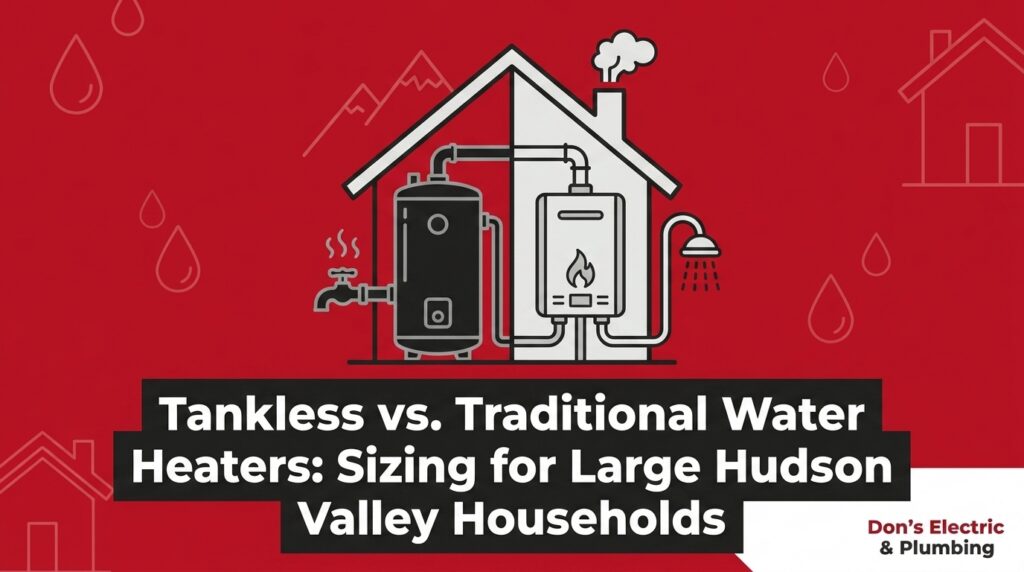
To make an informed decision about your home’s hot water future, we always tell our customers they must first understand the fundamental mechanical differences between the two leading technologies. A tankless water heater, often referred to as an on-demand system, does not store any hot water. Instead, it utilizes a powerful heat exchanger to rapidly heat cold water exactly as it flows through the unit. As long as you respect the system’s maximum flow rate, a properly sized tankless unit will provide an infinite supply of hot water, completely eliminating the fear of a cold shower.
In contrast, a traditional storage unit—such as a standard 50-gallon gas tank—heats a fixed volume of water and holds it at a constant temperature until you need it. When you turn on a faucet, hot water exits the top of the tank while cold groundwater enters the bottom to be heated. Once that 50-gallon reserve is depleted, you must wait for the burner to heat the incoming cold water, which is why back-to-back showers often end in frustration. Furthermore, storing water constantly carries inherent risks over time; understanding the internal anatomy of a catastrophic water heater rupture highlights why we highly recommend proactive replacement of aging traditional tanks.
Key Differences at a Glance
| Feature | Tankless Water Heater | Standard 50-Gallon Gas Tank |
|---|---|---|
| Supply Limit | Infinite (limited only by flow rate/GPM) | Fixed volume (50 gallons until depleted) |
| Footprint | Compact, wall-mounted, frees up floor space | Large, cylindrical, requires significant utility space |
| Lifespan | Often exceeds traditional units with proper maintenance | Generally shorter lifespan due to constant water storage |
| Energy Efficiency | High (meets stringent DOE/ENERGY STAR guidelines) | Lower (experiences standby heat loss) |
The ‘Delta T’ Factor: How Upstate Winters Impact Flow Rates
While the promise of endless hot water sounds perfect, our technicians know firsthand that the reality of achieving it depends heavily on a critical scientific concept known as “Delta T” (temperature rise). Delta T is simply the difference between the temperature of your incoming cold groundwater and your desired output temperature, which is typically set to 120 degrees Fahrenheit for safety and efficiency. This calculation is the single most important factor when our team sizes a tankless system for your home.
Why Climate Dictates Capacity
A standard 50-gallon gas tank is largely unaffected by Delta T when it comes to delivering its peak flow rate. Because the water sits in the tank for hours, the burner has plenty of time to heat frigid water up to 120 degrees. The only penalty a traditional tank suffers in cold weather is a slightly longer recovery time once the tank is empty.
Tankless systems, however, must heat water instantaneously as it rushes through the unit. This is where the local climate becomes a major hurdle. In our years of servicing the area, we’ve seen Hudson Valley winter groundwater temperatures drop significantly, meaning the incoming water might be as cold as 40 degrees Fahrenheit. To reach a safe 120 degrees, the tankless unit must achieve an 80-degree Delta T. Because the heat exchanger has a maximum energy output, the only way the unit can successfully heat that freezing water is by intentionally restricting the water flow (Gallons Per Minute). If you try to run three showers simultaneously in February, a tankless unit that isn’t properly sized for a high Delta T will throttle the water pressure down to a trickle to ensure the water remains hot.
Hidden Upgrades: Gas Lines, Venting, and Electrical Requirements
Replacing a standard 50-gallon gas tank with another traditional tank is usually a straightforward swap. The existing gas line, exhaust flue, and physical footprint are typically sufficient for the new unit. Transitioning to a tankless system, however, is a major home infrastructure retrofit that, in our experience, often reveals hidden upgrade requirements.
The Infrastructure Prerequisites
- Gas Line Upsizing: A traditional tank uses a relatively small burner that runs for long periods. A tankless unit requires a massive, instantaneous burst of energy to heat flowing water instantly. This often requires upgrading the home’s gas line from a standard half-inch pipe to a three-quarter-inch pipe to deliver the necessary fuel volume.
- Venting Modifications: High-efficiency tankless units extract so much heat from the combustion process that the resulting exhaust gas is relatively cool and highly acidic. This requires specialized PVC venting systems that can safely direct the exhaust outside without corroding, rather than using the existing metal chimney flue.
- Dedicated Electrical Circuits: Even if your tankless unit is powered by natural gas or propane, it still requires electricity to operate its digital control boards, sensors, and electronic ignition systems. This often necessitates running a new, dedicated electrical circuit to the installation location.
Coordinating these upgrades can be a logistical headache if you have to hire separate contractors. Fortunately, our team at Don’s Electric & Plumbing operates as a multi-trade contractor capable of handling both the complex plumbing (gas and water lines) and the necessary electrical panel upgrades seamlessly. This in-house capability eliminates the hassle of coordinating separate subcontractors and ensures we complete the entire retrofit safely and efficiently.

Calculating Your Household’s True Peak Demand
Sizing a water heater for a large family requires moving away from guessing and relying on concrete mathematics. When you have multiple bathrooms and high-capacity appliances, you cannot simply buy the unit with the highest marketing claims. We always calculate your household’s true peak demand, particularly anticipating high-stress periods like the August back-to-school transition (peak morning hot water demand).
The Sizing Framework
- Identify Simultaneous Usage: Determine the maximum number of hot water fixtures that will realistically run at the exact same time. For a large family, this might be two showers running while the kitchen sink is being used for dishes.
- Calculate Total Gallons Per Minute (GPM): Add up the flow rates of those simultaneous fixtures. If a standard showerhead uses 2.0 GPM and the kitchen sink uses 1.5 GPM, two showers and the sink running together require a total flow rate of 5.5 GPM.
- Factor in the Delta T: Cross-reference your required 5.5 GPM with the tankless unit’s performance chart based on your local winter groundwater temperature. A unit that promises 10 GPM in a warm southern climate might only deliver 4.5 GPM during a harsh Upstate winter.
- Consult a Professional: Never attempt to size a tankless system yourself. A miscalculation guarantees that your system will throttle flow during peak usage. Relying on our expert plumbing repair services in Middleburgh ensures your capacity assessment is accurate and accounts for all regional variables we see every day.
Long-Term Upkeep: Hard Water and Annual Descaling
One of the most persistent myths we encounter in home improvement is the idea of a maintenance-free appliance. Whether you choose a high-tech tankless unit or a standard 50-gallon gas tank, ongoing upkeep is non-negotiable. However, the type of maintenance required differs drastically between the two systems.
The Reality of Tankless Maintenance
Tankless water heaters utilize narrow, winding copper or stainless steel heat exchangers to transfer heat to the water as quickly as possible. Because the heat is so intense, any dissolved minerals in your water supply—specifically calcium and magnesium—will rapidly precipitate out and bake onto the interior walls of the heat exchanger. Over time, this scale buildup acts as an insulator, forcing the unit to burn more gas to achieve the same water temperature, eventually causing the system to overheat and fail.
To prevent this, tankless systems require a strict annual descaling process. Our professional plumbers will isolate the unit from your home’s plumbing and pump a specialized descaling solution (often food-grade white vinegar) through the heat exchanger for nearly an hour to dissolve the mineral deposits. Skipping this annual maintenance will almost certainly void the manufacturer’s warranty.
Traditional Tank Upkeep
Traditional tanks are not immune to hard water, but their maintenance is slightly different. Sediment still settles at the bottom of the tank, which requires an annual flushing to remove the debris before it buries the lower burner plate. Additionally, traditional tanks rely on a sacrificial anode rod—a metal rod suspended in the water that attracts corrosive elements to protect the steel tank from rusting. We periodically inspect and replace this rod when depleted to prevent the tank from rupturing.
Energy Efficiency, Longevity, and Generic Tax Incentives
When evaluating the long-term value of a water heater upgrade, energy efficiency and appliance longevity are critical factors. A standard 50-gallon gas tank suffers from a phenomenon known as standby heat loss. Because the tank must keep 50 gallons of water at 120 degrees 24 hours a day, the burner cycles on and off repeatedly, even when you are asleep or at work. You are continually paying to heat water you are not actively using.
Tankless systems eliminate standby heat loss entirely. The burners only ignite when a hot water tap is opened, meaning you only pay for the exact amount of energy required to heat the water you actually consume. This fundamental shift in operation makes tankless units inherently more energy-efficient. Furthermore, because tankless units do not store water, they are not subjected to the constant corrosive pressure that eventually destroys traditional steel tanks. With rigorous annual descaling by our team, a high-quality tankless unit can significantly outlast a standard storage tank.
Because of their high efficiency, many tankless installations meet stringent ENERGY STAR guidelines. Federal tax credits and local utility energy rebates may apply to qualifying high-efficiency installations. These incentive programs frequently change, so we always advise homeowners to consult with a tax professional or their local utility provider to verify current program details and eligibility requirements before committing to a specific model.
Frequently Asked Questions About Water Heater Upgrades
How does cold groundwater affect tankless water heaters?
Cold groundwater directly increases the Delta T (temperature rise) requirement of the system. When the incoming water is freezing, the tankless unit must work significantly harder to reach the target 120-degree output. To achieve this necessary temperature rise, the unit is forced to lower the flow rate, which we often see reduce water pressure during peak usage if the unit isn’t sized correctly.
Do I need a bigger gas line for a tankless water heater?
Often, yes. Tankless units require a very high volume of gas instantaneously to heat water on demand, which frequently exceeds the capacity of standard half-inch gas lines. Our professional assessment will determine if your home requires an upgraded three-quarter-inch line to safely support the sudden energy draw.
What is the maintenance difference between tankless and traditional water heaters?
The primary difference lies in how mineral buildup is managed. Tankless units require a rigorous annual descaling process to dissolve minerals baked onto the heat exchanger, which protects efficiency and the warranty. Traditional standard 50-gallon gas tanks require annual flushing to remove bottom sediment and periodic inspections of the sacrificial anode rod.
Is a tankless water heater worth it in New York?
Yes, provided it is properly sized by a professional who accounts for the local winter groundwater temperatures. A correctly calculated system will deliver endless hot water and high energy efficiency, but in our experience, a poorly sized unit will struggle to provide adequate flow during the colder months.
What size tankless water heater do I need for a large family?
Sizing depends entirely on the peak simultaneous flow rate (Gallons Per Minute) required during your household’s busiest time of day. We factor this total GPM against the local temperature rise (Delta T) to ensure the unit can deliver both the volume and the heat required without throttling the pressure.
Making the Right Choice for Your Family’s Comfort
Choosing the right water heating system for a large household is rarely a one-size-fits-all answer. The decision ultimately comes down to balancing the profound comfort of endless hot water against the necessary infrastructure upgrades—like larger gas lines and dedicated electrical circuits—and the commitment to annual descaling. If your household struggles through the August back-to-school transition (peak morning hot water demand) with a system that constantly runs cold, sticking with the status quo is no longer a viable option.
A professional assessment is the only reliable way to accurately determine your home’s capacity needs, calculate your specific Delta T requirements, and evaluate your existing plumbing framework. By relying on our experts at Don’s Electric & Plumbing who understand both the technology and the local climate, you can make an informed choice that guarantees long-term reliability. When you are ready to upgrade your home’s capacity, schedule a professional consultation for residential plumbing repair in Salsbury to ensure your family never has to endure a cold shower again.