



Why the Questions You Ask Before Hiring a Plumber Can Save You Thousands
Knowing the right questions to ask before hiring a plumber can be the difference between a smooth repair and a costly nightmare. Plumbing issues are already stressful — a burst pipe, a backed-up sewer, or a water heater that stops working can throw your whole household into chaos. The last thing you need is to make things worse by hiring someone who isn’t qualified, isn’t insured, or isn’t honest about what the job will involve.
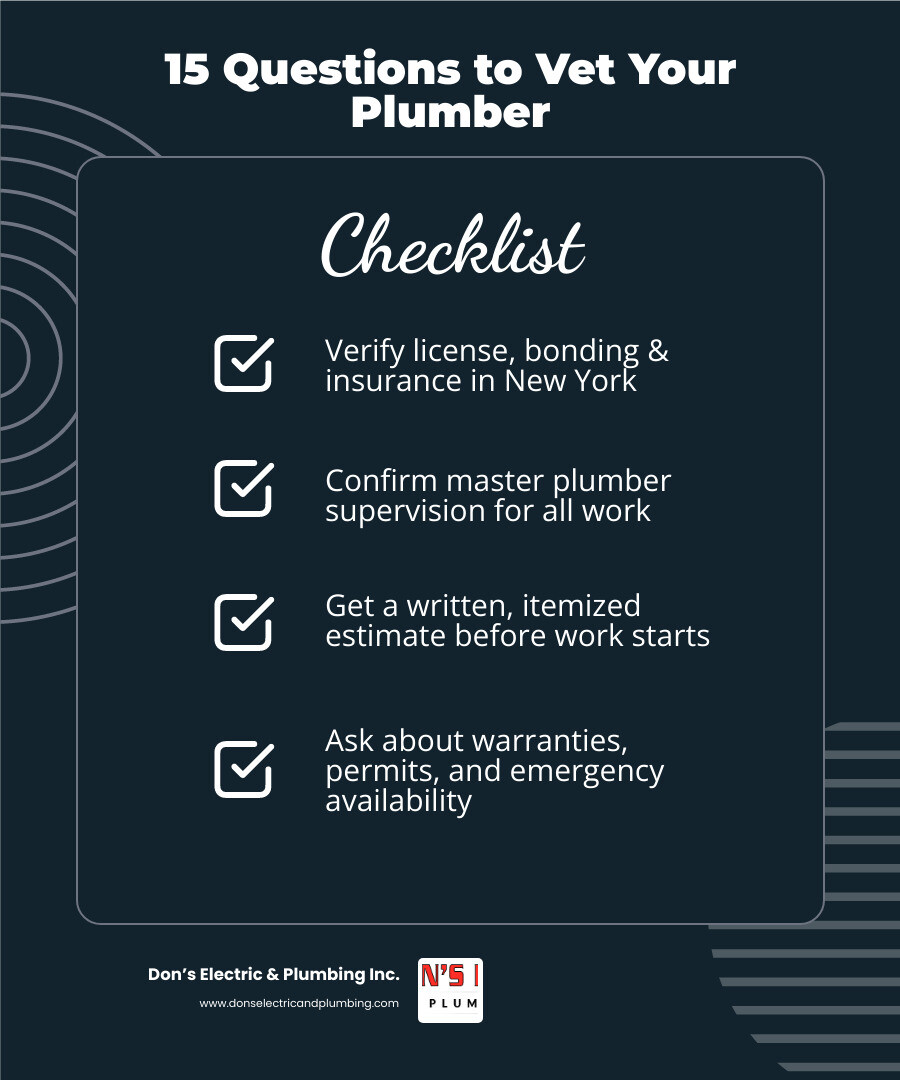
Here are the most important questions to ask any plumber before letting them start work:
- Are you licensed, bonded, and insured in New York?
- What type of license do you hold, and will a master plumber supervise the work?
- Do you carry workers’ compensation insurance?
- Will you pull all required permits and arrange inspections?
- How long have you been in business, and do you have experience with this specific job?
- Who will actually perform the work, and what are their qualifications?
- Can you provide a detailed written, itemized estimate?
- Do you charge a service call fee, and is it credited toward the repair?
- Do you offer flat-rate or hourly pricing, and what is your payment schedule?
- How do you handle unexpected issues or change orders?
- What warranty do you offer on labor and parts?
- Can you provide references from recent similar jobs?
- Will you use a camera inspection, and do you offer trenchless repair?
- What pipe materials will you use, and why?
- What is your availability for emergencies and after-hours service?
These questions are not about being difficult. They are about protecting your home, your budget, and your family. Research shows that homeowners who verify licensing and get multiple quotes before hiring can reduce the risk of overpaying or receiving substandard work by up to 40%. And water damage caused by faulty plumbing repairs is one of the most expensive types of home insurance claims — averaging over $10,000 per incident when unlicensed contractors are involved.
Plumbing is a regulated trade for good reason. Improper work can contaminate your drinking water, cause flooding behind walls, or create code violations that come back to haunt you when you sell your home. Asking the right questions upfront is the simplest way to protect yourself.
The sections below walk through each question in detail — what to ask, what a trustworthy answer sounds like, and what red flags to watch for.
Crucial Questions to Ask Before Hiring a Plumber
When you are facing a plumbing issue, it is easy to feel rushed. You want the water back on or the drain cleared immediately. However, taking a few minutes to verify a contractor’s credentials is the most effective way to safeguard your property. Let’s look at the foundational legal and safety questions you must ask before any tools touch your pipes.
Are you licensed, bonded, and insured in New York?
In New York, plumbing licensing is managed at the local municipal or county level rather than through a single statewide system. This makes it especially important to ask whether your contractor holds the correct local credentials for your specific town or village.
A valid plumbing license proves the contractor has passed rigorous exams, understands local building codes, and stays updated on safety standards. Bonding provides a layer of financial protection if the contractor fails to complete the job or perform the work as promised. General liability insurance protects your property from accidental damage during repairs. If a pipe bursts mid-repair and floods your basement, their liability policy should cover the cleanup and restoration.
If you want to understand why cutting corners on these credentials is never worth the risk, read our guide on why You Should Always Hire Professional Plumbers Here’s Why.
What type of license do you hold and who will supervise the work?
The plumbing industry is structured around a clear hierarchy of skill and experience:
- Apprentices are in training and must always work under direct supervision.
- Journeyman Plumbers are licensed to perform work independently but cannot pull permits or run a business.
- Master Plumbers have completed years of advanced field experience, passed comprehensive exams, and are authorized to run companies, pull municipal permits, and supervise entire crews.
You should always ask who will be physically performing the work in your home and who is supervising them. If an apprentice or junior technician is dispatched to your home, a licensed master plumber should still oversee the project, review the plans, and ensure everything meets local codes. To help determine the scale of your plumbing needs, check out The Ultimate Guide to Knowing When to Call a Plumber.
Do you carry workers’ compensation insurance?
Never overlook this question. If a technician is injured while working inside your home or on your property, and the company does not carry workers’ compensation insurance, you could be held legally and financially liable for their medical bills and lost wages.
A reputable plumbing contractor will gladly provide a Certificate of Insurance (COI) proving they carry active general liability and workers’ compensation coverage. If a contractor hesitates, makes excuses, or claims that “small residential jobs don’t need it,” do not let them cross your threshold.
Project Logistics, Experience, and Pricing Questions
Once you have verified that a plumbing company is fully legal and insured, it is time to dig into the logistics of how your project will actually be executed, managed, and priced. Transparency in these areas prevents unexpected surprises on your final invoice.
Will you pull all required permits and arrange inspections?
Many homeowners do not realize that major plumbing alterations — such as replacing a water heater, repiping supply lines, or performing sewer line work — require official permits from your local building department.
A professional, licensed plumber will handle the permit application process as standard practice and arrange for the municipal inspector to approve the completed work. If a contractor asks you to pull the permit as the homeowner, or suggests skipping the permit entirely to save time or avoid fees, walk away. Unpermitted work can void your homeowner’s insurance policy, fail future home inspections, and make your home difficult to sell.
For more details on navigating these common issues, explore Common Plumbing Problems Homeowners Face and How to Handle Them.
How long have you been in business and do you have experience with this specific job?
Longevity in the plumbing industry indicates a track record of reliability and satisfied local customers. A company that has served the community for decades has demonstrated that they stand behind their work and will be around to honor their warranties if something goes wrong down the line.
Furthermore, you need to ensure the team has experience with your specific issue. A technician who spends all day clearing simple kitchen sink clogs might not be the best fit for a complex trenchless sewer replacement or whole-house repiping. For those living in historic properties, specialized experience is even more critical. You can learn more about these unique challenges in our article on Plumbing Red Flags in Older Homes You Need to Know.
Who will actually perform the work and what are their qualifications?
It is a common scenario: you have an excellent conversation with a highly experienced master plumber who visits your home to evaluate a project, but when the work day arrives, a brand-new assistant shows up alone.
Always ask directly: Who will be doing the heavy lifting in my home? Are they background-checked and drug-tested? Are they direct employees of your company, or do you hire third-party subcontractors? Knowing who is entering your home gives you peace of mind and ensures that the person doing the work is held to the same high standards as the person who wrote your estimate.
Can you provide a detailed written, itemized estimate?
Never accept a verbal quote or a vague lump-sum number written on the back of a business card. A professional plumbing company will provide a detailed, written, and itemized estimate that clearly breaks down the scope of work, including:
- Specific materials and fixture brands to be used.
- Labor allocations.
- Permit and administrative fees.
- An estimated project timeline.
This level of detail ensures that both parties are on the same page and protects you from sudden, unexplained upcharges. If you are curious about what goes into professional service valuations, read about the Reasons Why Plumbing Services Can Be Expensive.
Do you charge a service call fee and is it credited toward the repair?
It is standard for plumbing companies to charge a service call or diagnostic fee to cover the time, travel, and fuel required for a licensed technician to evaluate your system in person.
However, you should always clarify how this fee is handled. Many reputable companies will waive or credit the diagnostic fee toward the total cost of the repair if you choose to hire them to complete the work. Asking this question upfront prevents any awkward surprises when the technician hands you the initial diagnostic invoice.
Do you offer flat-rate or hourly pricing and what is your payment schedule?
Plumbers generally charge in one of two ways:
- Flat-Rate Pricing: You are given a set price for the completed job, regardless of how many hours it takes. This provides excellent cost certainty for homeowners.
- Hourly Pricing: You pay for the exact time the technician spends on-site, plus the cost of materials.
Additionally, ask about the payment schedule. For standard repairs, payment is typically due upon completion. For large-scale projects, a reasonable deposit is standard, with the remaining balance paid in milestones or after final inspection. Be highly suspicious of any contractor who demands full payment upfront before a single pipe is cut.
How do you handle unexpected issues or change orders?
Plumbing systems are hidden behind walls, under concrete slabs, and deep underground. Even the most experienced plumber cannot see through solid drywall. Occasionally, once a project begins, a technician might discover hidden water damage, outdated corroded piping, or previous non-code-compliant installations that must be addressed.
Ask how these surprises are managed. A trustworthy plumber will stop work, show you the problem (often with photos or video), explain your options, and provide a written change order detailing any changes to the scope and pricing before proceeding.
Work Quality, Warranties, and Technology Questions
Modern plumbing relies on advanced technology and durable materials to ensure long-lasting results. The final set of questions helps you evaluate the technical quality of the work and the guarantees that back it up.
What warranty do you offer on labor and parts?
A plumbing repair is only as good as the guarantee behind it. You need to know that if a newly installed joint begins to drip a month after the plumber leaves, the company will return to fix it at no additional charge.
Always ask for the warranty terms in writing. A professional company will offer a clear workmanship guarantee on their labor, separate from the manufacturer’s warranty on fixtures, water heaters, or sump pumps. To understand why robust warranties and ongoing care are so critical for your home’s long-term health, explore our article on Why Regular Plumbing Service is Essential.
Can you provide references from recent similar jobs?
Online reviews on Google and local platforms are incredibly useful, but for major projects, asking for recent references is a great way to verify a company’s real-world performance.
Ask the plumber if they can share a few references from clients who recently had similar work completed. When you contact these references, ask about the team’s punctuality, cleanliness, communication, and whether the project was completed on schedule. A company that does great work will gladly share their local success stories.
Will you use a camera inspection and do you offer trenchless repair?
If you are dealing with a recurring sewer backup or a suspected main line break, do not let a plumber guess where the problem is. Modern plumbing diagnostics utilize high-definition sewer camera inspections to pinpoint the exact location and cause of blockages, root intrusion, or pipe collapses.
Furthermore, if you do have a broken sewer pipe under your yard or driveway, ask if they offer trenchless repair options (such as pipe lining or pipe bursting). Trenchless technology allows plumbers to repair or replace underground lines without digging massive trenches, preserving your beautiful landscaping, walkways, and driveways.
What pipe materials will you use and why?
Different plumbing applications require different materials. For modern water supply lines, flexible and corrosion-resistant PEX piping is highly popular, while traditional copper remains the gold standard for certain applications. For drain lines, durable PVC or ABS is standard.
Ask your plumber which materials they recommend for your specific project and why. They should be able to explain the pros and cons of each option, including lifespan, durability, and code compliance, helping you make an informed decision for your home.
Why are these questions to ask before hiring a plumber vital for emergency situations?
When a pipe bursts at midnight or your basement begins to flood on a holiday weekend, panic can easily set in. In these urgent moments, homeowners often hire the very first plumber who answers the phone, skipping all basic vetting.
However, asking key questions about emergency availability and response times is even more critical during a crisis. You need to know if they offer true 24/7 emergency dispatch, how quickly they can arrive, and whether they charge different rates for after-hours or holiday service. To prepare yourself for these high-stress situations, read our guide on When to Call for Plumbing Service.
Frequently Asked Questions About Vetting a Plumber
To help you quickly compare your options, we have put together a comparison table highlighting the differences between hiring a locally licensed, professional plumbing company and a general neighborhood handyman.
| Feature / Credential | Licensed Professional Plumbing Company | General Handyman |
|---|---|---|
| Local Municipal Licensing | Yes, verified and registered | No (typically general registration only) |
| General Liability Insurance | Yes, standard policy | Varies (often limited or none) |
| Workers’ Compensation | Yes, covers all technicians | Rarely |
| Ability to Pull Permits | Yes, handles all municipal filings | No |
| Code Compliance Guarantee | Yes, fully guaranteed | No |
| Specialized Diagnostic Tools | High-tech sewer cameras, leak detectors | Basic manual tools |
| Workmanship Warranty | Written labor and parts guarantees | Rarely in writing |
How do I verify a plumber’s license in New York?
Because New York does not have a single centralized state licensing board for plumbers, verification is done through your local county, city, or town building department. You can call your local municipal clerk or building inspector’s office to confirm that the plumbing contractor is registered, active, and authorized to pull permits in your specific municipality.
What are the red flags when asking questions to ask before hiring a plumber?
When you are interviewing potential plumbers, keep an eye out for these warning signs:
- Avoiding Written Estimates: If they refuse to put their pricing, scope of work, or warranties in writing, do not hire them.
- Demanding Full Payment Upfront: A legitimate business will never ask for 100% of the payment before starting work.
- Evasive or Defensive Answers: A professional contractor welcomes your questions. If they get defensive when you ask about licensing, insurance, or permits, they are likely hiding something.
- No Physical Business Address: Be cautious of contractors who only operate out of an unmarked personal vehicle with no verifiable office or local presence.
Why is master plumber supervision important for my home?
A master plumber has achieved the highest level of training, field experience, and legal authority in the trade. Having a master plumber supervise your project ensures that every connection, vent, and drain is installed in strict compliance with safety codes. This high-level oversight prevents premature system failures, protects your family’s health, and ensures the long-term value of your home. Discover more about how professional maintenance keeps your home safe by reading about the Importance of Regular Plumbing Services.
Conclusion
At Don’s Electric & Plumbing Inc., we believe that every homeowner deserves honesty, transparency, and top-tier craftsmanship. Family-owned and operated since 1984, we have spent decades serving our neighbors across Schoharie, Montgomery, and Fulton counties — including communities like Canajoharie, Palatine, Minden, Broadalbin, Sharon Springs, and beyond.
We understand that letting a service provider into your home requires trust. That is why our licensed, background-checked, and drug-tested technicians arrive in fully stocked service trucks, ready to provide upfront pricing, clear explanations, and a 100% satisfaction guarantee. Whether you need a simple faucet repair, a complex sewer line replacement, or emergency service in the middle of the night, we are here to provide the peace of mind you deserve.
Don’t risk your home’s safety and your hard-earned money on unverified contractors. To learn more about protecting your property, read our article on why you should Don’t Get Hammered by Choosing the Wrong Home Service Company.
When you are ready for reliable, professional plumbing service from a team that happily answers all your questions, contact us today to schedule your service.