


Why Equipment Lifespan Starts With a Plan, Not a Problem
Understanding how a maintenance plan extends equipment life is one of the most practical things a homeowner can do — and the answer is simpler than most people expect: scheduled, routine care catches small problems before they turn into expensive failures.
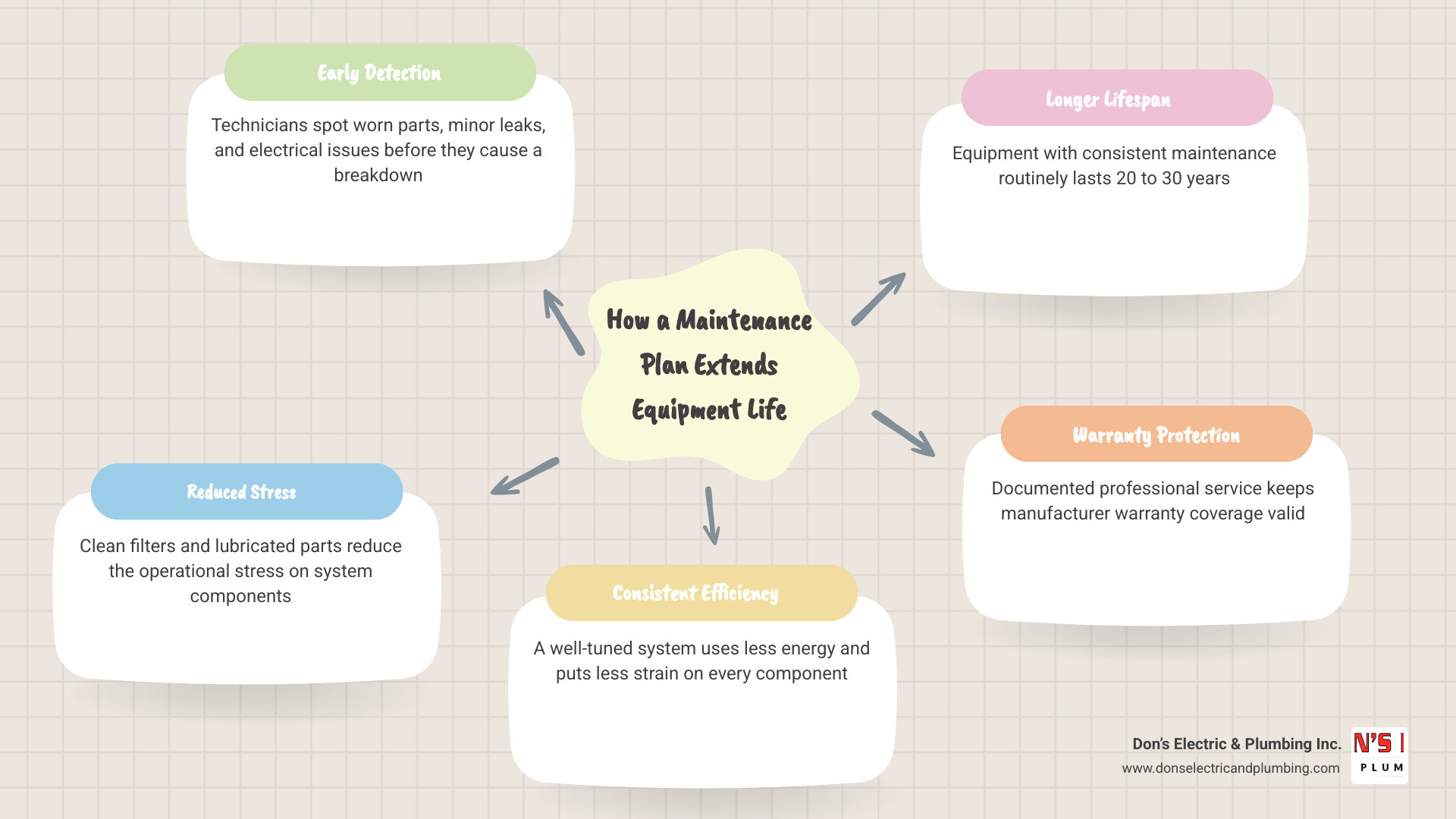
Here’s a quick summary of how a maintenance plan extends equipment life:
- Early detection – Technicians spot worn parts, minor leaks, and electrical issues before they cause a breakdown
- Reduced operational stress – Clean filters, lubricated parts, and clear airflow mean your system doesn’t have to work harder than it should
- Consistent efficiency – A well-tuned system uses less energy and puts less strain on every component
- Longer lifespan – Equipment with consistent maintenance routinely lasts 20 to 30 years, while neglected units often fail within 5 to 10 years
- Warranty protection – Many manufacturers require documented professional service to keep warranty coverage valid
Most homeowners in Schoharie, Montgomery, and Fulton County don’t think about their HVAC system, plumbing, or electrical equipment until something goes wrong. By that point, a small issue that could have been caught during a routine visit has already grown into a costly repair — or worse, a full replacement.
The research is clear: facilities and homes that shift from reactive to preventive maintenance reduce repair costs by up to 25% and can cut unplanned downtime by as much as 40% to 75%. That’s not a minor improvement — that’s the difference between a system that serves your family for decades and one that gives out years too soon.
Why a Proactive Strategy Beats Reactive Repairs
When it comes to keeping your home running smoothly, there are two distinct paths you can take: reactive repairs (waiting for something to break and then scrambling to fix it) or proactive care (scheduling routine checkups to prevent breakdowns in the first place).
Choosing reactive repairs means living in a constant state of uncertainty. There is nothing quite like the sudden shock of a furnace failing on a freezing January night in Canajoharie, or your air conditioning giving out during a humid July afternoon in Palatine. When you rely on reactive repairs, you are at the mercy of emergency service availability, expedited shipping premiums for last-minute parts, and the sheer stress of an uncomfortable home.
Even worse, reactive maintenance ignores what engineers call “system synergy.” Your heating and cooling systems are made of interconnected parts that rely on one another. If one small component begins to fail, it places an extra burden on the rest of the system. For example, a clogged air filter doesn’t just limit airflow; it forces the blower motor to work twice as hard, leading to overheating and premature motor failure. By the time you call for emergency service, a minor issue has caused a ripple effect of damage across multiple expensive components.
To see the real-world difference, let’s look at how proactive maintenance stacks up against a reactive approach:
| Feature / Outcome | Proactive Maintenance Plan | Reactive Repair Approach |
|---|---|---|
| Average Equipment Lifespan | 20 to 30 Years | 5 to 10 Years |
| Annual Breakdown Risk | Under 5% | 20% to 35% |
| System Operating Efficiency | 95% to 100% | 70% to 80% (drops 5-10% annually without care) |
| Unexpected Downtime | Reduced by up to 40% to 75% | High and unpredictable |
| Overall Maintenance Costs | 25% lower on average | High due to emergency fees & complete failures |
| Warranty Status | Fully validated with service records | Often voided due to lack of professional care |
Investing in proactive care preserves the natural synergy of your system. When every component is cleaned, calibrated, and working in harmony, the entire unit experiences less wear and tear. To dive deeper into how routine checkups keep your air conditioner running smoothly, explore the Benefits of Regular AC Maintenance.
A proactive strategy transforms maintenance from a stressful chore into a long-term strategic advantage for your home. Rather than paying for emergency fixes, you are investing in predictable, small adjustments that keep your utility bills low and your system running for decades. If you are wondering whether a yearly tune-up is truly necessary, read our guide on Why You Should Service Your AC at Least Once a Year.
How a Maintenance Plan Extends Equipment Life
To truly understand how a maintenance plan extends equipment life, it helps to look at the science of mechanical wear and thermal stress. Every piece of machinery in your home, from your heating system to your plumbing pumps, has a predefined design lifespan. However, whether your system actually reaches that milestone depends entirely on how it is cared for.
Consider this comparison: an HVAC system running in a typical home operates for thousands of hours every year. In terms of wear and tear, running your heating and cooling systems throughout the changing seasons is the mechanical equivalent of driving a car 200,000 miles annually. You wouldn’t dream of driving a car that far without changing the oil, rotating the tires, and checking the brakes. Yet, neglected home systems are frequently expected to perform under these exact conditions without any professional attention.
When a system is neglected, it faces severe mechanical wear. Dust and dirt act as abrasive agents on moving parts, increasing friction and heat. At the same time, systems suffer from thermal stress. As a furnace or boiler heats up and cools down, the metal components expand and contract. Without proper calibration and cleaning, this repeated thermal expansion can cause microscopic cracks in critical areas like the heat exchanger. Once a heat exchanger cracks, the system is no longer safe to operate and must be replaced entirely.
Additionally, neglected equipment experiences a massive drop in system efficiency. When coils are caked in dust and filters are clogged, the system must run longer and hotter to heat or cool your home. This extra runtime accelerates the aging process of every single wire, bearing, and motor in the unit. To understand the long-term impact of this wear and tear, check out our insights on HVAC Longevity When to Say Goodbye to Your Old Unit.
How a maintenance plan extends equipment life through early detection
The secret to preventing catastrophic equipment failure is early detection. Think of a maintenance plan as a regular medical checkup for your home’s mechanical systems. A skilled technician can spot the warning signs of trouble long before you notice a change in your home’s temperature.
During a scheduled maintenance visit, technicians perform precise electrical testing, measure refrigerant levels, and inspect critical safety controls. For example, a technician might use a thermal imaging camera or an amp draw test to discover that a blower motor is drawing more electrical current than it should. This high amp draw is a clear warning sign that the motor is overheating and on the verge of burning out. By replacing a small, inexpensive capacitor or lubricating a dry bearing during the visit, the technician saves the entire motor from failure.
Similarly, early detection catches minor leaks in refrigerant lines or plumbing pipes. A tiny refrigerant leak causes the compressor to run hotter and work harder, eventually leading to a complete compressor burnout—the most expensive failure an AC system can experience. Catching and sealing that minor leak early preserves the heart of your system. To see what a thorough inspection looks like, review our comprehensive Furnace Service Checklist.
How a maintenance plan extends equipment life by reducing operational stress
Operational stress is the silent killer of household machinery. When your systems have to fight against restricted airflow, poor lubrication, or dirty components, they enter a state of chronic strain.
Imagine trying to run a marathon while breathing through a drinking straw. That is exactly what your HVAC system goes through when it tries to push air through a dirty, clogged filter or a dust-coated evaporator coil. This restricted airflow suffocates the system, causing the heat exchanger to overheat in the winter and the cooling coils to freeze over in the summer.
Furthermore, friction is a major source of component wear. Research shows that poor or improper lubrication causes more equipment failures than almost any other single mechanical factor. Without regular lubrication, bearings grind, fan motors drag, and internal components experience rapid physical degradation.
A structured maintenance plan completely eliminates these unnecessary stressors. By keeping filters fresh, coils immaculate, and moving parts perfectly lubricated, the system operates with minimal resistance. This reduction in friction and strain allows the machinery to run cooler, use less electricity, and complete its cycles quickly and easily. For simple ways you can keep your system running smoothly between professional visits, read these Simple and Easy Tips to Improve Your HVAC Systems Efficiency.
Essential Components of a Longevity-Focused Maintenance Plan
A truly effective, longevity-focused maintenance plan is much more than a quick visual inspection. It requires a systematic, checklist-based approach that addresses every potential point of failure. When our professional technicians service a home in Montgomery or Fulton County, they follow rigorous protocols designed to maximize the life of your equipment.
Here are the essential components that must be included in any high-quality maintenance plan:
- Deep Cleaning Protocols: Dust and grime act as insulators on heating and cooling coils, forcing your system to run longer cycles. Thoroughly cleaning the outdoor condenser coils and the indoor evaporator coils ensures optimal heat transfer and prevents the compressor from running at dangerously high temperatures.
- Safety Audits and Controls Testing: Technicians test all safety limit switches, check gas valve pressures, inspect heat exchangers for cracks, and perform carbon monoxide testing to ensure your system is operating safely.
- Electrical Testing and Tightening: Over time, normal system vibrations can loosen electrical connections. Technicians inspect wiring, tighten terminal screws, and measure voltage and amperage draws on motors to prevent arcing, short circuits, and electrical fires.
- Lubrication and Fluid Management: Moving parts like bearings, blowers, and pumps are lubricated to manufacturer specifications to eliminate friction and prevent mechanical binding.
- Condensate Drain Flushing: Algae, mold, and dust can clog your system’s condensate drain lines, leading to water damage in your home or triggering safety switches that shut down your system completely. Flushing these lines and adding protective pan tablets prevents messy backups.
By systematically addressing these areas twice a year, you protect your system from the gradual decay caused by dirt, vibration, and friction. To make sure your system is ready for the changing seasons, check out our guide on What Should Be on Your End of the Year HVAC Maintenance Checklist and prepare your cooling system early with these Pre-Summer HVAC Maintenance Tips.
Frequently Asked Questions About Equipment Longevity
How often should professional HVAC maintenance be scheduled?
For the vast majority of homes in New York, professional maintenance should be scheduled twice per year: once in the spring before the cooling season begins, and once in the fall before the heating season starts. This seasonal timing ensures that your systems are clean, safe, and fully optimized before they have to face extreme summer heat or freezing winter temperatures.
If you heat your home with a heat pump, biannual service is especially critical because these systems run year-round to provide both heating and cooling. Regular attention keeps them running at peak efficiency in every season. To understand why autumn service is so vital for your heating system, read about Routine Furnace Service Why It Matters.
What are the common signs that my equipment needs immediate attention?
While routine maintenance prevents most issues, you should always keep an eye out for signs of performance drift or wear. If you notice any of the following warning signs, your system needs immediate professional attention to prevent a total breakdown:
- Unusual Noises: Squealing, rattling, popping, or grinding noises indicate loose components, failing bearings, or motor issues.
- Short Cycling: If your furnace or air conditioner turns on and off rapidly without completing a full heating or cooling cycle, it is likely overheating or experiencing a sensor failure.
- Weak Airflow: Poor airflow from your vents suggests a clogged filter, a failing blower motor, or ductwork obstructions.
- Sudden Utility Bill Spikes: A sharp increase in your monthly energy bills without a matching change in the weather means your system is working much harder than it should to keep up.
Ignoring these early warning signs is a lot like ignoring a toddler with a marker—if you don’t address the small issue immediately, it is going to spread and cause a much bigger mess. For homeowners utilizing boilers, you can find helpful advice in our Boiler Maintenance Tips for Homeowners.
Can skipping professional maintenance void my manufacturer warranty?
Yes, absolutely. This is one of the most overlooked aspects of home equipment care. The vast majority of major HVAC manufacturers explicitly state in their warranty terms that the warranty is only valid if the system receives regular, professional maintenance.
If a major component like a compressor or heat exchanger fails within the warranty period, the manufacturer will often require you to provide documented service records proving the system was professionally maintained every year. Without this documentation, they may deny your claim, leaving you to pay for the replacement parts out of pocket. A structured maintenance plan provides you with a clear paper trail of professional service, keeping your warranty fully protected.
Conclusion
At the end of the day, understanding how a maintenance plan extends equipment life is the key to protecting your home, your family’s comfort, and your hard-earned money. By shifting from a stressful reactive mindset to a smooth, proactive plan, you can double the lifespan of your heating and cooling systems, lower your monthly energy bills, and enjoy complete peace of mind.
Since 1984, Don’s Electric & Plumbing Inc. has been the trusted, family-owned one-stop solution for homeowners across Montgomery, Fulton, and Schoharie counties. Whether you are in Canajoharie, Sharon Springs, Broadalbin, or Middleburgh, our team is dedicated to keeping your home safe, efficient, and comfortable all year round. We back all of our work with a 100% satisfaction guarantee, offer flexible financing options, and provide reliable, 24/7 emergency services when you need us most.
Don’t wait for your system to cry for help. Protect your investment, extend your equipment’s life, and join a community of homeowners who enjoy worry-free comfort. Explore our customizable HVAC Maintenance Plan Cobleskill NY or contact us today to schedule your next seasonal tune-up!