


Why Choosing the Right AC System for Your Home Makes All the Difference
Knowing how to choose the right ac system for your home can save you years of frustration, high energy bills, and uncomfortable summers. Here’s a quick overview to get you started:
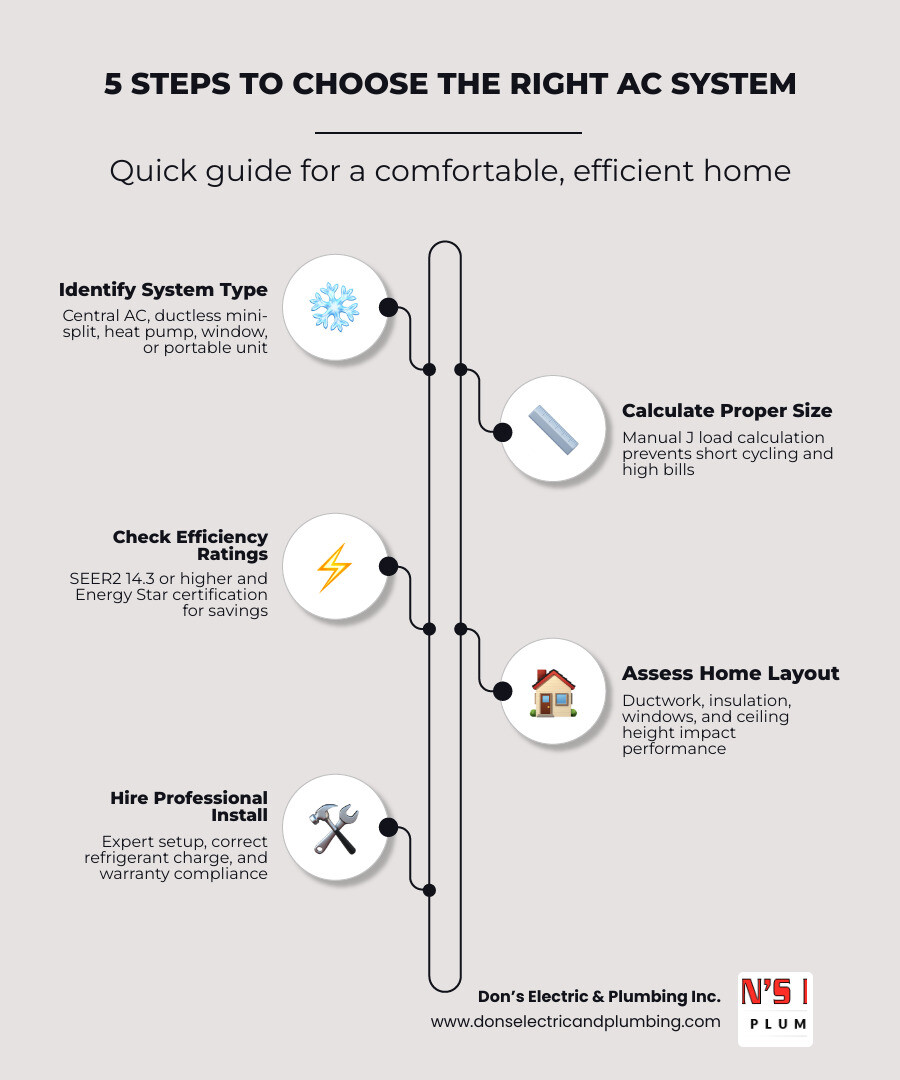
How to choose the right AC system for your home — quick steps:
- Identify your system type — central AC, ductless mini-split, heat pump, window unit, or portable
- Get a proper size calculation — a Manual J load calculation beats any rule of thumb
- Check efficiency ratings — look for SEER2 14.3 or higher; Energy Star certified is even better
- Assess your home’s layout — ductwork condition, insulation, windows, and ceiling height all matter
- Consider your climate — hot, humid regions have different needs than drier areas
- Hire a qualified HVAC professional — for installation, sizing, and ongoing maintenance
Every summer, homeowners across Schoharie, Montgomery, and Fulton counties face the same problem: an AC system that’s too big, too small, outdated, or just plain wrong for their home. The result? Rooms that never cool down, energy bills that keep climbing, and a system that breaks down earlier than it should.
The truth is, picking an air conditioner isn’t just about buying the biggest unit you can afford. According to data from Consumer Reports tracking over 13,000 units, nearly 1 in 5 central AC systems purchased between 2009 and 2024 ran into at least one significant problem — and nearly a quarter stopped working as well as they should. A lot of that comes down to poor selection and improper sizing from the start.
This guide walks you through everything you need to know — from system types and sizing to efficiency ratings and professional installation — so you can make a confident, informed decision.
Related content about how to choose the right ac system for your home:
- choosing an ac for humid northeast summers
- single stage vs variable speed ac explained
- what size air conditioner do i need
Types of Air Conditioning Systems for Your Home
When you begin researching how to choose the right ac system for your home, the sheer variety of equipment can feel overwhelming. Each system type has its own installation requirements, performance characteristics, and ideal use cases.

To help you narrow down your choices, we recommend checking out our detailed guide on the Pros Cons of Top 8 Air Conditioners Choose the Best. In general, most residential properties in our region—from the historic homes of Sharon Springs to the lakeside properties in Wells—rely on one of three primary system configurations:
- Central Air Conditioning: The classic choice for whole-home comfort. It utilizes a network of supply and return ducts to distribute cooled air evenly throughout your living spaces.
- Ductless Mini-Split Systems: A highly flexible option that uses individual indoor air handlers connected to an outdoor condenser. This allows you to cool specific rooms or “zones” without needing any ductwork.
- Heat Pumps: A highly efficient alternative to traditional AC-only units. Heat pumps look and operate exactly like central air conditioners in the summer, but they can reverse the refrigeration cycle in the winter to provide clean, electric heat.
Central Air Conditioning vs. Ductless Mini-Splits
The choice between a ducted central system and a ductless mini-split usually comes down to your home’s existing infrastructure and your zoning needs.
If your home already has a functional duct network from a forced-air furnace, replacing or upgrading your central AC is often the most direct path to whole-home comfort. However, before you move forward, you must consider the condition of those ducts. Did you know that sealing your ducts can prevent 20 to 30 percent of the energy used to run your system from escaping? If your ducts are leaky, uninsulated, or poorly routed, a new high-efficiency central unit won’t perform to its potential.
On the flip side, ductless mini-splits are the undisputed champions of flexibility. They are perfect for historic homes in Canajoharie or Middleburgh that were built long before ductwork existed. Mini-splits also allow for precise zoning. If you spend most of your day in the home office and your evenings in the bedroom, you only have to cool those specific spaces rather than wasting energy on empty rooms.
Before making a final choice, it is helpful to review the Three Factor to Consider Before Air Conditioning Installation to ensure your home’s structure aligns with your cooling goals.
The Versatility of Heat Pumps for Year-Round Comfort
Heat pumps have grown immensely popular across New York, and for good reason. Because they move heat rather than creating it, they offer incredible efficiency. In the summer, they pull warm air out of your home and dump it outside, leaving you with cool, dehumidified indoor air. In the winter, they pull ambient heat from the cold outdoor air and transfer it inside.
For homeowners in colder spots like Dolgeville or Bleecker, heat pumps can be paired with an existing gas or oil furnace in a “dual-fuel” or hybrid setup. In this configuration, the highly efficient heat pump handles the cooling in summer and the mild heating in spring and autumn. When the temperature drops below freezing (typically around 20°F to 30°F), the system automatically switches over to your furnace to keep you cozy. This dual-season capability provides excellent utility savings and reduces wear and tear on your primary heating system.
How to Choose the Right AC System for Your Home Based on Size
One of the most expensive mistakes a homeowner can make is assuming that a bigger air conditioner is always better. In the HVAC world, cooling capacity is measured in British Thermal Units (BTUs) and tons (one ton of cooling equals 12,000 BTUs per hour).
Getting the size exactly right is what we call Finding the Goldilocks Zone for Your AC Unit Size. If your system is too large or too small, your comfort and your wallet will suffer.
Why Proper Sizing Matters for Your Comfort
When an air conditioner is oversized, it cools the home incredibly quickly and then shuts off. This is known as short cycling. Because the unit only runs for a few minutes at a time, it never has the chance to perform one of its most important secondary jobs: removing humidity from the air. This leaves you with a cold, damp, and clammy home. Furthermore, the constant starting and stopping dramatically increases energy consumption (by 8 to 30 percent) and places immense strain on the compressor, leading to premature system failure.
Conversely, an undersized AC unit will run constantly without ever reaching your thermostat’s set temperature. This constant operation wastes energy, drives up your utility bills, and wears out the mechanical components rapidly.
The Role of Manual J Load Calculations in Sizing
So, how do we avoid the pitfalls of improper sizing? We throw out generic “rules of thumb” like sizing an AC based solely on square footage. Two identical 2,000-square-foot homes in Montgomery County can require completely different AC capacities based on their unique build characteristics.
To find the perfect fit, we perform a professional Manual J load calculation. This industry-standard scientific calculation evaluates a wide range of factors, including:
- The R-value of your wall and attic insulation
- The age, type, and orientation of your windows (south-facing windows trap significantly more heat)
- The height of your ceilings and the overall layout of your rooms
- The local climate and average summer temperatures
- The number of occupants in the home and heat-generating appliances
By analyzing these variables, we can pinpoint the exact cooling load your home requires, ensuring your new system runs at peak efficiency.
Decoding Energy Efficiency Ratings and Critical Home Factors
Once you know the correct size for your system, the next step in how to choose the right ac system for your home is evaluating efficiency ratings.
The primary efficiency metric for air conditioners is the SEER2 (Seasonal Energy Efficiency Ratio 2) rating. SEER2 represents the total cooling output of the system over a typical cooling season divided by the total electric energy input. It is an updated testing standard introduced to better reflect real-world static pressure from ductwork.
Selecting a high-efficiency system is central to modern AC Installation Services Energy Efficiency. While units with higher SEER2 ratings often carry a higher upfront cost, they drastically reduce your monthly energy bills. To put this in perspective:
- Upgrading from an older, inefficient system to a modern 16 SEER2 unit can save you 15 to 25 percent on your summer cooling costs.
- Choosing an Energy Star certified unit ensures your system is at least 10 to 15 percent more efficient than standard baseline models.
How to Choose the Right AC System for Your Home with Variable-Speed Compressors
To maximize your energy savings, you should pay close attention to compressor technology. In our guide on The Speed Debate Choosing Between Single and Variable Stage AC, we break down the three main types of compressors:
- Single-Stage: These units operate like a light switch—they are either 100% on or completely off. This leads to temperature swings and higher energy spikes when the system kicks on.
- Two-Stage: These compressors can operate at a lower capacity (typically around 70%) on milder days and ramp up to 100% when the summer heat peaks. They run longer, quieter, and use less energy.
- Variable-Speed (Inverter): These systems act like cruise control for your home’s climate. They can adjust their operating speed to any percentage of capacity, drawing only the exact amount of electricity needed to maintain your target temperature within 0.5 degrees. They provide unparalleled humidity control and operate so quietly you’ll barely notice they are running.
How to Choose the Right AC System for Your Home When Upgrading Older Properties
If you own a historic property in a village like Sharon Springs or Middleburgh, retrofitting modern air conditioning requires a thoughtful approach. Many of these beautiful older homes feature plaster walls, gorgeous woodwork, and zero space for traditional ductwork.
Before you assume you’re stuck using noisy window units, look for the Signs AC System Needs Replacement or upgrade. For older homes, ductless mini-splits are often the perfect solution. They only require a small, three-inch hole through the exterior wall to connect the indoor air handler to the outdoor condenser, preserving your home’s historic integrity while delivering modern comfort.
The Importance of Professional Installation and Maintenance
Even the most expensive, high-efficiency air conditioning system on the market will underperform if it is installed incorrectly.
Ensuring your system is set up correctly from day one is why understanding the Professional AC Installation Process is so vital. A professional installation guarantees proper refrigerant charge, optimal airflow, and correct electrical connections.
Why DIY Installation Is a Costly Mistake
With the rise of online retail, some homeowners are tempted to purchase equipment online and attempt a DIY installation. This is a highly risky and often costly mistake.
First, handling refrigerants requires specialized equipment and EPA certification. Newer, environmentally friendly refrigerants like R-32 and R-454B (which are replacing older R-410A units phased out in 2025) require precise pressure calibrations. Second, central AC systems run on high-voltage electricity, posing serious safety hazards if wired incorrectly. Finally, almost all major HVAC manufacturers will instantly void your equipment warranty if the system is not installed by a licensed professional. To protect your investment, always follow the best Tips to Choose an Excellent HVAC System and hire an experienced team.
Ongoing Maintenance Strategies for Longevity
Once your new system is up and running, consistent maintenance is the key to keeping your utility bills low and preventing unexpected breakdowns. If you are wondering, “What Do I Need to Know About Installing an Air Conditioner?“, the answer always includes a plan for ongoing care.
- Change Filters Regularly: Check and replace your air filters every 1 to 3 months. A clogged filter restricts airflow, forcing your system to work harder and dramatically increasing wear and tear.
- Keep the Outdoor Unit Clear: Maintain at least 2 to 3 feet of clearance around your outdoor condenser. Clear away grass clippings, leaves, and weeds to ensure proper heat transfer.
- Schedule Annual Tune-Ups: Having a professional inspect your system every spring is the best way to catch minor issues before they turn into major, expensive repairs.
Frequently Asked Questions About Choosing a Home AC
What is the difference between SEER and SEER2 ratings?
SEER2 is the updated efficiency testing standard implemented in 2023. Unlike the original SEER testing, which evaluated equipment in a lab under perfect conditions, SEER2 testing uses a much higher static pressure level to simulate the actual resistance of home ductwork. Because of this more rigorous testing, a SEER2 rating will typically look slightly lower numerically than an old SEER rating for the exact same unit, but it represents a much more accurate picture of real-world efficiency.
Can a heat pump completely replace my traditional central AC and furnace?
Yes, modern cold-climate heat pumps are incredibly advanced and can easily handle both summer cooling and winter heating in our region. However, because winter temperatures in upstate New York can occasionally drop below zero, many local homeowners choose a dual-fuel setup. This pairs the heat pump with a high-efficiency gas furnace, ensuring you always have a reliable, cost-effective backup heat source during the coldest winter nights.
How do I know if my home’s ductwork is compatible with a new high-efficiency AC?
A professional HVAC technician must inspect your ductwork before installing a new system. Modern high-efficiency AC units utilize powerful, variable-speed blowers that require precise duct sizing and static pressure. If your existing ducts are undersized, poorly sealed, or falling apart, they will choke the airflow, reducing your new system’s efficiency and potentially damaging the blower motor.
Conclusion
Choosing a new air conditioner is a major decision that impacts your daily comfort, indoor air quality, and monthly energy expenses for the next 15 to 20 years. By understanding your system options, insisting on a professional Manual J load calculation, and selecting a system with high efficiency and modern compressor technology, you can enjoy a cool, worry-free home all summer long.
If you are ready to explore your options and want to learn more about budgeting for your upgrade, check out our guide on How Can You Save Money on a New AC Unit?.
At Don’s Electric & Plumbing Inc., we’ve been helping our neighbors throughout Montgomery, Fulton, Schoharie, Herkimer, and Hamilton counties stay comfortable since 1984. As a family-owned and operated business based in Canajoharie, NY, we stand behind our work with a 100% satisfaction guarantee. We also offer flexible financing options to make your home comfort upgrade as stress-free as possible.
Don’t leave your summer comfort to chance. If you are looking to upgrade your home’s cooling and want to know who in Canajoharie specializes in energy-efficient systems, we are here to help!
Explore our energy-saving options and learn how you can save money on a new AC unit today!