


Is It Time to Repair or Replace? How to Decide Between HVAC Repair and Replacement
Knowing how to decide between HVAC repair and replacement can save you from spending money in the wrong direction — whether that means pouring cash into a system that’s already on its way out, or replacing one that still has years of good service left.
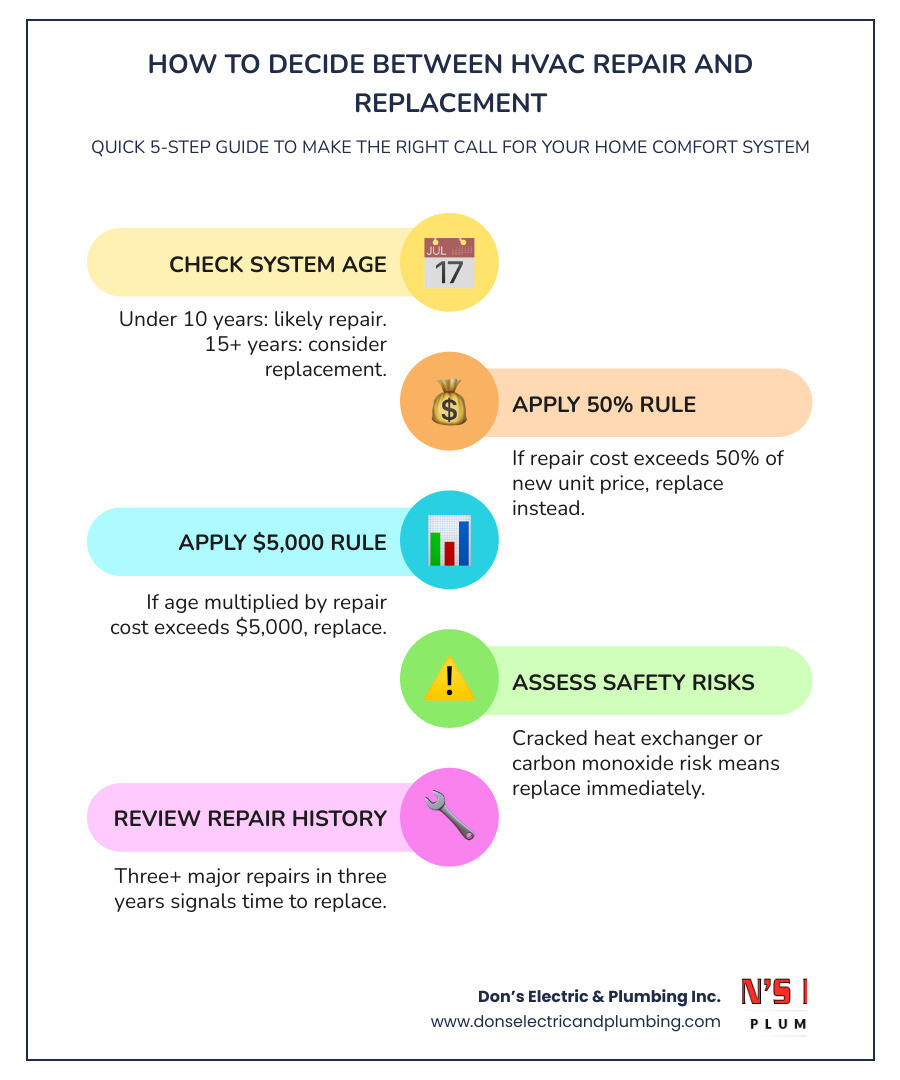
Here’s a quick-reference guide to help you decide:
| Situation | Likely Best Choice |
|---|---|
| System is under 10 years old, minor issue | Repair |
| Repair cost exceeds 50% of new system cost | Replace |
| Age × repair cost exceeds $5,000 | Replace |
| Cracked heat exchanger or carbon monoxide risk | Replace immediately |
| System uses R-22 refrigerant and needs recharging | Replace |
| Three or more significant repairs in three years | Replace |
| First major repair on a well-maintained system | Repair |
| Energy bills rising steadily without explanation | Evaluate for replacement |
Most HVAC systems last between 10 and 20 years depending on the type — air conditioners typically run 10 to 15 years, while furnaces can last 15 to 20 years or more. But age alone doesn’t tell the whole story. The real question is whether your system is still doing its job reliably, safely, and without bleeding your wallet dry month after month.
For homeowners in Canajoharie, NY and across Schoharie, Montgomery, and Fulton counties, a mid-summer AC failure or a furnace going out in January isn’t just an inconvenience — it’s urgent. Making a quick, uninformed decision in that moment can cost you far more in the long run.
This guide walks you through every factor that matters: system age, repair history, safety risks, energy efficiency, and the simple math rules that HVAC professionals actually use to guide this decision.
Key Indicators: How to Decide Between HVAC Repair and Replacement

When your heating and cooling system starts acting up, it usually drops several hints before completely shutting down. Recognizing these warning signs early can save you from a complete system failure during a freezing winter night in Sharon Springs or a muggy summer afternoon in Palatine.
The first factor to consider is system age. While age alone shouldn’t condemn a system, it shifts the risk profile of future repairs. If your air conditioning unit is older than 10 years and/or your furnace is older than 15 years, it is time to actively consider a replacement rather than assuming a repair is the best long-term investment.
Another major indicator is the frequency of breakdowns. If you find yourself on a first-name basis with your local technician because your system has required three or more significant repairs over the last three years, you are likely experiencing a “domino effect.” In aging systems, the failure of one component often places additional stress on other parts, leading to a compounding cycle of breakdowns.
You should also keep an eye on your monthly utility bills. When your energy usage climbs steadily despite your household habits remaining exactly the same, your system is losing its operational efficiency. To learn more about how long your heating and cooling equipment should realistically last in our Upstate New York climate, check out our guide on HVAC Longevity: When to Say Goodbye to Your Old Unit.
Signs Your Heating System Needs Immediate Attention
Our winters in Montgomery and Fulton counties do not play around. When your furnace or boiler begins to struggle, it is not just a comfort issue — it can quickly become a safety concern.
Keep an ear out for strange noises. While no heating system is completely silent, loud banging, grinding, squealing, or rattling sounds are clear indications of mechanical distress. A rattling noise, for example, can sometimes point to a cracked heat exchanger or loose internal components, which require immediate professional diagnostic attention.
Another visual warning sign is the color of your furnace’s burner flame. A healthy gas burner should always burn a bright, steady blue. If you notice a yellow, flickering burner flame, it means the fuel is not burning completely, which can lead to dangerous carbon monoxide production.
Additionally, constant short-cycling — where your furnace turns on and off rapidly without ever reaching the temperature set on your thermostat — indicates that the system is overheating or failing to distribute heat properly. For a deeper look at these issues, read our articles on Signs It’s Time to Replace Your Furnace and the Top Reasons for Furnace Breakdowns.
Signs Your Cooling System is Failing
Summer in Broadalbin or Middleburgh can bring intense humidity and heat. If your air conditioner is blowing warm air even when the thermostat is set to cool, or if you notice incredibly weak airflow coming from your registers, your system is struggling.
Refrigerant leaks are another major red flag. Air conditioners are closed systems, meaning they should never naturally lose refrigerant. If your system is low on refrigerant, it means there is a physical leak in your coils or lines.
In older systems, these leaks are particularly problematic. If your unit was manufactured before 2010, it likely relies on R-22 refrigerant (often called Freon). Because R-22 has been phased out due to environmental regulations, sourcing it is incredibly difficult and expensive, making even a simple recharge economically impractical. For more details on warning signs, explore our resources on Signs AC System Needs Replacement and get valuable advice on Tips for Keeping Your AC System Running Smoothly.
The Mathematical Rules of Thumb for Homeowners
Making a major home comfort decision shouldn’t be based on guesswork. Fortunately, the HVAC industry relies on two straightforward mathematical formulas to help homeowners evaluate whether a repair is a sound investment or if those funds would be better spent on a brand-new, high-efficiency system.
| Rule of Thumb | Formula / Description | Best Used For |
|---|---|---|
| The 50% Rule | If the cost of the repair exceeds 50% of the cost of a new system, replace it. | Major component failures (compressors, heat exchangers) |
| The $5,000 Rule | Multiply the system’s age (in years) by the cost of the repair. If the total exceeds $5,000, replace it. | Mid-aged systems with moderate to expensive repairs |
Using the 50% Rule to Decide Between HVAC Repair and Replacement
The 50% Rule is one of the most widely accepted economic frameworks in the industry. The math is simple: if the cost of a single repair exceeds 50% of the cost of a brand-new replacement system, then replacement is almost always the more economical choice.
Think of it like an old car. If your vehicle is out of warranty and needs a new transmission that costs more than half of the car’s actual value, you would likely hesitate to pay for the repair. The same logic applies to your heating and cooling equipment. Investing heavily in a system that has already depreciated and is likely to experience another failure in the near future is often a poor use of your hard-earned money. If you are looking for ways to make a new system more affordable, read about How Can You Save Money on a New AC Unit?.
Applying the $5,000 Rule to Decide Between HVAC Repair and Replacement
The $5,000 Rule is another excellent “gut check” for homeowners. To apply this rule, you simply multiply the age of your system (in years) by the estimated cost of the current repair. If the resulting number is greater than $5,000, it is highly recommended that you replace the unit. If the number is under $5,000, proceeding with the repair is generally considered a lower-risk decision.
Let’s look at two real-world examples to see how this works:
- Scenario A (Repair Recommended): You have a 6-year-old air conditioner that needs a minor electrical repair. $$\text{Age (6 years)} \times \text{Repair Cost (Example: \$400)} = 2,400$$ Since 2,400 is well below the 5,000 threshold, repairing the unit is a smart, low-risk decision to keep your relatively young system running smoothly.
- Scenario B (Replacement Recommended): You have a 12-year-old system facing a major component failure. $$\text{Age (12 years)} \times \text{Repair Cost (Example: \$500)} = 6,000$$ Because 6,000 exceeds the $5,000 threshold, the math strongly indicates that replacement is the wiser long-term financial choice.
To learn more about common system lifespans and diagnostic details, check out our HVAC System FAQ.
Safety Risks and Environmental Factors to Consider
While financial calculations are incredibly helpful, some decisions transcend math. Safety should always be your absolute top priority. If your heating system poses an immediate threat to your family’s health, replacement is not just an option — it is the only safe path forward.
The most serious safety hazard in residential heating is a cracked heat exchanger. The heat exchanger is the metal chamber that keeps combustion gases (such as carbon monoxide) completely separate from the clean air circulating through your home’s ductwork. If this metal chamber cracks due to age, rust, or overheating, toxic carbon monoxide can leak directly into your living spaces. Carbon monoxide is tasteless, odorless, and invisible, making a cracked heat exchanger an absolute emergency.
Beyond safety, environmental compliance and changing regulations also play a massive role in how to decide between HVAC repair and replacement. If your air conditioning system is older and relies on R-22 refrigerant, you are dealing with an obsolete chemical. In 2020, the EPA completely banned the production and import of R-22 due to its ozone-depleting properties. Trying to repair a major refrigerant leak on an R-22 system is highly unsustainable, as the chemical is extremely scarce, and any future leak will leave you right back at square one.
Energy Efficiency and Modern Technology
If your current system was installed over a decade ago, it was built to meet much lower efficiency standards. Today’s modern HVAC systems utilize incredible technological advancements that keep your home perfectly comfortable while consuming drastically less power.
Cooling systems are rated by SEER2 (Seasonal Energy Efficiency Ratio), while heating systems are rated by AFUE (Annual Fuel Utilization Efficiency). Older air conditioners typically operate at SEER ratings of only 8 to 12. By contrast, modern high-efficiency units start at SEER 15 and can go much higher. Upgrading a SEER 9 or 10 unit to a modern SEER 14 or 16 unit can reduce your cooling energy consumption by 35% or more!
Furthermore, modern systems offer advanced features that older units simply cannot match:
- Variable-Speed Motors: Unlike older single-stage systems that only run at 0% or 100% capacity (like a car that only goes zero or sixty), variable-speed systems continuously adjust their output to match your home’s exact heating or cooling needs. This eliminates temperature swings and dramatically improves humidity control.
- Smart Thermostat Integration: Modern systems communicate seamlessly with smart thermostats, allowing you to monitor your system’s performance and adjust temperatures from your smartphone.
- Zoned Comfort: You can customize temperatures in different areas of your home, ensuring you aren’t wasting energy heating or cooling empty rooms.
To ensure your new system is perfectly matched to your home’s specific layout, read our guide on Finding the Goldilocks Zone for Your AC Unit Size.
The Importance of Professional Installation
An HVAC system is not a plug-and-play appliance. Its performance, efficiency, and safety depend heavily on the quality of its installation. In fact, studies show that improper installation can reduce a system’s operating efficiency by up to 30%!
When you choose a professional installation, certified experts will perform a precise Manual J load calculation. This calculation factors in your home’s square footage, insulation levels, window placement, and local climate to determine the exact size of equipment you need. An oversized system will short-cycle constantly, leading to premature wear and uneven temperatures, while an undersized system will run continuously without ever keeping you comfortable.
Professional installers also ensure that your ductwork is properly balanced, safety switches are correctly calibrated, and all manufacturer warranty requirements are fully met. For more information on why who installs your system is just as important as the system you choose, explore the Benefits of Professional Furnace Installation.
Frequently Asked Questions About HVAC Decisions
Is it worth repairing an HVAC system that is over 15 years old?
Generally, no. Once a heating or cooling system passes the 15-year mark, major repairs are rarely a sound investment. At this age, the system has reached the end of its reliable lifespan, and repairing one failed component often leads to a domino effect of other parts breaking down shortly after. Furthermore, the efficiency gap between a 15-year-old unit and a modern ENERGY STAR certified system is vast. Investing that money into a new system gives you a full manufacturer’s warranty, lower monthly utility bills, and complete peace of mind. To keep your system running reliably as long as possible, consider enrolling in our HVAC Maintenance Plan Cobleskill NY.
Should I replace my furnace and air conditioner at the same time?
In most cases, yes, replacing both units together is highly recommended. Because your furnace and air conditioner share the same indoor blower motor and ductwork system, pairing a brand-new AC with an outdated furnace can severely limit the performance and efficiency of your new cooling system. Replacing them together as a matched system ensures they are perfectly compatible, maximizes your overall energy savings, and saves you significant money on labor costs compared to scheduling two separate installations years apart.
How do modern high-efficiency systems lower monthly utility bills?
Modern high-efficiency HVAC units utilize advanced technology like multi-stage compressors and variable-speed blower motors to consume significantly less electricity and fuel. ENERGY STAR certified HVAC systems can save you up to 20% on your overall heating and cooling costs compared to standard new models, and even more when replacing an outdated system from the early 2000s. Additionally, many high-efficiency systems qualify for local utility rebates and federal tax credits, helping to offset your initial investment.
Conclusion
Deciding whether to repair or replace your home’s heating and cooling system is a major decision, but you do not have to make it alone. At Don’s Electric & Plumbing Inc., we have been helping our neighbors across Upstate New York navigate these choices with honesty and integrity since 1984.
As a family-owned and operated business based in Canajoharie, NY, we are proud to serve families throughout Montgomery, Schoharie, Fulton, Herkimer, and Hamilton counties. We back all of our work with a 100% satisfaction guarantee, offer 24/7 emergency services for those unexpected breakdowns, and provide flexible financing options to help you get the comfort and safety your home deserves without added stress.
Whether you need a quick, reliable repair to get through the season or a professional installation of a highly efficient new system, our friendly team is here to help. Reach out to us today, or visit Don’s Electric and Plumbing Service Areas to find our dedicated technicians in your local community!