


The Smartest Way to Decide When to Repair vs Replace Your HVAC System
Knowing when to repair vs replace your HVAC system can save you thousands of dollars — and a lot of stress. The short answer depends on three things: how old your system is, what the repair costs, and whether it’s safe to keep running.
Here’s a quick-reference guide to help you decide:
| Situation | Recommended Action |
|---|---|
| System is under 10 years old, repair is minor | Repair |
| System age × repair cost exceeds $5,000 | Replace |
| Repair costs more than 50% of a new system | Replace |
| 3 or more repairs in the last 3 years | Replace |
| Cracked heat exchanger or carbon monoxide risk | Replace immediately |
| System uses R-22 refrigerant and needs a recharge | Replace |
| System is under 12 years old, single isolated failure | Likely repair |
| System is 15+ years old with rising energy bills | Replace |
Most homeowners face this decision at the worst possible time — when the heat goes out on a cold January morning in Schoharie County, or when the AC quits during an August heat wave. The pressure to decide fast is real. But making an emotional, rushed call can cost you far more than it should.
The good news is that this decision doesn’t have to be a gut call. There are proven, math-based rules that cut through the guesswork. Whether you’re in Canajoharie, Cobleskill, or anywhere across Montgomery, Schoharie, or Fulton County, the same logical framework applies — and Don’s Electric & Plumbing Inc. has been helping local homeowners work through it since 1984.
This guide walks you through every factor that matters: system age, repair history, safety risks, refrigerant type, energy efficiency, and available financial incentives in 2026. By the end, you’ll know exactly where you stand.
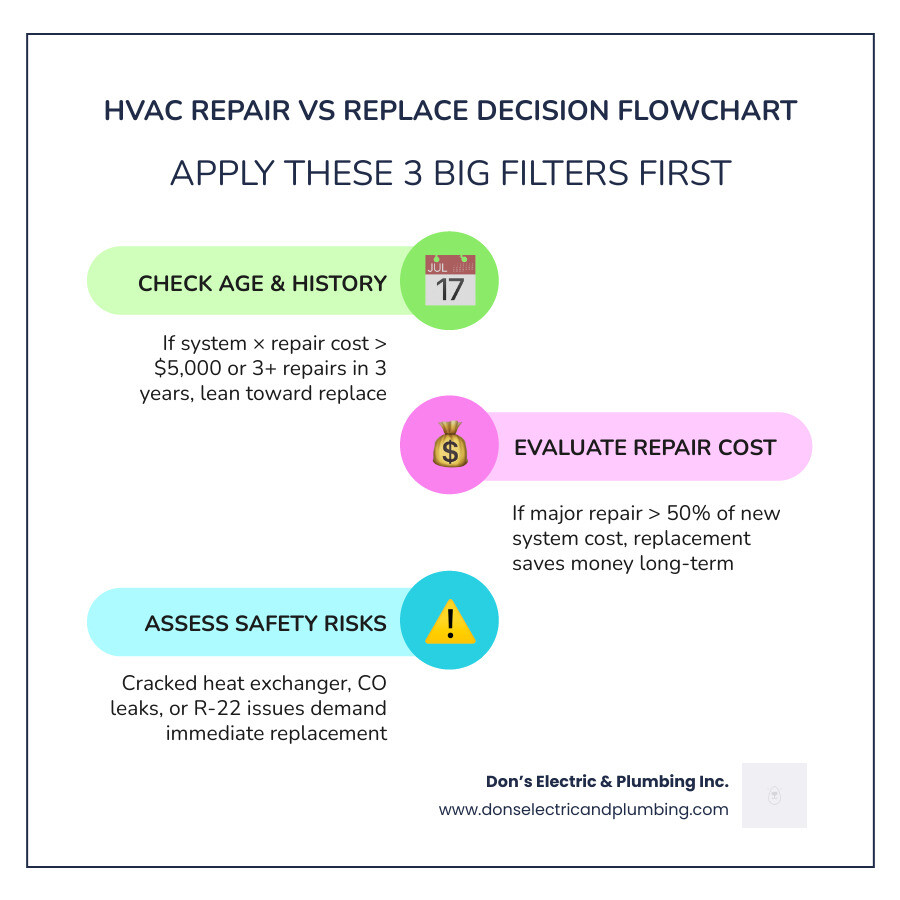
When to Repair vs Replace Your HVAC System: Start With the 3 Big Filters
When we visit a home in Broadalbin or Sharon Springs to look at a struggling unit, we don’t just look at the broken part. We look at the “Three Big Filters”: age, history, and safety. These filters help us determine if a repair is a smart investment or just throwing good money after bad.
A “repair spiral” is a common trap. It happens when you fix a capacitor one month, a fan motor the next, and then find yourself facing a refrigerant leak the following season. Suddenly, you’ve spent a significant portion of what a new system would have cost, but you still have an old, inefficient unit that could break again tomorrow.
Use the $5,000 Rule to Make the First Call
The $5,000 Rule is a favorite among HVAC experts because it’s objective. It removes the emotion from the decision. Here is how you calculate it:
Multiply the age of your system (in years) by the repair quote.
- Example A: You have a 12-year-old furnace and a repair quote for $600. (12 x 600 = 7,200). Since 7,200 is greater than 5,000, the rule suggests replacement is the better move.
- Example B: You have a 6-year-old AC unit with that same $600 repair. (6 x 600 = 3,600). Since 3,600 is less than 5,000, repairing it is the logical choice.
Apply the 50% Rule Before Approving a Major Repair
If the $5,000 rule leaves you on the fence, apply the 50% Rule. This rule states that if the cost of a single repair exceeds 50% of the value of a brand-new system, you should replace it.
Newer equipment comes with a full manufacturer’s warranty and significantly higher efficiency ratings. Investing half the price of a new unit into an old one that is already out of warranty is rarely a sound financial decision.
Count Repairs Over the Last 3 Years
Frequency matters as much as the amount on the bill. If you have needed three or more repairs in the last three years, your system is officially in a “repair spiral.” This indicates that the internal components are reaching the end of their collective lifespan. At this stage, knowing when your HVAC system needs repair becomes a monthly guessing game that ruins your peace of mind.
Age Matters: When to Repair vs Replace Your HVAC System by Equipment Type
Different parts of your HVAC system age at different rates. In the Upstate New York climate, our furnaces work overtime in the winter, while our AC units might sit idle for months. This uneven wear affects their longevity.

Central AC: When an Older Cooling System Stops Making Sense
A central air conditioner typically lasts 15 to 20 years. However, if your unit was built before 2010, it likely uses R-22 refrigerant (Freon), which has been phased out. If an older AC unit starts short-cycling, failing to remove humidity, or leaving hot spots in your home, it’s often a sign of a failing compressor or a refrigerant leak. These are classic signs an AC system needs replacement rather than a temporary fix.
Furnace: The Age and Wear Signs That Push You Toward Replacement
Furnaces generally last 15 to 20 years. Because they involve combustion, age is a major safety factor. If you notice your furnace is running constantly to keep up with a Montgomery County winter, or if your gas bills are skyrocketing despite no change in usage, your AFUE (Annual Fuel Utilization Efficiency) rating has likely plummeted. There are several signs it’s time to replace your furnace that go beyond just “it won’t turn on.”
Heat Pumps: Why Year-Round Use Can Shorten the Timeline
Heat pumps are incredible for efficiency, but because they provide both heating and cooling, they run year-round. This dual-season runtime means they often need replacement closer to the 15-year mark. If your heat pump struggles with defrost cycles or seems to lose its “oomph” during extreme cold-weather strain, it may be time to look at modern, high-efficiency upgrades.
Safety Red Flags That Make Replacement the Only Smart Option
There are some situations where the “repair vs replace” debate ends immediately. If your system poses a risk to your family’s safety, replacement isn’t just a suggestion — it’s mandatory.
A Cracked Heat Exchanger or Carbon Monoxide Risk Is a Stop Sign
The heat exchanger is the part of your furnace that keeps combustion gases (like carbon monoxide) separate from the air being blown into your home. If this metal component cracks due to age or stress, carbon monoxide can leak into your living space.
A cracked heat exchanger cannot be safely patched or repaired; the entire part must be replaced, which is often so expensive that a full system replacement is the only logical path. If you see a yellow or flickering burner flame instead of a steady blue one, this is a major sign you need furnace repair or immediate inspection.
Leaks, Short Cycling, and Constant Running Can Signal Deeper Failure
While a clogged drain line is a simple fix, recurring HVAC leaks can have many causes, some of which are terminal for the equipment. Similarly, if you find yourself asking “why is my HVAC constantly running?“, it could be a sign that the system is no longer sized correctly for your home’s needs or that the internal components are failing to reach the required pressures.
What Homeowners Can Check Before Calling for Service
Before you assume the worst, we recommend a few quick checks:
- Filter Condition: A filthy filter can cause the system to overheat and shut down.
- Thermostat Settings: Ensure it’s not just a dead battery or an accidental setting change.
- Breaker Panel: Check if a circuit has tripped.
- Vents: Ensure they aren’t blocked by furniture or curtains.
- Burner Color: As mentioned, look for a steady blue flame.
Efficiency, Refrigerant, and Incentives: The Financial Side of Replacing
In May 2026, the financial landscape for HVAC replacement is more favorable than ever. Between high-efficiency standards and federal incentives, the “effective cost” of a new system is often much lower than the sticker price.
Why R-22 Refrigerant Changes the Repair Decision
If your system was manufactured before 2010, it likely uses R-22. Production of this refrigerant has ceased entirely. Because the supply is so limited, the cost of a single recharge can be astronomical. If an R-22 system has a leak, we almost always recommend replacement. Moving to a modern system using R-454B or other current standards eliminates the risk of being stuck with an unfixable unit.
How Much Efficiency Upgrades Can Lower Energy Use
Modern systems are leaps and bounds ahead of units from just 10 years ago. Upgrading from an old SEER 9 unit to a modern SEER2 14+ system can reduce your cooling energy consumption by over 35%. For heating, moving to a 96% AFUE furnace means 96 cents of every dollar you spend goes directly into heating your home, rather than up the chimney.
2026 Tax Credits and Rebates Homeowners Should Check
The Inflation Reduction Act (IRA) remains a huge benefit in 2026. Homeowners can often claim federal tax credits of up to 30% (capped at $2,000) for high-efficiency heat pumps. Additionally, many local utility providers in Montgomery and Schoharie counties offer rebates for ENERGY STAR certified equipment. These incentives can effectively reduce the price gap between a basic repair and a full system upgrade.
Should You Replace the Furnace and AC at the Same Time?
This is one of the most common questions we get. While it is a larger upfront investment, replacing both units simultaneously is usually the most cost-effective path.
When a Full System Swap Makes More Sense Than Replacing One Piece
If both your furnace and AC are over 12 years old, replacing them together saves significantly on labor costs. It also ensures that the components are perfectly matched. A new high-efficiency AC unit won’t perform at its peak if it’s forced to work with an old, inefficient furnace blower motor. Matching the system ensures the best airflow and the longest possible lifespan for the new equipment.
When Replacing Only One Component Is Still Reasonable
If your furnace is only five years old but your AC has suffered a catastrophic failure, replacing just the AC is perfectly fine. We will ensure the new unit is compatible with your existing blower and ductwork. This is also a common choice for homeowners who have a strictly limited budget or are planning to move in the very near future.
How Long You Plan to Stay in Your Home Should Affect the Decision
If you plan to stay in your home for the next seven years or more, replacement is almost always the better financial move because you will actually see the “payback” in energy savings. However, if you’re selling next year, a repair might be enough to keep the system functional for the home inspection. For more specific scenarios, our HVAC system FAQ offers deeper insights into long-term planning.
A Practical Next Step for Homeowners in Canajoharie and Nearby Areas
Deciding when to repair vs replace your HVAC system doesn’t have to be a solo mission. At Don’s Electric & Plumbing Inc., we believe in providing the facts so you can make the decision that’s right for your family and your budget.
Gather the Right Details Before You Decide
Before making a final call, gather your “system stats”:
- Age: Check the manufacture date on the outdoor unit or furnace.
- Repair Logs: Look back at how much you’ve spent over the last 24 months.
- Energy Bills: Compare this year’s bills to last year’s.
- Symptoms: Note any strange noises or smells. Knowing the top reasons for furnace breakdowns can help you identify if your issue is a one-off or a systemic failure. If you’re tech-savvy, you can even try some basic HVAC troubleshooting before calling us.
Know When to Stop Repairing and Move Forward With Replacement
The moment your system becomes a safety hazard or a “money pit” that requires annual major fixes, it’s time to move forward. A new system provides more than just lower bills; it provides peace of mind. You won’t have to worry about the heat failing during a blizzard in Little Falls or the AC dying during a family gathering in Cobleskill.
Schedule a Professional HVAC Evaluation
If you are struggling with the Great HVAC Debate, let us help. We provide expert assessments across Montgomery, Schoharie, Fulton, and Herkimer Counties. We’ve been family-owned and operated since 1984, and we stand behind our work with a 100% guarantee.
Whether you need 24/7 emergency service or want to discuss financing options for a new high-efficiency system, we are here to help. Contact Don’s Electric & Plumbing Inc. today for a professional consultation and take the guesswork out of your home comfort.
Visit our Service Areas page to find an HVAC expert near you