


Why Knowing How to Identify Which Circuit Breaker Controls What Could Save You Time, Money, and Stress
Knowing how to identify which circuit breaker controls what is one of the most practical things a homeowner can do — and one of the most overlooked. When power goes out in one room, when you need to safely work on an outlet, or when an appliance trips the panel, you need answers fast. A mystery panel full of blank labels (or no labels at all) turns a five-minute fix into a frustrating hour of guesswork.
Here’s a quick answer to get you started:
How to identify which circuit breaker controls what — fast summary:
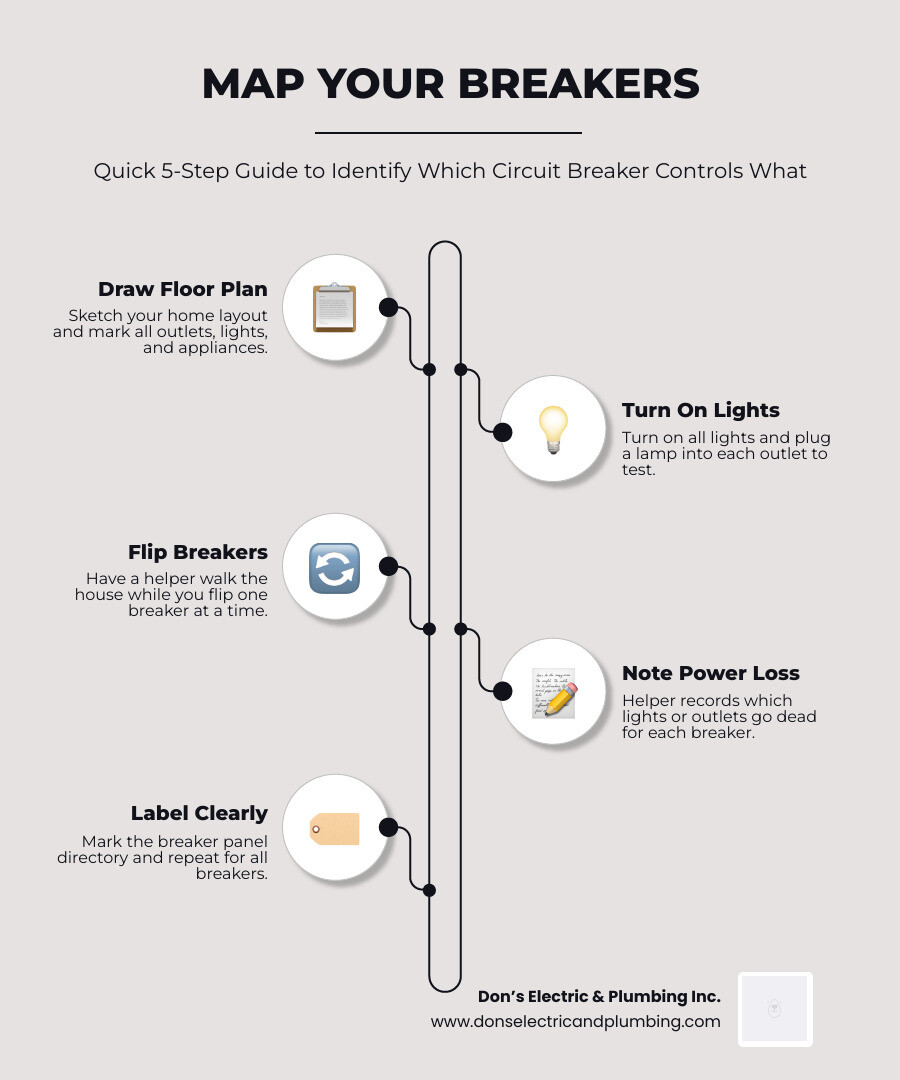
- Draw a simple floor plan marking every outlet, light, and appliance
- Turn on all lights and plug a lamp into each outlet you want to test
- Have a helper walk the home while you flip breakers one at a time
- When power cuts out, your helper notes which lights or outlets went dead
- Label that breaker clearly on the panel directory
- Repeat until every breaker is identified
Most panels have between 10 and 40 breakers. Mapping them all in one session takes about an hour with two people — and it pays off every time you need to cut power safely or troubleshoot a problem.
What a Circuit Breaker Does and Why Mapping It Matters
At Don’s Electric & Plumbing Inc., we’ve been serving families in Montgomery, Fulton, and Schoharie counties since 1984. We’ve seen plenty of “mystery panels,” and we know that a labeled box is a safe box.
Think of a circuit breaker as a safety gate. Its job is to monitor the flow of electricity. If too much current flows through the wires—either because you plugged in too many high-power devices (an overload) or because a wire came loose (a short circuit)—the breaker “trips” or flips itself to the “off” position. This prevents the wires from overheating and starting a fire.
Mapping your panel is essential for:
- Faster Repairs: No more running back and forth to see if the kitchen light is finally off.
- Safer DIY: If you’re replacing a light fixture in Canajoharie or fixing an outlet in Sharon Springs, you need to be 100% sure the power is dead.
- Emergency Response: If an appliance starts sparking, you need to know exactly which switch kills the power to that unit instantly.
Where the Main Breaker Panel Is Usually Located
If you’ve just moved into a home in Palatine or Minden, your first task is finding the panel. It’s usually tucked away in a low-traffic area. Check the:
- Basement: Often near the area where the main utility lines enter the house.
- Garage: Mounted on an interior or side wall.
- Utility Room or Laundry Area: Near the water heater or furnace.
- Exterior Wall: In some newer builds, the main panel (or a main disconnect) might be outside near the electric meter.
Breaker Types You Should Recognize Before You Start
Before you start flipping switches, it helps to know what you’re looking at.
- Single-Pole Breakers: These are the most common. They are thin switches that handle 120 volts, powering your standard lights and outlets.
- Double-Pole Breakers: These take up two slots and are often joined by a single handle. They provide 240 volts for heavy hitters like your electric range, clothes dryer, or central AC.
- GFCI (Ground Fault Circuit Interrupter): These have a “test” and “reset” button on the breaker itself. They are designed for wet areas like bathrooms and kitchens to prevent shocks.
- AFCI (Arc Fault Circuit Interrupter): Also featuring a test button, these detect dangerous electrical “arcing” (sparks) to prevent house fires.
Safety Rules to Follow Before Opening the Panel Door
Electrical safety is our top priority. Even if you aren’t touching wires, the panel deserves respect.
- Dry Hands and Feet: Never stand in water or have wet hands when touching the panel.
- Flashlight Handy: Don’t rely on the room’s overhead light—it might be the one you’re about to turn off!
- The One-Hand Rule: Keep one hand in your pocket or at your side while flipping breakers. This reduces the risk of a current passing through your chest if there were a major fault.
- No Exposed Wires: If you see sparks, charred smells, or the panel cover is missing, stop immediately and Contact a professional electrician.
How to Identify Which Circuit Breaker Controls What: Tools and Setup
Mapping is a systematic process. If you try to wing it, you’ll end up frustrated. Gather these items first:
- Floor Plan: A simple hand-drawn sketch of your home.
- Masking Tape & Permanent Marker: For temporary labels.
- Small Appliances: A lamp, a digital clock, or even a radio.
- Communication: Two-way radios or a cell phone with a clear connection.
Tools for the Manual Two-Person Method
This is the most reliable way to map a house. You’ll need a “Panel Operator” (the person at the box) and a “Scout” (the person moving through the rooms). The Scout needs a pencil and the floor plan to mark exactly which outlets go dead when a specific breaker is flipped.
Tools for Using a Circuit Breaker Finder
If you’re working alone in a large house in Broadalbin or Ephratah, a circuit breaker finder is a lifesaver. This tool has two parts:
- The Transmitter: You plug this into the outlet you want to identify. It sends a signal through the wires.
- The Receiver Wand: You wave this over the breakers in the panel. It beeps or lights up when it finds the breaker carrying that signal.
How to Prepare the House Before Testing
- Turn on every light: This makes it obvious when a circuit dies.
- Unplug computers: Sudden power loss can corrupt data or damage sensitive electronics.
- Notify the family: You don’t want someone in the middle of a shower or a movie to be suddenly left in the dark.
- Test one at a time: Never flip five breakers at once; you’ll never know which one did what.
How to Identify Which Circuit Breaker Controls What With the Two-Person Method
This method is foolproof if you stay organized. It’s the “gold standard” we recommend for homeowners in the Mohawk Valley.
Step-by-Step: Map Lights, Switches, and Receptacles
- Establish Communication: Make sure you can hear each other clearly.
- Number the Breakers: If the panel doesn’t have numbers, use masking tape to assign a number to every switch.
- Start at the Top: The Panel Operator flips Breaker #1 to “OFF.”
- The Scout’s Walkthrough: The Scout walks through the house. Which lights went out? Which outlets (tested with a lamp) are now dead?
- Mark the Plan: The Scout writes “Breaker 1” next to those items on the floor plan.
- Restore and Repeat: The Panel Operator flips Breaker #1 back “ON” and moves to Breaker #2.
How to Identify Which Circuit Breaker Controls What for Appliances and Outdoor Areas
Don’t forget the big stuff!
- Dedicated Circuits: High-draw appliances like the refrigerator, microwave, and dishwasher usually have their own dedicated breakers.
- Sump Pumps: In our area, keeping the sump pump running is vital. Ensure you know exactly which breaker protects it.
- Outdoor Areas: Check the garage, porch lights, and those exterior outlets you use for holiday lights. These are often shared with a GFCI outlet in a nearby bathroom or basement.
What to Do if One Breaker Feeds Multiple Rooms or Seems Unclear
In older homes in places like Little Falls or Dolgeville, wiring can be… creative. You might find that one breaker controls the living room lights and the guest bedroom outlets. If a breaker doesn’t seem to do anything, mark it with a small dot of tape and keep going. It might be for an attic fan, a crawlspace light, or an appliance that isn’t currently running.
How to Use a Circuit Breaker Finder and How to Map Circuits Solo
If you don’t have a helper, don’t panic. You can still get the job done.
| Feature | Manual Mapping | Breaker Finder |
|---|---|---|
| Effort | High (lots of walking) | Low |
| Accuracy | Excellent | Good (requires calibration) |
| Cost | Free | $30 – $60 for the tool |
| Best For | Whole-house mapping | Identifying one specific outlet |
Step-by-Step: Using a Circuit Breaker Finder
- Plug in the Transmitter: Insert it into the outlet you want to find.
- Calibration Scan: Go to the panel. Wave the receiver over all the breakers once. It’s “learning” the signal strengths.
- The Real Scan: Wave it over them a second time. The breaker with the strongest signal will trigger a loud beep or a green light.
- Verify: Flip that breaker off and check the transmitter. If the lights on the transmitter are off, you found it!
Solo Mapping Without Special Tools
No helper and no finder? Use the Radio Method. Plug a loud radio into the outlet you’re testing. Turn the volume up high. Go to the panel and flip breakers until the music stops. It’s low-tech, but it works! You can also use a phone to record a video of a lamp or use a baby monitor to watch a light in another room.
Common Mistakes That Make Breaker Mapping Harder
- Testing Too Fast: Give the Scout time to check every room.
- Forgetting Switched Outlets: Some outlets only work when a wall switch is flipped on. Check those!
- Ignoring the Main Breaker: If you flip the big switch at the top, everything goes dead. That doesn’t help you map individual rooms.
- Missing GFCI Resets: If an outlet is dead and the breaker is on, you might just need to hit “Reset” on a GFCI outlet in the bathroom.
Labeling the Panel Clearly, Resetting Tripped Breakers, and Knowing When to Call a Pro
Once the hard work is done, make it permanent.
How to Label Your Breaker Panel So It Makes Sense Later
Avoid vague labels like “Lights.” Instead, use specific descriptions:
- “Master Bedroom Outlets / Hallway Light”
- “Kitchen GFCI / Dishwasher”
- “Garage / Outdoor Receptacles”
- Pro Tip: Create a “Panel Legend” or map on a piece of paper, laminate it, and tape it to the inside of the panel door. Include the date you last updated it.
How to Reset a Tripped Breaker Safely
If a breaker trips, it will usually sit in the middle—neither fully ON nor fully OFF.
- Unplug: Remove whatever you just plugged in that caused the trip.
- Full OFF: Push the switch firmly to the “OFF” position first. You should hear a click.
- Full ON: Flip it back to “ON.” For more detailed help, check out our guide on Troubleshooting Your Tripped Breaker Without Calling An Electrician or learn more about why breakers trip in the first place.
When Repeated Trips or Unlabeled Breakers Mean It’s Time for Professional Help
Sometimes, mapping reveals bigger problems. If you notice any of the following, it’s time to call Don’s Electric & Plumbing Inc.:
- Burning Smells or Buzzing: This is an emergency. Shut off the main power and call us.
- Warm Breakers: Breakers should not be hot to the touch.
- Frequent Tripping: If a breaker trips even after you’ve reduced the load, the breaker itself may be faulty.
- Old Panels: If your home still has a fuse box or an outdated panel brand, you may be at risk. Read more about the risks of a repeatedly tripping breaker and top reasons older home breakers keep tripping.
If your panel is simply too crowded or broken, it might be time for a panel replacement or professional repair in Canajoharie.
Frequently Asked Questions About Circuit Breaker Mapping
Can one breaker control outlets in more than one room?
Yes, absolutely. Especially in older homes, it was common to “daisy-chain” outlets across hallways or adjacent bedrooms. This is why thorough mapping is so important.
How often should you update breaker labels?
We recommend a quick check once a year or whenever you perform a renovation. If you add a new appliance or finish a basement, update those labels immediately while the information is fresh.
Should you remove the panel cover to identify circuits?
No. Homeowners should only interact with the switches. Removing the “dead front” (the metal cover) exposes live bus bars that can cause fatal shocks. If you need to see the wiring behind the cover to identify a circuit, call a licensed electrician.
Conclusion
Identifying which circuit breaker controls what might seem like a chore, but it’s a major step toward home mastery and safety. Whether you’re in Canajoharie, Sharon Springs, or Broadalbin, having a clearly labeled panel means you’re always in control of your home’s energy.
If you run into a circuit that refuses to be identified, or if your breakers are tripping more often than they should, don’t lose your mind—just give us a call. Our family-owned team is ready to help you with 24/7 emergency service and a 100% satisfaction guarantee.
Ready to upgrade your home’s electrical safety? Schedule an estimate with Don’s Electric & Plumbing Inc. today!