


Why Knowing the Signs Your Circuit Breaker Panel Needs Attention Could Save Your Home
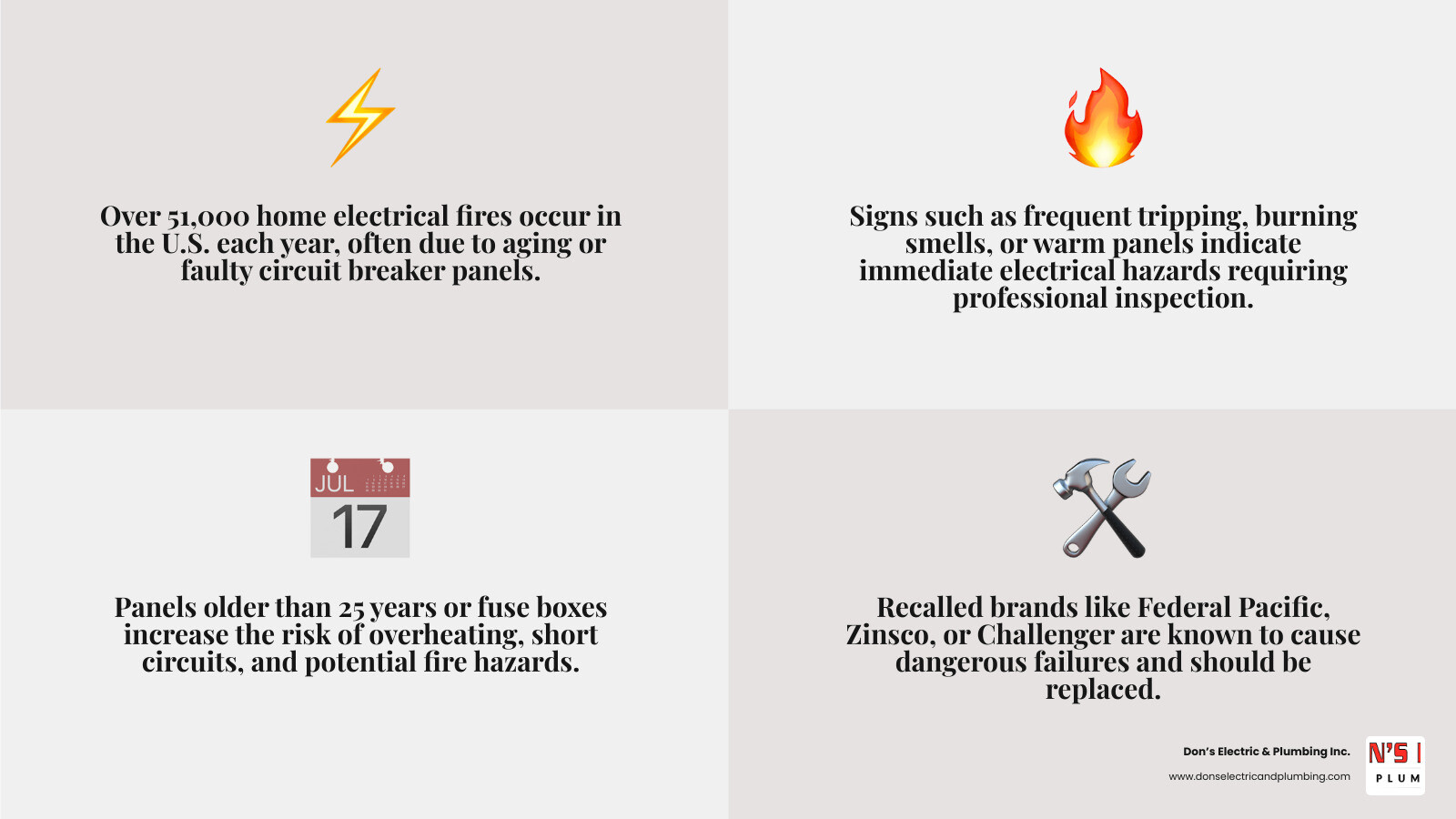
Knowing the signs your circuit breaker panel needs attention could be the difference between a quick fix and a serious house fire. According to the National Fire Protection Association, an estimated 51,000 home electrical fires occur every year in the United States — and aging or faulty electrical panels are a leading contributor. Most homeowners never think about their panel until something goes wrong. But by then, the warning signs have often been there for a while.
Here are the most common signs your circuit breaker panel needs attention:
- Breakers that trip frequently — especially without an obvious cause
- Flickering or dimming lights — particularly when appliances turn on
- Burning smells or scorch marks near the panel
- Buzzing, crackling, or humming sounds coming from the panel box
- A panel that feels warm or hot to the touch
- Breakers that won’t stay reset after being switched back on
- Visible rust, corrosion, or physical damage on or inside the panel
- A panel that’s 25 years old or older — even without obvious symptoms
- An older fuse box or a recalled brand like Federal Pacific, Zinsco, or Challenger
- Running out of breaker slots while needing to add new circuits or appliances
Any one of these signs deserves a closer look from a licensed electrician. Some are minor inconveniences today — others are active fire hazards. The good news is that catching them early makes the solution much simpler.
Key Signs Your Circuit Breaker Panel Needs Attention
Your electrical panel is the central nervous system of your home’s power supply. It receives high-voltage electricity from the utility company and safely distributes it to various circuits throughout your living spaces. When the panel functions properly, it protects your home from overloads and electrical hazards. However, like any mechanical or electrical system, it wears out over time.
Understanding how to spot the early warning signs of panel failure is essential for protecting your family and your property. If your system is starting to struggle, you may notice distinct indicators that something is wrong behind the service door. If you are experiencing general electrical issues, it helps to understand the broader Signs You Need Electric Repair so you can differentiate between a localized outlet issue and a systemic panel failure.
Many homeowners overlook minor symptoms, assuming they are just quirks of an older house. But ignoring these issues can lead to severe consequences. For a deeper dive into diagnosing hidden hazards, read our guide on Sniffing Out Trouble: How to Spot Dangerous Electrical Problems and familiarize yourself with the 10 Most Common Electrical Problems in the Home to keep your household safe.

Frequent Tripping: One of the Signs Your Circuit Breaker Panel Needs Attention
Circuit breakers are safety devices designed to interrupt the flow of electricity when a circuit carries too much current. If a breaker trips, it is doing its job. However, if you find yourself constantly walking down to the basement or utility room to flip a switch back on, your panel is sending you a clear message.
Frequent tripping typically happens for three main reasons:
- Overloaded Circuits: This is the most common residential issue. It occurs when you plug too many high-draw appliances into a single circuit—such as running a microwave and a toaster at the same exact time on a kitchen circuit.
- Short Circuits: A more severe issue where a hot wire touches a neutral wire, causing a sudden, massive spike in electrical current.
- Ground Faults: This happens when a hot wire makes contact with a grounded portion of the junction box or home structure, which is especially dangerous in wet areas like kitchens and bathrooms.
If your breakers are constantly cutting power, you should read about Circuit Breaker Tripping: Find the Cause and Keep the Lights On to understand what is happening. Furthermore, ignoring a breaker that repeatedly shuts off is a major risk. To understand why, review our article on Safety First: Understanding the Risks of a Repeatedly Tripping Breaker. Over time, a breaker that is forced to trip repeatedly can wear out, lose its sensitivity, or fail to trip entirely, leaving your home vulnerable to extreme heat and electrical fires.
Flickering Lights and Other Signs Your Circuit Breaker Panel Needs Attention
Have you ever noticed your living room lights dim for a brief second when your refrigerator compressor kicks on or when you start your washing machine? This is not just an annoying quirk; it is a symptom of voltage fluctuations.
In older homes, electrical panels were often designed to handle only 60 or 100 amps of service. Modern households consume more than double the electricity compared to the 1970s, with average annual household consumption jumping from about 5,000 kWh in 1970 to over 10,700 kWh in 2023. When you run high-draw modern appliances on an outdated panel, the system struggles to distribute power evenly. This results in voltage drops that cause your lights to flicker or dim.
Additionally, flickering can be caused by loose connections at the bus bar inside your panel box. When connections loosen due to thermal expansion and contraction over the years, the electrical path becomes unstable. This unstable connection can damage sensitive modern electronics, like computers and smart TVs, which rely on a steady flow of voltage. To learn more about how older systems struggle, take a look at the Top Reasons Older Home Breakers Keep Tripping.
Burning Smells, Scorch Marks, or Hot Panel Surfaces
If you smell a strange, plastic-like odor or a faint scent of ozone near your electrical panel, treat this as an absolute emergency. A burning smell indicates that wire insulation, plastic components, or the breaker itself is actively melting due to extreme heat.
This heat is typically caused by electrical arcing. Arcing occurs when electricity jumps across a gap in a damaged or loose connection, creating temperatures that can easily exceed several thousand degrees. If left unchecked, this arcing will quickly ignite surrounding materials, leading to a devastating house fire.
When inspecting your panel, look for:
- Scorch marks or discolored plastic around the individual breakers.
- Discoloration on the drywall or wood surrounding the panel enclosure.
- A panel cover plate that feels warm or hot to the touch.
Your panel should always remain cool. If you detect heat or a burning odor, shut off the main breaker immediately (if it is safe to do so) and contact a professional. These Electrical Safety Issues Require Attention immediately to protect your property and family from harm.
Unusual Noises Like Buzzing or Crackling
A healthy electrical panel should operate in complete silence. If you stand near your panel box and hear a persistent buzzing, humming, clicking, or crackling sound, something is wrong.
These noises are audible indicators of electrical issues:
- Buzzing or Humming: Often points to a breaker that is overloaded but failing to trip, or a loose wire connection vibrating at the standard 60 Hz electrical frequency.
- Crackling or Sizzling: This is the classic sound of electrical arcing. It means electricity is actively jumping across loose contacts or damaged wires inside the panel.
Any unusual noise indicates that components are wearing out or struggling to maintain a solid connection. Over time, this arcing and vibration will degrade the physical integrity of the bus bar, rendering the panel highly unsafe.
Understanding Panel Lifespan and Outdated Systems
How long can you expect your electrical panel to perform reliably? Generally, most residential breaker panels have a typical lifespan of 25 to 40 years. However, even if a panel is not showing obvious signs of distress, reaching this age range means it is time to plan for an upgrade.
Many homes built before 1990 still rely on outdated technology, such as fuse boxes. While fuses themselves are not inherently dangerous when maintained perfectly, they are highly impractical for modern electrical loads. Homeowners often make the mistake of replacing blown fuses with incorrect sizes (such as putting a 30-amp fuse on a 15-amp wire), which bypasses the safety limits of the wire and creates an extreme fire hazard.
To help you understand where your home stands, here is a comparison of residential electrical systems:
| System Type | Typical Era | Primary Safety Mechanism | Key Risks & Limitations | Recommendation |
|---|---|---|---|---|
| Fuse Box | Pre-1970s | Fuses melt to cut power | Easy to bypass with incorrect fuse sizes; lacks capacity for modern appliances; rejected by many insurance carriers. | Replace immediately with a modern breaker panel. |
| Outdated Breaker Panel | 1970s–1990s | Standard thermal-magnetic breakers | Aging components; potential lack of modern safety protections (GFCI/AFCI); may be a recalled brand. | Have inspected; plan to upgrade if over 30 years old. |
| Modern Breaker Panel | 2000s–Present | Standard, GFCI, and AFCI breakers | None under normal loads; requires routine inspection every 5-10 years. | Maintain regularly; upgrade capacity if adding major loads. |
If you are unsure about the type of panel in your home or how it functions, check out our comprehensive guide on Everything You Need to Know About Your Home Electrical Panel.
The Danger of Recalled Panel Brands
Age is not the only factor that determines whether a panel is safe. Several brands manufactured between the 1950s and the early 2000s have documented design flaws that make them significant fire hazards.
If your home has one of the following panel brands, you should schedule a replacement as soon as possible:
- Federal Pacific Electric (FPE): Famous for their “Stab-Lok” breakers, these panels have a notoriously high failure rate. In many cases, the breakers fail to trip during an overload or short circuit, causing the wires to overheat and ignite.
- Zinsco: These panels have a design flaw where the breakers can fuse directly to the bus bar. Once fused, the breaker cannot trip, allowing unlimited electrical current to flow through the home’s wiring.
- Challenger: Manufactured primarily in the 1980s and 1990s, certain Challenger panels use breakers that overheat easily, damaging the bus bar and creating a severe fire risk.
Many homeowners insurance companies will outright refuse to cover homes with FPE or Zinsco panels, or they may charge significantly higher premiums until the panel is replaced by a licensed professional.
When to Upgrade to a Higher-Amp Panel
Sometimes, your panel is not necessarily “broken,” but it is simply outgrown. If your home still runs on a 100-amp panel, you may find yourself limited in what you can do. While 100 amps is sufficient for smaller homes with gas heating and basic appliances, it leaves very little room for future growth.
Upgrading to a 200-amp panel is highly recommended if you plan to make any of the following home improvements:
- Installing a Level 2 Electric Vehicle (EV) charger.
- Upgrading to an energy-efficient electric heat pump or central air conditioning.
- Adding a hot tub, sauna, or tankless electric water heater.
- Remodeling your kitchen or adding a major home addition.
- Installing a whole-home standby generator.
A 200-amp panel provides the necessary headroom to handle these heavy electrical loads safely without overloading your system. To help you decide whether a full replacement is the right move for your home, read Is Your Breaker Box Broken? A Guide to Panel Replacement.
Frequently Asked Questions About Electrical Panels
How can I troubleshoot a tripped breaker safely?
If a breaker trips, you can try to reset it yourself once you have addressed the likely cause. First, head to the room where the power went out and unplug any high-draw appliances that were running when the power cut. This is called “deloading” the circuit.
Next, locate your panel box. Look for a breaker switch that is resting in the middle position (or pointing toward “OFF”). To reset it, push the switch firmly to the “OFF” position until you hear a distinct click, and then flip it back to the “ON” position. If the breaker instantly trips again, do not force it. This indicates a more serious issue like a short circuit or a failing breaker. For step-by-step instructions on doing this safely, check out our guide on Troubleshooting Your Tripped Breaker Without Calling an Electrician.
How often should my electrical panel be inspected?
For most modern homes, a professional visual inspection by a licensed electrician is recommended every 5 to 10 years. However, if your home is more than 30 years old, or if you have recently added major new appliances, you should have it inspected every 3 to 5 years. Routine visual checks by the homeowner—looking for rust, listening for noises, and ensuring there is at least three feet of clear space in front of the panel—should be done every few months.
Can a homeowner replace an electrical panel themselves?
No. Under no circumstances should an unlicensed homeowner attempt to replace or work inside an electrical panel. Even if you turn off the main breaker, the main service wires coming from the utility company into the top of the panel remain fully energized with lethal voltage.
Replacing a panel requires pulling local permits, performing precise electrical load calculations to comply with the National Electrical Code, coordinating a physical power disconnect with your local utility provider, and passing a professional code inspection. This is a job that must be left strictly to licensed, insured professionals.
Conclusion
Your electrical panel is the heart of your home’s safety and comfort. Ignoring the signs your circuit breaker panel needs attention can lead to damaged appliances, frequent power interruptions, and serious fire hazards. Whether you are dealing with flickering lights, a buzzing box, or an outdated panel that is simply too old to keep up with modern life, taking proactive action is the best way to protect your home.
Since 1984, Don’s Electric & Plumbing Inc. has been the trusted, family-owned one-stop solution for homeowners across Canajoharie, NY, and the surrounding areas—including Montgomery, Fulton, Schoharie, Herkimer, and Hamilton counties. We back all of our professional electrical services with a 100% satisfaction guarantee, offer convenient financing options, and provide reliable emergency services when you need us most.
Do not wait for a small spark to turn into a major emergency. If your electrical panel is showing signs of wear or is overdue for a safety check, contact the friendly, neighborly team at Don’s Electric & Plumbing Inc. today to schedule a professional inspection and keep your home safe, efficient, and fully powered.