


Why New York Residential Electrical Code Basics Matter for Every Homeowner
Understanding New York residential electrical code basics is one of the most important steps any homeowner can take to keep their family safe. Non-compliant residential wiring is the leading cause of home fires in the United States — and in New York, the rules governing your home’s electrical system are more layered than most people realize.
Here is a quick overview of the key standards that apply to New York homes:
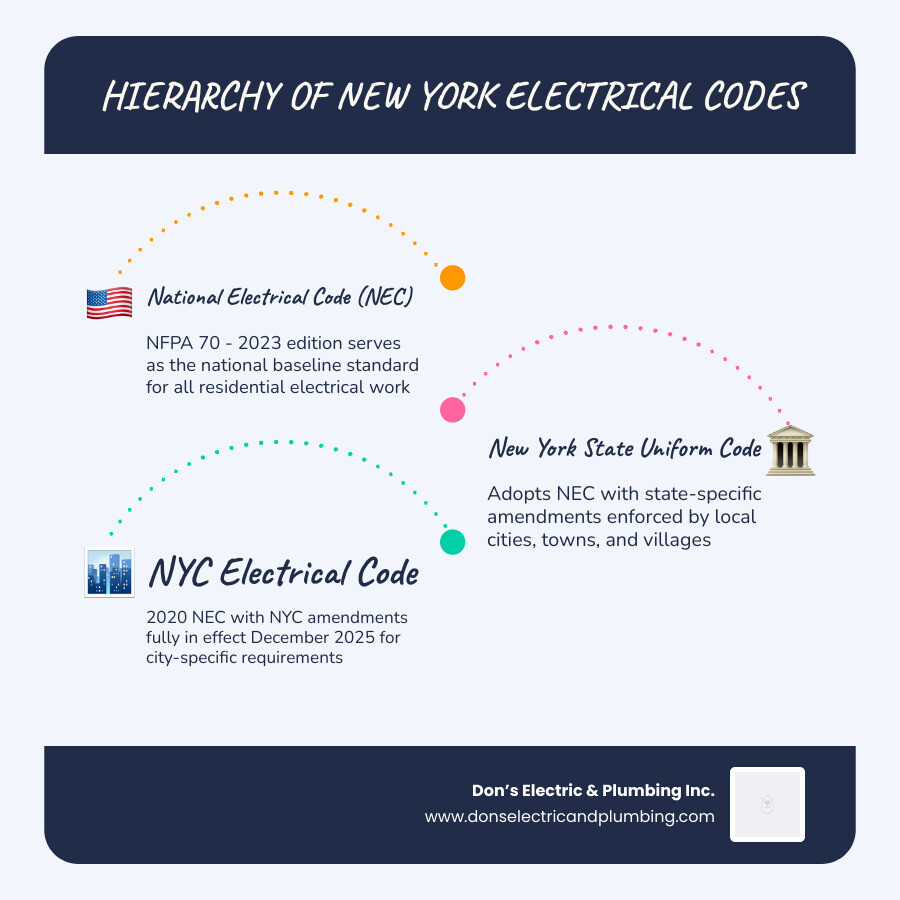
- National Electrical Code (NEC): The 2023 edition of NFPA 70 serves as the baseline standard, effective January 1, 2023
- New York State Uniform Code: Adopts the NEC with state-specific amendments, enforced locally by cities, towns, and villages
- New York City Electrical Code: A separate code based on the 2020 NEC with NYC amendments — fully in effect as of December 21, 2025
- GFCI protection: Required in bathrooms, kitchens, garages, outdoors, basements, and within 6 feet of any sink
- AFCI protection: Required on virtually all 120-volt branch circuits for lighting and receptacles in a home
- Minimum service size: 100 amperes for new residential construction; 200 amperes recommended for modern homes with electric HVAC or EV charging
- Permits required: For new circuits, panel replacements, service upgrades, and most significant electrical work
Whether you own a newly built home in Montgomery County or an older farmhouse in Schoharie County, the rules that apply to your wiring directly affect your safety — and your home’s insurability and resale value.
This guide breaks down each major area of New York’s residential electrical code in plain language, so you know what to expect and when to call a licensed electrician.
New york residential electrical code basics vocabulary:
Understanding the New York Residential Electrical Code Basics
When we talk about the law of the land for wiring, we are usually talking about the NFPA 70, better known as the National Electrical Code (NEC). This massive book is updated every three years to account for new technology and safety data. As of May 2026, the 2023 NEC is the current gold standard across most of the country.
However, New York does things a little differently. The state uses the New York State Uniform Fire Prevention and Building Code (often just called the “Uniform Code”). This code, found in 19 NYCRR, officially adopts the NEC but adds its own specific amendments. If you are Mastering the New York Residential Electrical Code, you have to realize that local enforcement is handled by your town or village building department.
For our neighbors in Montgomery, Fulton, and Schoharie counties, it is vital to distinguish between the state-wide rules and the specific NYC code, as they are not the same.
New York City vs. New York State: A Quick Comparison
| Feature | New York State Uniform Code (Upstate) | New York City Electrical Code |
|---|---|---|
| Primary Reference | 2023 NEC with NYS Amendments | 2020 NEC with NYC Amendments |
| Effective Date | January 1, 2023 | December 21, 2025 |
| Enforcement | Local Building Departments | NYC Department of Buildings (DOB) |
| Licensing | Varies by County/Town | Strict NYC Master Electrician License |
| Service Minimum | 100 Amps | 100 Amps (Strict utility meter limits) |
Essential Safety: AFCI and GFCI Protection Requirements
One of the most confusing parts of new york residential electrical code basics for many homeowners is the difference between GFCI and AFCI protection. Think of it this way: GFCIs protect people from shocks, while AFCIs protect property from fires.
GFCI (Ground Fault Circuit Interrupter): These are required for all 125V through 250V receptacles in areas where water is present. The “6-foot rule” is a big one: any outlet within 6 feet of a sink (kitchen, bar, or laundry) must be GFCI protected. You’ll also need them in bathrooms, garages, crawl spaces, unfinished basements, and all outdoor locations.
AFCI (Arc Fault Circuit Interrupter): These “smart” breakers detect dangerous electrical arcing (like a loose wire sparking behind a wall). The NEC now requires AFCI protection on nearly every 120-volt, 10, 15, and 20-amp circuit in a home, including bedrooms, living rooms, and kitchens.
If you find your circuit breaker tripping, it might be doing its job by preventing a fire. Understanding safety first: the risks of a repeatedly tripping breaker is essential; never just flip it back on without investigating why it tripped.
New York residential electrical code basics for Kitchens and Bathrooms
Kitchens and bathrooms are the most “electrically dense” rooms in your house. In a modern New York home, a kitchen requires at least two 20-amp “small appliance” circuits for countertop receptacles. These can’t be shared with the lights or the dining room.
- Countertop Spacing: No point along the wall line above a kitchen counter can be more than 24 inches from a receptacle. This means you should find an outlet every 4 feet.
- Dedicated Circuits: Major appliances like the dishwasher, disposal, and microwave usually require their own dedicated circuits to prevent overloads.
- Bathroom Rules: At least one 20-amp circuit must be dedicated to bathroom receptacles. If electrical outlets suddenly stop working in your bathroom, check the GFCI reset button first!
Room-by-Room Receptacle Spacing and Circuit Standards
The code tries to prevent the use of dangerous extension cords by requiring plenty of outlets. The primary rule for living areas and bedrooms is the 6/12 rule. This means that no point along a floor line in any wall space can be more than 6 feet from a receptacle. Effectively, you need an outlet every 12 feet.
Additional spacing rules include:
- Hallways: Any hallway 10 feet or longer must have at least one general-purpose outlet.
- Foyers: If your foyer is larger than 60 square feet, it needs a receptacle on any wall space 3 feet or wider.
- Tamper-Resistant (TR) Outlets: To keep your little ones safe around outlets, New York code requires TR receptacles in all dwelling units. These have built-in shutters that prevent children from sticking objects into the slots.
- Weather-Resistant (WR) Outlets: Any outlet installed outdoors or in wet locations must be WR-rated and have an “extra-duty” bubble cover.
Following the ultimate home electrical safety checklist for beginners can help you spot where your home might be falling short of these modern standards.
New York residential electrical code basics for Bedrooms and Living Areas
In bedrooms and living areas, AFCI protection is the biggest priority. Every light fixture and outlet in these rooms must be protected by an AFCI breaker or outlet.
Furthermore, every “habitable room” must have a wall-switch-controlled lighting outlet. While this is usually a ceiling light, it can be a switched outlet where you plug in a lamp. Don’t forget smoke detectors! New York code requires smoke alarms in every bedroom, outside each sleeping area, and on every level of the home, including the basement. These must be hardwired with a battery backup and interconnected so that if one goes off, they all do. This is one of the best ways to avoid common home electrical hazards.
Service Panels, Load Calculations, and Grounding
The “brain” of your home is the service panel. Under new york residential electrical code basics, the minimum service size for a new single-family home is 100 amps (3-wire). However, with the rise of electric vehicles (EVs) and heat pumps, we almost always recommend 200-amp service for our customers in Canajoharie and surrounding areas.
Load Calculations (NEC Article 220)
Before upgrading a panel, we perform a “load calculation.” This involves taking the square footage of the home (3 volt-amperes per sq. ft.), adding the small appliance circuits (1,500 VA each), and factoring in heavy hitters like the range, dryer, and AC. We then apply “demand factors” because you aren’t likely to have every light and appliance on at the exact same second.
Grounding and Bonding
Grounding is your safety net. It provides a path for electricity to return safely to the earth in the event of a fault. In New York, we typically use a combination of grounding electrodes, such as:
- Ground Rods: Two copper-clad rods driven 8 feet into the ground.
- Water Pipe Grounding: Bonding to the metal cold water pipe entering the house.
- Ufer Ground: Connecting to the steel rebar in the concrete foundation.
If you are troubleshooting your tripped breaker, a breaker that won’t reset might be a sign of a “ground fault”—meaning electricity is escaping where it shouldn’t.
Permitting, Inspections, and Upgrading Older Homes
One of the most common questions we get is, “Do I really need a permit?” In New York, the answer is almost always yes. Permits are required for new circuits, service upgrades, and adding permanent equipment.
The process usually involves two stages:
- Rough-in Inspection: This happens after the wires are pulled but before the drywall goes up. The inspector checks box depths, wire stapling, and protection plates.
- Final Inspection: This happens once the walls are finished and the devices (outlets, switches, lights) are installed and energized.
There are serious consequences for electrical work without a permit, including fines, trouble selling your home, and potential insurance claim denials if a fire occurs.
Older Homes and Historic Buildings
If you live in a historic home in Sharon Springs or Middleburgh, you might encounter knob-and-tube wiring or older aluminum wiring. While the code doesn’t necessarily force you to rip out old wiring just because the code changed, any new work or renovations must be brought up to current standards. You should definitely watch out for old wiring warning signs, such as flickering lights or warm switch plates.
Frequently Asked Questions about New York Electrical Standards
Can a homeowner perform their own electrical work in New York?
This depends entirely on your local jurisdiction. While some towns allow homeowners to do their own work on their primary residence (provided they get a permit and inspection), others—including New York City—strictly forbid it. Regardless of the law, there are many common electrical issues why you legally can’t fix everything. Given the fire risks, we always recommend hiring a licensed professional for anything beyond changing a lightbulb.
How many outlets can be installed on a single 20-amp circuit?
Technically, the NEC doesn’t set a hard limit for general-purpose outlets in a house, but industry best practice (and the 80% capacity rule) suggests about 10 outlets per 20-amp circuit. Each outlet is calculated at 1.5 amps for load purposes. Limiting the number of outlets ensures that you don’t trip the breaker every time you plug in a vacuum cleaner.
When is AFCI protection required during a renovation?
If you extend an existing circuit by more than 6 feet or replace an existing receptacle in a room where AFCI is now required (like a bedroom), you must add AFCI protection. This is a common “trigger” for upgrades during a remodel. If you are sniffing out trouble and smell burning plastic, an AFCI breaker might have been able to prevent that issue before it started.
Conclusion
Navigating the new york residential electrical code basics can feel overwhelming, but these rules exist for one reason: to keep you safe. From the specific spacing of outlets in your kitchen to the complex grounding of your service panel, every requirement is backed by decades of safety research.
At Don’s Electric & Plumbing Inc., we’ve been helping our neighbors in Montgomery, Fulton, Schoharie, and Herkimer counties since 1984. Whether you need an electrical safety inspection in Gloversville or you’ve realized that your electrical safety issues require attention, our family-owned team is here to help.
We offer a 100% satisfaction guarantee, emergency services, and financing options to ensure your home is up to code without the stress. Don’t leave your family’s safety to chance—trust the experts who know New York codes inside and out.