


I’m looking to lower my energy usage in Cobleskill. How does switching to LED lighting help?
Understanding how LED lighting reduces your electric bill starts with one simple fact: lighting accounts for 15 to 20 percent of the average home’s electricity use. That’s a meaningful chunk of your monthly bill — and it’s one of the easiest places to reduce energy waste without sacrificing comfort.
Here’s a quick look at how LEDs reduce your electricity usage:
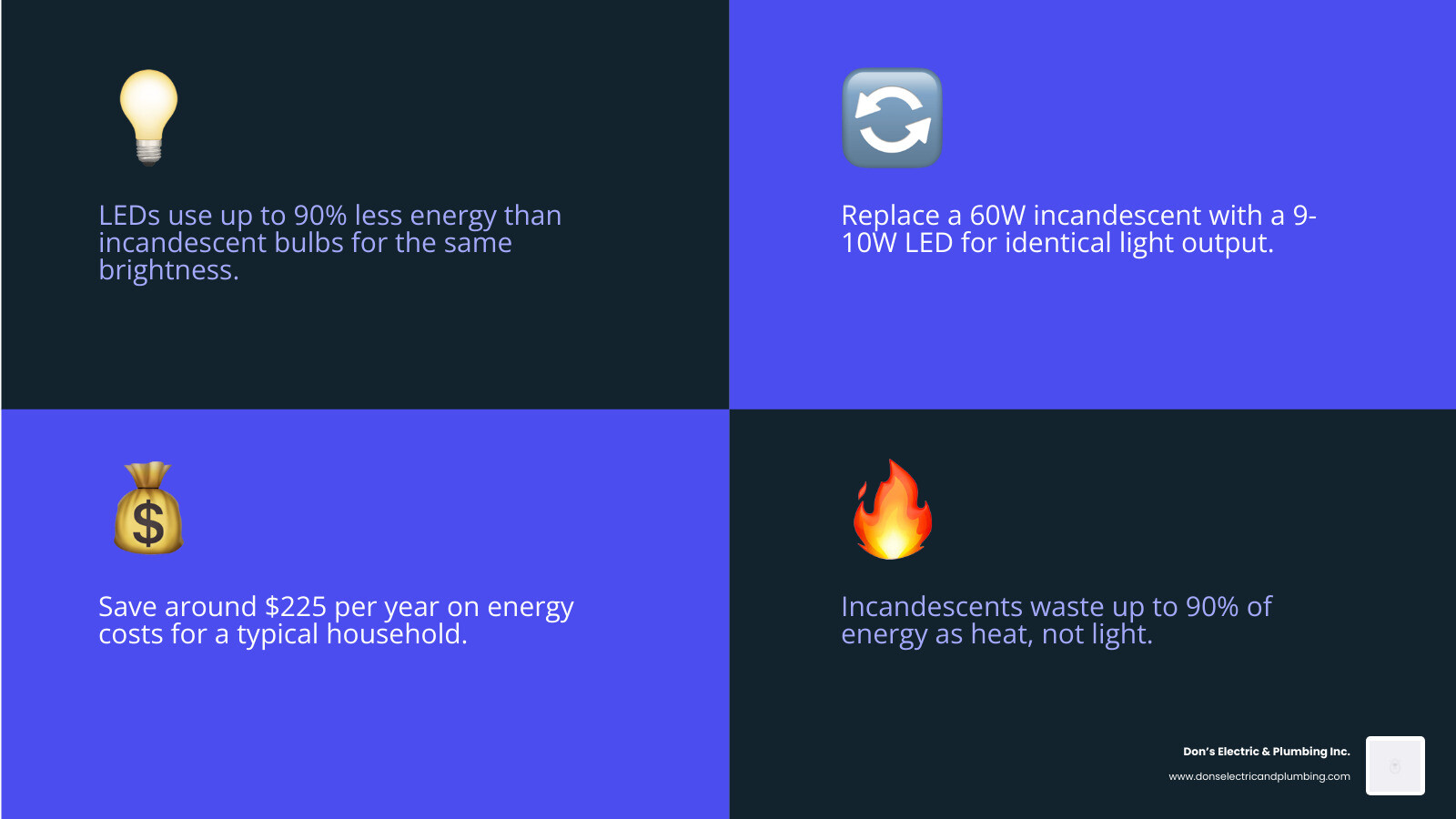
- Use up to 90% less energy than standard incandescent bulbs for the same brightness
- Replace a 60W incandescent with a 9–10W LED and get identical light output
- Last up to 25 times longer, meaning fewer replacements and lower long-term energy consumption
- Significantly reduce annual energy consumption for a typical household
- Reduce heat waste — incandescents burn off up to 90% of their energy as heat, not light
Most homes still have bulbs that waste far more electricity than they need to. Whether it’s old incandescents in the living room, halogens over the kitchen counter, or porch lights left on all night, those inefficiencies add up fast on your monthly bill. Switching to LEDs is one of the simplest upgrades a homeowner can make — and the savings start showing up right away.
How LED Lighting Reduces Your Electric Bill
LEDs lower power use because they create light in a much more efficient way than older bulbs. Instead of heating a filament until it glows, an LED uses a semiconductor to produce visible light directly. Less wasted heat means less wasted electricity.
That matters more than most homeowners realize. Incandescent and halogen bulbs spend a huge share of their energy making heat. If you’ve ever touched an old bulb and yanked your hand back, congratulations, you have met your electric bill in physical form.
CFLs are more efficient than incandescents, but LEDs still usually win. They typically use 40% to 50% less electricity than CFLs for similar brightness, operate cooler, and avoid the mercury found in many CFL bulbs.
Why LEDs use less electricity for the same brightness
The secret is understanding lumens versus watts:
- Lumens tell us how much light a bulb gives off
- Watts tell us how much electricity it uses
Older bulbs trained people to shop by watts, but that approach no longer works well. A traditional 60W incandescent and a 9W or 10W LED can produce about the same brightness. The difference is that the LED turns much more of that electricity into usable light.
In practical terms:
- 40W incandescent replacement: about 6W to 8W LED
- 60W incandescent replacement: about 8W to 10W LED
- 75W incandescent replacement: about 11W to 13W LED
- 100W incandescent replacement: about 14W to 17W LED
That is the core of how LED lighting reduces your electric bill: same light, fewer watts, lower kWh use.
How led lighting reduces your electric bill in everyday rooms
The savings are most noticeable in rooms where lights stay on the longest.
Living rooms often use multiple lamps and overhead fixtures for hours every evening. Bedrooms may have fewer fixtures, but table lamps, closets, and bathroom-adjacent lighting still add steady usage. Kitchens are usually packed with recessed lights, pendants, and under-cabinet lighting. Bathrooms often have bright vanity lights that come on multiple times a day. Hallways, entryways, and porch lights can quietly run longer than almost any other fixture.

The biggest opportunities usually come from:
- Porch and driveway lights
- Hallway lights
- Kitchen ceiling and task lighting
- Bathroom vanity fixtures
- Basement and utility-room lights
- Any fixture that stays on 3 or more hours per day
If you replace the bulbs you use the most, you usually see savings faster than if you start with the guest-room lamp nobody touches except during holidays.
Compare LED Energy Use With Incandescent, CFL, and Halogen Bulbs
Not all bulbs are equal, even when they look similar from across the room.
LED vs incandescent: the biggest drop in power use
This is where the biggest jump in efficiency happens. LEDs commonly use 75% less energy than incandescents, and in some cases up to 90% less.
For roughly the same brightness:
- 40W incandescent -> 6W to 8W LED
- 60W incandescent -> 9W to 10W LED
- 75W incandescent -> 11W to 13W LED
- 100W incandescent -> 14W to 17W LED
Incandescent bulbs also have a short life, often around 1,000 hours. LEDs can last around 25,000 hours or more. So you save on electricity and avoid replacing bulbs constantly.
LED vs CFL and halogen: where the savings still add up
Halogen bulbs are basically incandescents with a slight efficiency improvement, but they still use much more power than LEDs. If you have halogen track lights, vanity bars, or outdoor floodlights, switching those to LEDs can make a noticeable difference.
CFLs were a big step forward years ago, but LEDs now offer several advantages:
- Lower power use for the same brightness
- No warm-up time
- No flicker or humming in many applications
- Longer lifespan
- No mercury
Some research also shows LEDs can be up to 44% more efficient than fluorescent lighting in certain use cases. That means households that already switched once may still have more room to cut lighting energy use.
How much electricity does an LED bulb actually use?
Here is the simple formula:
kWh = (watts ÷ 1000) x hours used
If a 10W LED runs for 8 hours a day:
- Per hour: 0.01 kWh
- Per day: 0.08 kWh
- Per 30-day month: 2.4 kWh
- Per year: about 29.2 kWh
If a 60W incandescent ran the same 8 hours a day:
- Per hour: 0.06 kWh
- Per day: 0.48 kWh
- Per 30-day month: 14.4 kWh
- Per year: about 175.2 kWh
That is a huge drop in energy use from one bulb alone.
| Bulb type | Typical watts for 60W equivalent brightness | Monthly use at 8 hrs/day | Relative efficiency |
|---|---|---|---|
| Incandescent | 60W | 14.4 kWh | Lowest |
| Halogen | 43W to 50W | 10.3 to 12.0 kWh | Better than incandescent |
| CFL | 13W to 15W | 3.1 to 3.6 kWh | Good |
| LED | 9W to 10W | 2.2 to 2.4 kWh | Best |
How to Calculate LED Savings in Your Home
You do not need a spreadsheet obsession to figure this out. A simple count of bulbs and hours of use gets you most of the way there.
The simple formula to measure lighting energy use
Use this process:
- Find the bulb wattage
- Divide by 1,000 to convert watts to kilowatts
- Multiply by hours used per day
- Multiply by days per month or year
- Multiply by your electric rate on your utility bill
To compare two bulbs, run the formula twice and subtract the LED total from the old bulb total.
Example:
- Old bulb: 60W
- New bulb: 10W
- Use: 5 hours per day
Annual energy use:
- 60W bulb: 0.06 x 5 x 365 = 109.5 kWh
- 10W LED: 0.01 x 5 x 365 = 18.25 kWh
Annual energy savings from one bulb:
- 91.25 kWh
Now imagine that across a whole home.
How led lighting reduces your electric bill one bulb at a time
A single bulb may not seem dramatic, but the math stacks up quickly.
Research shows a standard incandescent bulb can use several times more energy per year to operate than an LED. One common finding shows that replacing a 60W incandescent with a 9W LED can significantly reduce energy consumption when used 5 hours a day, depending on local electric rates.
We are not going to pin your home to one exact number, because usage habits and utility rates vary. But the pattern is clear:
- One bulb saves a little
- Ten bulbs save a lot more
- High-use bulbs save the most
- Whole-home replacement can cut lighting energy usage significantly
If you have 20 bulbs used regularly, or closer to 50 sockets in a larger home, the total savings can become very meaningful.
A real-world household example of bill reduction
Let us use two simple examples.
Example 1: 20 frequently used bulbs, 5 hours per day
- Incandescent setup: 20 x 60W = 1,200W
- LED setup: 20 x 10W = 200W
Daily use:
- Incandescent: 1.2 kW x 5 = 6 kWh
- LED: 0.2 kW x 5 = 1 kWh
Yearly use:
- Incandescent: 2,190 kWh
- LED: 365 kWh
Annual reduction:
- 1,825 kWh less electricity for lighting
Example 2: One high-use bulb, 8 hours per day
- 60W incandescent monthly use: 14.4 kWh
- 10W LED monthly use: 2.4 kWh
Monthly reduction:
- 12 kWh for one bulb
That is why porch lights, kitchen fixtures, and basement lights are such strong upgrade targets. The longer the light stays on, the faster the efficiency improvement shows up.
Factors that change your results
Your actual savings depend on several things:
- Bulb wattage
- Brightness needed in lumens
- Hours of daily use
- Number of fixtures
- Local electricity rate
- Bulb quality
- Fixture type
- Whether the bulb is in an enclosed fixture
- Dimmer compatibility
- Household habits
Quality matters. Better LEDs often have better drivers and heat management, which helps them maintain efficiency and last longer. Poor-quality bulbs may run hotter, dim improperly, or fail early.
Choose the Right LED Bulbs to Maximize Savings
Switching to LED is smart. Choosing the right LED is smarter.
Focus on lumens, not watts, when buying LEDs
If you want strong savings without ending up in a room that feels like a cave or a stadium, shop by brightness first.
Use the packaging to compare lumens. Then check wattage to see how efficiently the bulb delivers that light. Higher lumens per watt generally means better efficiency.
This also helps prevent two common problems:
- Over-lighting, which wastes electricity
- Under-lighting, which makes people add extra lamps and cancel out savings
Look for high-efficiency, well-labeled bulbs, especially ENERGY STAR-certified products when available.
Recommended LED wattage for different rooms
These are common residential ranges for general use:
- Living room: 10W to 12W LED per main bulb
- Bedroom: 7W to 10W LED
- Kitchen: 8W to 12W LED for general lighting, higher-output task lighting as needed
- Bathroom: 8W to 10W LED, especially around vanity mirrors
- Dining room: 8W to 10W LED, depending on fixture style
- Home office: 8W to 12W LED, with task lighting for desks
- Hallway: 5W to 8W LED
- Porch or entry: 8W to 12W LED
- Outdoor security lighting: fixture-specific LED flood or integrated LED setup
The goal is not the lowest wattage possible. The goal is the right brightness with the lowest practical energy use.
Does color temperature affect energy savings?
Usually, not enough to be the deciding factor.
You may hear that warm-colored LEDs use slightly less power than cooler ones because of chip and phosphor differences. In real-world home use, though, the difference is usually small. Efficiency rating and lumen output matter much more than color temperature alone.
So choose color temperature based on comfort and function:
- Soft white or warm white for living rooms and bedrooms
- Neutral or cool white for kitchens, bathrooms, and work areas
- Daylight where crisp task visibility matters
Pick the room feel you want, then choose an efficient bulb within that color range.
Do dimmable and smart LEDs save even more?
Yes, they can.
Dimmable LEDs use less power when dimmed, and lower operating intensity can also help extend bulb life. Smart LEDs and smart controls can reduce waste by making sure lights are only on when needed.
Helpful options include:
- Dimmers
- Timers
- Schedules
- Motion sensors
- Vacancy sensors
- Remote shutoff
These are especially useful for outdoor lights, hallways, garages, and spaces where lights are often forgotten. If you are planning an upgrade, our lighting installation services in Cobleskill can help homeowners think through placement, controls, and compatibility.
Avoid the Mistakes That Shrink LED Savings
LEDs are efficient, but bad choices can chip away at the benefit.
Common LED mistakes homeowners make
Here are the issues we see most often:
- Buying by watts instead of lumens
- Choosing bulbs that are too bright for the room
- Using non-dimmable bulbs on dimmer circuits
- Installing bulbs in enclosed fixtures when they are not rated for it
- Buying low-quality decorative bulbs for high-use fixtures
- Leaving lights on constantly because “they are LED, so it does not matter”
It does matter. LEDs use far less electricity, but zero is still less than ten. A forgotten light is still a forgotten light.
Older dimmers can also cause flickering, buzzing, or poor dimming performance. In some cases, updating the switch or fixture is the better long-term move.
Tips that maximize electricity savings with LED lighting
To get the best results:
- Start with the lights used most often
- Use natural daylight whenever possible
- Add task lighting instead of over-lighting the whole room
- Use layered lighting so every fixture does not need to be on
- Add occupancy or vacancy sensors in low-traffic spaces
- Put porch and outdoor lights on timers or smart schedules
- Upgrade outdated fixtures when they limit LED performance
- Choose quality bulbs with good efficiency ratings
If you are also thinking about lighting layouts for a shop, garage, or larger property, our commercial lighting services in Cobleskill may be useful as well.
Why LED lifespan matters as much as energy use
Energy savings get most of the attention, but lifespan is a big part of the story.
Typical incandescent bulb life:
- About 1,000 hours
Typical LED bulb life:
- Around 25,000 hours
That means one LED may last as long as many incandescent replacements. Fewer replacements mean less maintenance, less hassle, and fewer trips to find the same bulb shape again because apparently every fixture in a home wants to be special.
Long life matters even more in:
- High ceilings
- Outdoor fixtures
- Hard-to-reach porch lights
- Multi-bulb vanity fixtures
- Basement or attic spaces
Frequently Asked Questions About How LED Lighting Reduces Your Electric Bill
Do brighter LEDs use more electricity?
Usually yes, but not by nearly as much as older bulb types. A brighter LED with more lumens will generally use more watts than a dimmer LED, but it is still highly efficient. The best move is to choose the brightness that fits the room instead of buying the brightest bulb on the shelf.
Which LED color temperature saves the most energy?
For most homeowners, the difference is minimal. Warm, cool, and daylight LEDs do not differ enough in energy use to drive the decision. Focus on lumen output, lumens per watt, and overall bulb quality. Then pick the color temperature that feels right for the space.
How much can a household save by switching most lights to LEDs?
A typical household can see a significant reduction in energy consumption by using LED lighting, and some homes reduce usage more depending on how many fixtures they have and how long those lights stay on. Homes with lots of bulbs, outdoor lighting, or several high-use rooms often see the biggest reductions.
Conclusion
Once you understand the math, how LED lighting reduces your electric bill is not mysterious at all. LEDs use fewer watts for the same brightness, waste less energy as heat, last dramatically longer, and work especially well in the rooms and fixtures you use every day.
For homeowners in Canajoharie, Broadalbin, Middleburgh, Esperance, Wells, and surrounding communities, lighting upgrades are one of the simplest ways to improve comfort, reduce wasted energy, and make a home feel more modern at the same time.
At Don’s Electric & Plumbing Inc., we have been serving local homeowners since 1984. As a family-owned and operated company, we back our work with a 100% guarantee and offer same-day and emergency service when needed. If you are ready to improve your home’s lighting, explore our lighting services in Canajoharie or request a consultation to get started.