


Why Your Home Won’t Cool Down When the Heat Peaks
Your air conditioner is running nonstop, but the house still feels uncomfortably warm. Understanding the critical relationship between attic insulation and AC compressor longevity becomes painfully obvious when you are forced to endure peak July summer heat indoors. Homeowners often stare at their thermostat, listen to the system grinding away outside, and immediately assume their expensive compressor is failing. The air coming out of the vents might even feel cool, yet the living room remains stifling. When the heat peaks, the immediate reaction is to blame the mechanical equipment, but the true culprit is often hiding directly above your ceiling.
If your system is struggling to keep up with the summer forecast, evaluating your home envelope through comprehensive home comfort services is the first step toward lasting relief. Here in Upstate New York, our technicians frequently visit homes where the AC is blamed for a sweltering living room, only to discover a severely under-insulated attic space.
A home does not operate as a collection of isolated parts; it functions as a complete thermal envelope. The conditions inside your attic directly dictate how hard your cooling equipment must work. Before you commit to replacing major mechanical components or authorizing expensive repairs, you have to look at the boundaries protecting that equipment. Evaluating your attic insulation is a vital decision point. If your home’s thermal boundary is compromised, putting a brand-new, high-efficiency air conditioner into the exact same harsh environment will only lead to the exact same frustrating results.
The Physics of Thermal Transfer: What Happens Above Your Ceiling
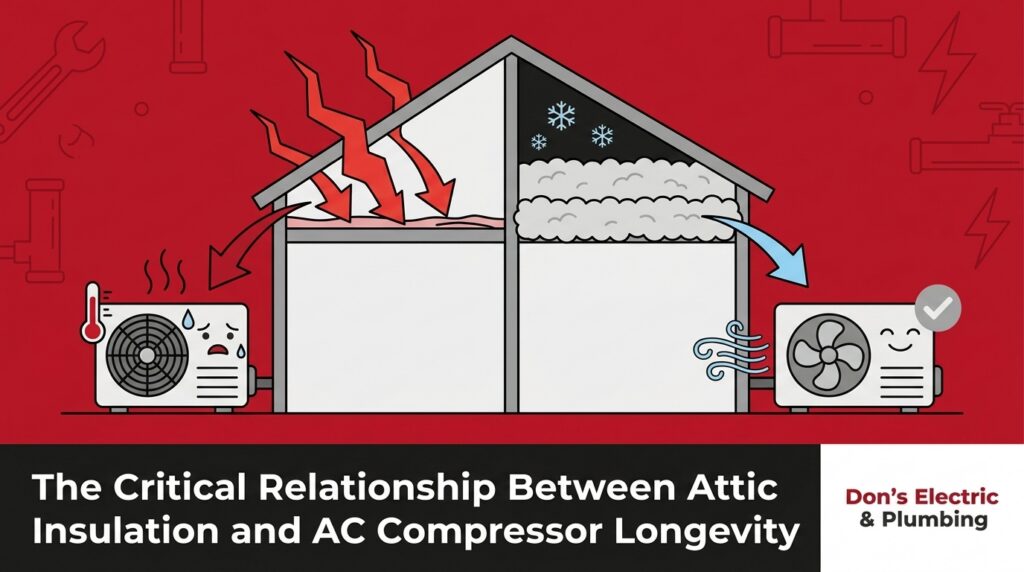
To understand why your air conditioner is struggling, you have to look at the science of radiant heat transfer. Your roof acts like a giant solar collector. As the sun beats down on the shingles, that heat does not simply bounce off; it absorbs into the roofing materials and radiates directly into the attic space. This creates an artificial heat load that constantly presses down on your living areas. When you have attic temperatures significantly exceeding ambient outdoor heat, that trapped thermal energy desperately seeks a cooler space.
- Solar Absorption: The roof deck absorbs intense UV radiation throughout the afternoon.
- Radiant Transfer: Heat radiates from the underside of the roof deck into the trapped air of the attic.
- Downward Migration: Without a strong thermal boundary, this superheated air transfers through the ceiling drywall and into your living space.
- Continuous Load: The indoor air temperature rises, forcing the thermostat to call for continuous cooling.
Radiant Heat vs. Ambient Temperature
There is a massive difference between the ambient temperature reported on the local weather forecast and the radiant heat baking your roof deck. While it might be 90 degrees outside, the enclosed space beneath your roof can easily reach 140 degrees or more. This extreme temperature differential means that the heat pressure pushing down into your home is exponentially stronger than the heat pressing against your exterior walls. Inadequate insulation allows this thermal energy to bypass your ceiling barrier effortlessly, turning your attic into a giant radiator that constantly warms the rooms below.
The Sensible and Latent Heat Load
Temperature is only half the battle. In our experience servicing Canajoharie homes, Upstate NY’s humid summers create a dual sensible (temperature) and latent (humidity) heat load that severely taxes AC systems when the attic is poorly sealed. Sensible heat is the actual temperature you read on a thermometer, while latent heat refers to the moisture content in the air. A poorly sealed attic envelope allows heavy, humid air to seep into your home. Your air conditioner now has to simultaneously lower the physical temperature and wring gallons of water out of the air. This dual load forces the equipment to work twice as hard just to maintain a baseline level of comfort.

Mechanical Fatigue: Why Constant Operation Kills Compressors
Air conditioning systems are meticulously engineered to run in cycles. A normal cooling cycle involves the system turning on, removing heat and humidity from the air until the thermostat target is reached, and then shutting down to rest. These resting periods are mechanically necessary. When an unmitigated heat load from the attic constantly warms the house during peak July summer heat, the thermostat never registers that the target temperature has been satisfied. As a result, the system is forced to run continuously without a single break.
If you are wondering when to say goodbye to your old unit, continuous operation is one of the primary factors that accelerates that timeline.
The Importance of the Cooling Cycle
Short-cycling occurs when a unit turns on and off too rapidly, which is terrible for the equipment. However, continuous operation is equally destructive. The compressor is the heart of your air conditioning system, responsible for pumping chemical refrigerant through the lines. As it compresses this gas, it generates its own intense internal heat. The compressor relies on the downtime between cooling cycles to dissipate this self-generated heat. When the system never cycles off, the compressor never gets a chance to cool down, leading to dangerous internal operating temperatures.
Accelerated Wear and Tear
When a compressor runs hot for hours on end, the internal lubrication begins to break down. Just like a car engine running without sufficient oil, the moving parts inside the compressor start to grind against one another. This friction causes microscopic metal shavings to contaminate the refrigerant lines, further degrading system efficiency. Over time, this continuous mechanical strain shortens the expected lifespan of the equipment drastically. What should be a reliable appliance that lasts for over a decade quickly turns into a burnout risk, all because the system was deprived of its necessary cooling-off periods.
The Hidden Electrical Toll on Your Home’s System
The damage caused by continuous operation extends far beyond the mechanical components of the air conditioner itself. An overworked compressor impacts the entire home’s electrical system. High amperage draw is a normal part of an air conditioner’s startup phase, but during continuous operation, the system demands a relentless, heavy flow of electricity. This constant electrical demand generates heat within your home’s wiring, strains the dedicated breakers, and puts a significant continuous load on the main electrical panel.
Because our team at Don’s Electric & Plumbing brings dual-trade expertise in both HVAC and electrical services to Canajoharie and the surrounding areas, we have a unique, firsthand understanding of how these systems interact. In our years of dispatching technicians during peak July heatwaves, we consistently see a pattern: treating the air conditioner in isolation ignores the systemic electrical stress caused by poor insulation. When attic temperatures significantly exceeding ambient outdoor heat force the compressor to run all afternoon, the electrical panel is forced to sustain maximum capacity for hours. Over time, this can lead to weakened breaker switches, degraded wire insulation, and potential safety hazards within the panel itself. The home envelope, the mechanical cooling equipment, and the electrical infrastructure are all deeply interconnected.
Diagnosing the Root Cause: Insulation Deficits vs. Equipment Failure
When the house is hot, the immediate assumption is that the air conditioner is broken. However, diagnosing the root cause requires a careful evaluation of the home’s thermal boundary before assuming the mechanical equipment is dead. If you replace a burned-out compressor without addressing the superheated attic, the new unit will suffer the exact same fate during the next peak July summer heat wave. You have to determine if the equipment is failing to produce cold air, or if it is successfully producing cold air but losing the battle against an overwhelming heat load.
Signs Your Envelope is Failing
- Cold air from vents, but hot rooms: If you hold your hand to the supply register and feel distinctly cold air, the mechanical cooling process is working. The heat is simply entering the room faster than the AC can remove it.
- Uneven temperature distribution: Rooms directly beneath the attic, or those with expansive ceilings, are noticeably warmer than the lower levels of the house.
- Afternoon continuous operation: The air conditioner runs non-stop during the peak afternoon sun but successfully catches up and cycles off once the sun goes down.
- Hot ductwork: If your home’s ductwork is routed through an unconditioned attic, the cold air inside the ducts is being heated before it ever reaches your living space.
| Symptom | Likely Insulation Deficit | Likely Equipment Failure |
|---|---|---|
| Airflow Temperature | Cold air blowing from vents | Warm or room-temperature air blowing |
| Time of Day Impact | System catches up at night | System struggles day and night |
| Room Location | Upper floors significantly hotter | All floors equally uncomfortable |
| System Cycling | Runs constantly during sunny afternoons | Short-cycles or fails to turn on at all |
A professional evaluation of the attic’s thermal boundary and existing R-value is crucial. Proper diagnosis ensures you are fixing the actual problem rather than just treating the most obvious symptom.
Creating a Thermal Boundary to Protect Your HVAC Investment
The technical solution to this cascading problem is establishing a robust thermal boundary. This involves a dual approach: air sealing gaps and upgrading the insulation to the proper R-value. R-value measures a material’s resistance to conductive heat flow; the higher the number, the greater the insulating power. By creating a thick, continuous blanket over your ceiling, you effectively sever the connection between the superheated attic air and your comfortable living space.
Air sealing is just as important as the insulation itself. Plumbers, electricians, and builders leave dozens of small penetrations in the ceiling for wires, pipes, and light fixtures. These gaps allow conditioned air to escape into the attic and latent humidity to sink into the house. Sealing these penetrations stops convective heat transfer. Once the envelope is sealed and properly insulated against attic temperatures significantly exceeding ambient outdoor heat, the air conditioner can finally satisfy the thermostat and cycle off normally.
It is also worth noting that generic energy rebates or federal tax credits may apply to qualifying envelope and efficiency upgrades. While you should always check with a tax professional or your local utility provider for current programs, these incentives often make upgrading your thermal boundary highly accessible. Ultimately, proper insulation should be viewed as a vital preventative maintenance strategy for your compressor, shielding it from unnecessary wear and tear.
Protecting Your Compressor Through Whole-Home Solutions
HVAC equipment and home insulation act as a single interconnected system. You cannot expect a mechanical air conditioner to overcome major structural deficiencies in the home’s envelope. Addressing the root cause of thermal transfer satisfies the immediate need for reliable cooling while simultaneously extending the life of your expensive mechanical and electrical equipment. When you stop the radiant heat from pushing through your ceiling, you allow your compressor to rest, your electrical panel to cool down, and your indoor environment to stabilize even during peak July summer heat.
If your system is running constantly and your home is still uncomfortable, it is time to have your whole home envelope evaluated by professionals who understand both the mechanical and electrical demands of the system. Do not wait for the compressor to burn out completely. Reach out and contact our HVAC technicians to ensure your thermal boundary and your cooling equipment are working together to protect your home.