


When Repair Bills Stop Making Sense: Your HVAC Repair vs Replacement Cost Guide
This HVAC repair vs replacement cost guide helps you quickly decide whether fixing your current system or investing in a new one makes more financial sense.
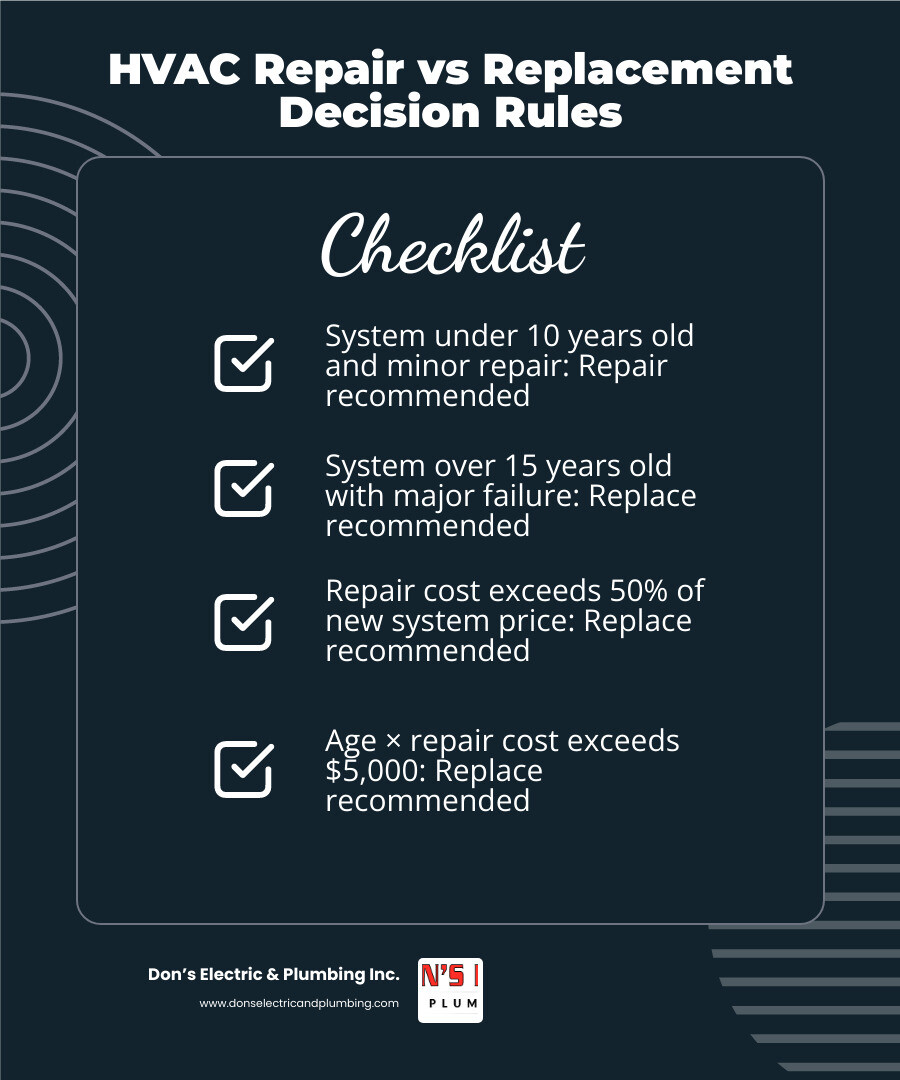
Quick Decision Summary:
| Situation | Likely Best Choice |
|---|---|
| System under 10 years old, minor repair | Repair |
| System over 15 years old, major failure | Replace |
| Repair cost exceeds 50% of new system price | Replace |
| Age × repair cost exceeds $5,000 | Replace |
| Cracked heat exchanger or R-22 refrigerant leak | Replace immediately |
| System under warranty, isolated failure | Repair |
Your HVAC system just stopped working. Maybe it’s the middle of a cold Upstate New York winter, or the heat of July, and a technician is standing in your home waiting for an answer. That moment — stressed, rushed, and expensive — is exactly the wrong time to make a major financial decision without a clear framework.
The truth is, not every breakdown means you need a new system. But not every repair is worth the money either. System age, repair costs, efficiency ratings, and safety all factor into the right call. And getting it wrong in either direction costs you.
This guide walks you through the key decision rules, real cost thresholds, and warning signs that make the repair-or-replace question a lot easier to answer.
Know your hvac repair vs replacement cost guide terms:
Navigating Your Options with an HVAC Repair vs Replacement Cost Guide
When your heating or cooling system acts up, it is easy to feel overwhelmed by the choices. Should you patch it up one more time, or is it time to start fresh? Navigating this decision requires a clear framework that balances immediate relief with long-term financial planning.
To make a smart decision, you have to look beyond the immediate repair bill. You must consider how much longer the system will last, how much energy it will consume, and whether you are simply throwing good money after bad. Homeowners often find themselves caught in a cycle of repeated minor fixes, unaware that they are slowly paying for a new system anyway—without getting any of the benefits of modern technology.
If you are trying to weigh your options, we recommend taking a step back to evaluate the system as a whole. Sometimes, the choice is clear-cut, while other times it requires a bit of math. For a deeper look into this decision, you can read about why you should Consider AC Replacement Over Repair and explore The Great HVAC Debate and How to Know When to Finally Replace your system.
How to Use an HVAC Repair vs Replacement Cost Guide to Apply the $5,000 Rule
One of the most reliable and widely accepted mathematical formulas in the industry is the $5,000 rule. This rule serves as a fast financial threshold to help you determine if a repair is a sound investment or a waste of money.
To apply this rule, you simply multiply the age of your system (in years) by the repair quote (in dollars):
$$\text{System Age (Years)} \times \text{Repair Cost (Dollars)} = \text{Financial Index}$$
- If the result is over $5,000: Replacement is usually the smarter move.
- If the result is under $5,000: Repairing the system is generally a financially sound choice.
Let’s look at how this plays out in real-world scenarios:
- Scenario A: A 12-year-old system needing a $600 repair totals $7,200 under the $5,000 rule. Because $7,200 exceeds the $5,000 threshold, investing in a replacement is typically the wiser decision.
- Scenario B: A 5-year-old system with the exact same $600 repair totals $3,000. This is well under the $5,000 threshold, which means moving forward with the repair is the right call.
By using this objective math, you can remove the emotional stress from the situation and make a decision based on clear financial logic.
The 50% Rule for Major Component Failures
While the $5,000 rule is an excellent quick filter, we also like to use the 50% rule, especially when dealing with major component failures. This rule focuses on the ratio between the repair quote and the actual replacement value of a brand-new system.
The premise is simple: if the cost of repairing your current HVAC system exceeds 50% of the price of a brand-new, equivalent system, you should replace it instead of repairing it.
Spending more than half the cost of new equipment to keep an aging, out-of-warranty unit running for just a few more seasons is rarely a good value. Older systems are highly likely to suffer another component failure shortly after a major repair, starting a “repair spiral” that drains your savings. If you are leaning toward an upgrade, you might want to learn How Can You Save Money on a New AC Unit? to keep your transition as cost-effective as possible.
System Age and Performance Indicators: When to Say Goodbye
Just like any hardworking mechanical system, your heater and air conditioner have a natural lifespan. In our local climate—where systems endure freezing winters in Sharon Springs and humid summers in Canajoharie—equipment undergoes significant thermal stress.
Most air conditioners and heat pumps have an expected operational lifespan of 15 to 20 years, while well-maintained gas furnaces can last a similar duration. However, as systems enter their “golden years,” their performance naturally declines, and their risk of catastrophic failure increases. To better understand how age limits your equipment, take a look at our guide on HVAC Longevity: When to Say Goodbye to Your Old Unit.
To help you quickly evaluate your system’s current standing, we have compiled a comparison of key performance indicators:
| Performance Indicator | Lean Toward Repair | Lean Toward Replacement |
|---|---|---|
| Equipment Age | Under 10 years | Over 12–15 years |
| Repair Frequency | First or second minor issue | 3+ repairs in the last 3 years |
| Utility Bills | Stable and predictable | Rising 20% to 40% with no rate change |
| Comfort Levels | Consistent, even temperatures | Hot and cold spots; poor humidity control |
| Operating Noise | Standard hum or quiet cycling | Loud banging, screeching, or constant rattling |
| System Safety | Sealed combustion, clean flame | Cracked heat exchanger, carbon monoxide risks |
Evaluating Component Failures with an HVAC Repair vs Replacement Cost Guide
Not all equipment failures are created equal. Some parts are minor and easy to swap out, while others represent the “heart” of the system and signal that the unit is nearing the end of its useful life.
- Minor Components (Usually Worth Repairing): Parts like run capacitors, contactors, flame sensors, and simple thermostats are inexpensive to replace. If your system is otherwise healthy, replacing these parts is almost always worth doing.
- Major Components (Signals for Replacement):
- Compressor Failure: The compressor is the most expensive part of your AC. If it fails on a system over 10 years old, replacing the entire outdoor unit is almost always better than putting a new compressor into an old system.
- Cracked Heat Exchanger: This is a critical failure in a furnace. Because a cracked heat exchanger can leak deadly carbon monoxide into your home, it must be addressed immediately, and replacement is almost always the only safe option.
- Blower Motor or Control Board: These mid-tier parts can be costly to fix. If your system is over 12 years old, a failed blower motor or main control board often tips the scale toward replacement.
Warning Signs of an Outdated Furnace or AC
Sometimes, your system doesn’t break down completely, but it drops subtle hints that it is on its last legs. If you notice uneven temperatures throughout your home, strange noises like screeching or banging, or a sudden spike in your monthly energy bills, your system is struggling. Frequent short-cycling (turning on and off rapidly) is another major warning sign that your equipment is oversized, failing, or severely degraded.
If you are experiencing these issues with your heating system, read about the Signs It’s Time to Replace Your Furnace or explore the Five Signs It’s Time for a New Furnace.
For cooling systems, you can check out the common Signs AC System Needs Replacement and learn more about the 3 Signs It’s Time to Replace Your Central AC That Is Outdated.
Efficiency Ratings, Refrigerant Phase-Downs, and Environmental Factors
Modern HVAC systems are vastly different from the units installed fifteen or twenty years ago. Today, the decision to replace a system isn’t just about avoiding repairs; it’s also about capturing massive energy savings and complying with environmental regulations.
SEER2 and AFUE Efficiency Standards
If you are running an older system, you are likely paying a heavy premium on your monthly utility bills. Cooling efficiency is measured by SEER2 (Seasonal Energy Efficiency Ratio), while heating efficiency is measured by AFUE (Annual Fuel Utilization Efficiency).
- Cooling Upgrades: Upgrading from an old SEER 9 or 10 unit to a modern SEER2 14 or higher can reduce your cooling energy consumption by over 35%.
- The DOE’s Stance: According to the Department of Energy, installing a standard new model can save you 20% to 40% in monthly operating costs compared to an older, degraded unit.
- ENERGY STAR Advantage: If you choose an ENERGY STAR-certified model, you can expect to save an additional 15% beyond the standard new-unit savings.
In cold-climate areas like Herkimer and Fulton counties, upgrading a 78% AFUE furnace to a 96% AFUE condensing furnace can dramatically cut your winter heating bills, helping the new system pay for itself over time.
The R-22 and R-410A Refrigerant Transitions
Environmental regulations are also reshaping the financial math of HVAC repairs.
- R-22 (Freon): Production and import of R-22 completely ceased. If your old AC uses R-22 and develops a refrigerant leak, the cost of sourcing this scarce chemical is astronomical. A single recharge can cost almost as much as a down payment on a new system, making any major repair on an R-22 system a poor investment.
- R-410A Phase-Down: The industry is currently undergoing a phased-down transition away from R-410A to newer, low-GWP (Global Warming Potential) A2L refrigerants like R-454B and R-32. While existing R-410A systems can still be serviced, the cost of R-410A refrigerant will rise over the coming years.
Upgrading to a modern system using the latest compliant refrigerants protects your home from future service price spikes and ensures long-term environmental compliance.
Strategic Replacement: Bundling AC and Furnace Upgrades
When one half of your HVAC system fails, you will face a crucial question: should you replace just the broken unit, or should you upgrade both the air conditioner and the furnace at the same time?
While replacing both units requires a larger upfront investment, bundling your upgrades is almost always the most cost-effective path in the long run.
- Matched System Performance: HVAC systems are designed to work as matched sets. If you connect a brand-new, high-efficiency AC condenser to an old, single-speed furnace blower indoors, the system will struggle to achieve its rated efficiency and humidity-control benefits.
- Labor Savings: A massive portion of installation costs comes from labor, site preparation, and ductwork modifications. By replacing both units at once, our technicians only have to open up your plenum, recover refrigerant, and configure the electrical connections once. This dramatically reduces the overall labor bill compared to scheduling two separate installations a few years apart.
- Avoiding Future Headaches: If your furnace and AC are similar in age, replacing only one means you will likely have to repeat the entire disruptive installation process when the other unit fails shortly down the road.
To learn more about what goes into these projects, you can read about Why Is the Furnace Installation So Expensive?, explore 7 Reasons Why Is AC Installation So Expensive?, or dive into What Is the Deal With HVAC Installation Being So Expensive? and Reasons for a High Furnace Installation Bill.
Frequently Asked Questions about HVAC Decisions
Making a major home comfort decision can bring up a lot of questions. Here are some of the most common inquiries we receive from local homeowners.
Does a home warranty cover HVAC repair and replacement?
Home warranties can be helpful, but they often come with strict limitations, high service call fees, and caps on replacement coverage. Many warranty companies will push for repeated cheap repairs on a failing system rather than approving a much-needed replacement. To understand the fine print, read our detailed breakdown on Does a Home Warranty Cover HVAC Repair and Replacement?.
Should I replace my furnace and AC at the same time?
Yes, especially if both systems are over 12 years old. Upgrading them together ensures that the indoor blower motor and outdoor condenser are perfectly matched for maximum efficiency, saves you significantly on duplicate labor costs, and resets the warranty clock for your entire home comfort system.
What safety hazards require immediate system replacement?
Any safety issue that threatens your family’s health requires immediate attention. The most common critical hazard is a cracked heat exchanger in a gas furnace, which can release deadly carbon monoxide gas into your living spaces. Severe gas leaks, failing electrical controls that pose fire hazards, and persistent exhaust venting failures are also critical issues that often require an immediate system replacement to ensure your home remains safe.
Conclusion
Deciding whether to repair or replace your HVAC system doesn’t have to be a stressful guessing game. By applying the $5,000 rule, evaluating the age of your equipment, and considering the massive energy savings of modern SEER2 and AFUE standards, you can make a clear, logical decision that protects your comfort and your wallet.
Since 1984, Don’s Electric & Plumbing Inc. has been the trusted, family-owned one-stop solution for homeowners across Montgomery, Fulton, Schoharie, Herkimer, and Hamilton counties. We are proud to serve our neighbors in Canajoharie, Broadalbin, Sharon Springs, Little Falls, and the surrounding areas with a 100% satisfaction guarantee, reliable 24/7 emergency services, and flexible financing options to fit your budget.
If you are ready to explore your options, you can Apply for HVAC Financing Canajoharie NY or check out our latest HVAC Specials HVAC Rebates to save on your upcoming project.
Don’t wait for your system to leave you in the cold or the heat. Schedule a consultation with our local experts today, and let us help you find the perfect, reliable climate solution for your home!