


Preparing for the Holiday Cooking Rush
Thanksgiving in Upstate New York brings crisp air, busy kitchens, and heavy holiday cooking. Unfortunately, nothing ruins a late fall gathering faster than sudden fats oils grease plumbing clogs backing up into your kitchen sink. As you plan the perfect menu and prepare to host guests, your home’s drainage system is bracing for one of the most stressful weeks of the year.
The Friday after Thanksgiving is notoriously known in the industry as “Brown Friday.” During this late fall week, residential plumbing calls can spike by up to 50 percent nationwide. Here at Don’s Electric & Plumbing, our team sees this holiday rush firsthand every single year. The primary culprit behind this massive wave of local service requests is the improper disposal of fats, oils, and grease—commonly referred to as FOG. When a home is full of visitors, the last thing you want is a completely unusable kitchen.
If you want to ensure your home is fully prepared to handle the extra demand, scheduling expert plumbing services for a routine check before the holiday rush hits is a smart move. Taking proactive steps now means you won’t have to scramble for emergency plumbing repair while the turkey is still in the oven.
The Science Behind Fats, Oils, and Grease Plumbing Clogs
To understand why fats oils grease plumbing clogs are so destructive, you have to look at the physical mechanics of how these substances behave once they leave your sight. When FOG goes down the drain, it does not simply wash away into the municipal sewer system. Instead, it undergoes a transformation that slowly chokes your home’s drainage lines.
Nationwide, FOG is recognized by environmental agencies as a leading cause of sanitary sewer overflows (SSOs). These clogs do not happen instantly from a single pan of bacon grease. They are the result of cumulative buildup. Every time grease goes down the drain, it adds another micro-layer to the inside of the pipe. When heavy Thanksgiving usage hits, that narrowed pipe finally reaches its tipping point and completely seals shut.
What Constitutes FOG in the Kitchen?
Most homeowners know that pouring straight cooking oil down the drain is a bad idea, but FOG hides in many other common holiday foods. Understanding these hidden sources is the first step in protecting your pipes.
- Meat fats and drippings: The juices from your roasted turkey, ham, or roast beef are incredibly dense in animal fats.
- Dairy products: Heavy cream, butter, sour cream, and ice cream contain high levels of milk fat that coat pipes.
- Sauces and gravies: These are often made with a base of butter or meat drippings, making them prime culprits for drain blockages.
- Salad dressings and mayonnaise: Oil-based condiments cling to pipe walls long after the water has washed away.
The Layering Effect Inside Your Pipes
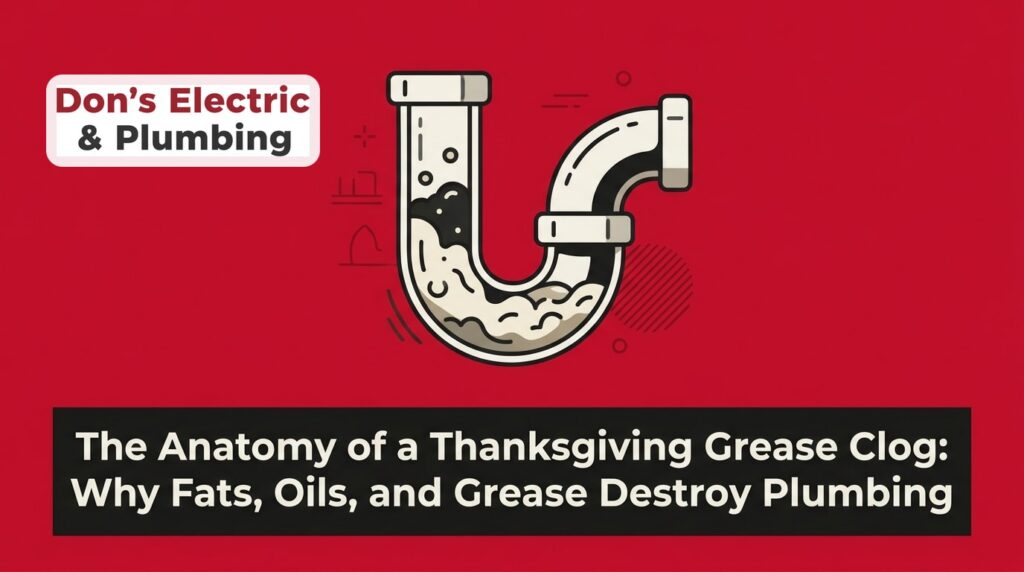
When liquid grease enters your plumbing, it coats the inner diameter of the pipes. As it cools, it turns into a sticky, viscous paste. This creates a “layering effect.” The sticky walls then act like a trap, catching small food particles, hair, and soap scum that pass by.
| Substance Type | Behavior in Drain | Risk Level |
|---|---|---|
| Liquid Cooking Oils (Canola, Olive) | Coats pipe walls, remains sticky, traps other debris. | High Risk |
| Animal Fats (Bacon, Turkey, Butter) | Solidifies rapidly into a hard, wax-like block. | Severe Risk |
| Dairy and Heavy Sauces | Leaves a thick film that catches starchy food scraps. | Moderate to High Risk |
Over months or years, this buildup restricts water flow until the pipe is effectively choked off. The heavy volume of Thanksgiving cooking simply provides the final plug that stops the flow entirely.

Why Cold Upstate Weather Accelerates the Blockage
The climate in Upstate New York plays a massive, often overlooked role in how quickly a kitchen drain fails. In warmer southern climates, liquid grease might travel significantly further down the municipal sewer line before it cools enough to harden. However, as our plumbers know all too well from servicing Canajoharie, NY, our local environmental conditions are entirely different.
By late November, average temperatures in Canajoharie drop well into the 30s. This near-freezing weather drastically cools the exterior walls of your home, as well as the ground surrounding your main sewer line. When you pour warm liquid turkey fat down the sink, it eventually hits these freezing cold sections of plumbing. The thermodynamic reaction is immediate: the warm liquid hits the ice-cold pipe and solidifies almost instantly into a hard, waxy block.
When our team gets called out for residential plumbing repair during the colder months, our technicians frequently pinpoint this rapid temperature drop as the root cause. The plumbing system acts like a flash-freezer for holiday drippings.
The Vulnerability of Unheated Basements
Homes in Upstate New York often feature unheated basements or crawlspaces where plumbing lines run exposed to the ambient cold air. These specific sections of pipe are highly susceptible to temperature drops. While the pipes inside your heated kitchen might allow the grease to flow freely, the moment that liquid reaches the uninsulated crawlspace, it halts.
Turkey fat, which is solid at room temperature, turns into a dense, concrete-like obstruction within minutes of hitting a 35-degree pipe. This localized freezing effect is why clogs often form deep in the system, far beyond the reach of a standard sink plunger.
The Dangerous Mix: FOG and Starchy Thanksgiving Foods
While fats and oils are destructive on their own, they become a catastrophic plumbing emergency when combined with the other staples of a Thanksgiving meal. The holiday menu is heavily reliant on starchy foods—mashed potatoes, sweet potatoes, rice, pasta, and bread.
When starchy food scraps go down the garbage disposal, they do not simply vanish. Starches naturally absorb water and expand. When these expanding, sticky starches meet the sticky layer of FOG already coating your pipes, they bind together chemically and physically. The grease acts as the mortar, and the starchy food scraps act as the bricks.
Much like the destructive reality of flushable wipes in your main sewer line, this combination creates an impenetrable mass that standard drain clearing methods cannot break through. Other common kitchen scraps like coffee grounds and crushed eggshells add grit to this mixture, compounding the problem.
Creating a Kitchen “Fatberg”
In municipal sewer systems, massive blockages of grease and trash are known as “fatbergs.” In a residential setting, your kitchen sink can develop a mini-fatberg. The garbage disposal cannot prevent this chemical binding. Disposals are designed to chop food into smaller pieces, but chopping a potato peel into tiny bits does not remove its starch content. It simply creates smaller, stickier pieces that embed themselves perfectly into the grease lining your pipes.
Debunking the Hot Water and Soap Myth
One of the most persistent and damaging myths in home maintenance is the belief that running hot tap water and a heavy dose of dish soap will safely wash grease away. Many homeowners assume that if they keep the water running hot enough, the grease will stay liquid all the way to the city sewer.
The physics of your plumbing system prove otherwise. Hot water from your tap generally maxes out around 120 degrees Fahrenheit. While this is hot enough to melt grease in the sink basin, the heat dissipates rapidly as the water travels down the drain. Hot water only succeeds in pushing the liquid grease slightly deeper into the system.
Once that warm mixture reaches the freezing exterior walls or the unheated basement pipes of a Canajoharie home, the ambient cold overpowers the tap water. The grease solidifies further down the line. Pushing a clog deeper into the system makes it significantly harder, more invasive, and more expensive for a professional to access and clear.
The Illusion of Melting
When you pour boiling water over a greasy pan in the sink, the grease appears to vanish. This creates an illusion of safety. In reality, the FOG is just reforming out of sight. Standard dish soaps are formulated to break up small amounts of grease on a dinner plate, but they are completely powerless against the sheer volume of fat generated by a 15-pound Thanksgiving turkey.
When a Sink Clog Becomes an Electrical Problem
A severe fats oils grease plumbing clog doesn’t just stop water from draining; it can cause cascading failures throughout your kitchen. When a dense block of grease and starch forms directly below or inside the garbage disposal, the appliance cannot drain.
If you turn on the disposal while it is packed with this concrete-like mixture, the motor faces immense mechanical strain. The blades cannot turn through the solid blockage. As the motor struggles, it rapidly overheats. This can result in two frustrating scenarios: the disposal motor burns out entirely, or the electrical strain trips the kitchen’s circuit breaker, killing power to your surrounding appliances right in the middle of holiday cooking.
This is where our multi-trade approach becomes invaluable. Because our technicians handle both trades at Don’s Electric & Plumbing, we frequently respond to holiday disasters where a homeowner thinks they just have a clog, only to discover a burnt-out disposal motor. Instead of calling one contractor for the clog and another for the wiring, relying on our team capable of fixing leaks and plumbing issues alongside electrical faults saves you time, stress, and coordination during a holiday emergency.
Jammed Disposals and Tripped Breakers
When a disposal jams against a grease block, the electrical draw spikes. Modern electrical panels will trip the breaker to prevent a fire hazard. If you reset the breaker without clearing the underlying FOG clog, the disposal will simply trip the breaker again—or worse, permanently damage the internal wiring of the unit.
Safe Disposal Methods for Holiday Drippings
The only guaranteed way to prevent a holiday plumbing disaster is to keep FOG out of your pipes entirely. Modifying your cleanup routine during late fall gatherings ensures your drains remain clear and functional.
- Use the Jar Method: Allow cooking grease to cool slightly so it is safe to handle, but while it is still warm and pourable. Pour it into a heat-safe container, like an empty glass pickle jar or a metal coffee can. Let it solidify completely on the counter or in the fridge, then throw the entire container in the household trash.
- Scrape Before You Rinse: Use a rubber spatula to thoroughly scrape all plates, roasting pans, and serving dishes directly into the garbage can before they ever touch the sink basin.
- Wipe Down Cookware: After scraping, take a dry paper towel and vigorously wipe down greasy pots and pans. The paper towel will absorb the residual film of oil that scraping leaves behind. Throw the greasy paper towel in the trash.
- Catch the Scraps: Place a fine mesh strainer over your drain basket while washing dishes to catch stray food particles, potato peels, and rice that slip past the scraping phase. Dump the strainer into the garbage.
Frequently Asked Questions About Kitchen Clogs
Can you pour oil down the sink with hot water?
No, pouring oil down the sink with hot water is a recipe for a severe blockage. The hot water only keeps the oil liquid temporarily. Once the mixture travels further down the pipes and hits colder temperatures, the oil solidifies and coats the pipe walls, eventually leading to a complete clog.
What happens if you accidentally pour grease down the drain?
If a small amount of grease accidentally goes down the drain, it will begin to coat the inside of the plumbing lines. Over time, this sticky layer catches food particles and debris. While one accidental pour won’t instantly destroy your plumbing, repeated offenses will build up until the pipe is completely choked off.
How long does it take for grease to clog a pipe?
The timeline varies based on usage and climate, but a complete blockage can form in a matter of months. In cold late fall weather, heavy usage during a holiday weekend can rapidly accelerate the process, turning months of minor buildup into a sudden, total blockage in just a few days.
Why is the day after Thanksgiving the busiest day for plumbers?
The day after Thanksgiving, known as “Brown Friday,” sees a massive spike in service calls due to the heavy volume of cooking and hosting. Homeowners frequently overload their garbage disposals with starchy foods and pour turkey drippings down the drain, resulting in overwhelmed and blocked plumbing systems.
Are garbage disposals safe for small amounts of cooking oil?
Garbage disposals are not designed to process any amount of cooking oil or liquid grease. The disposal blades only chop solid foods; they do nothing to break down liquid fats. The oil will simply pass through the disposal and solidify in the pipes directly below it.
Can chemical drain cleaners fix a solid grease blockage?
Chemical drain cleaners are generally ineffective against large, solid grease blockages and can actually cause more harm than good. The harsh chemicals often sit on top of the clog, generating intense heat that can warp or damage your pipes without actually clearing the dense fatberg.
Keeping Your Kitchen Flowing This November
Understanding how fats oils grease plumbing clogs form is the best defense against a ruined holiday. When you realize that the near-freezing pipes beneath your Canajoharie home act as a flash-freezer for warm turkey drippings, the importance of proper disposal becomes clear. By utilizing the jar method and keeping starches out of your disposal, you can keep the focus on family and food rather than overflowing sinks.
If you notice your kitchen sink draining slowly as the holidays approach, it is a sign that a buildup is already occurring. Our team has spent countless late fall weekends helping Canajoharie families recover from these exact blockages, and we always recommend proactive maintenance. Taking action before the house is full of guests ensures your plumbing system operates smoothly. Reach out for professional drain assessment and clearing to guarantee your kitchen is ready for the heavy cooking season ahead.