


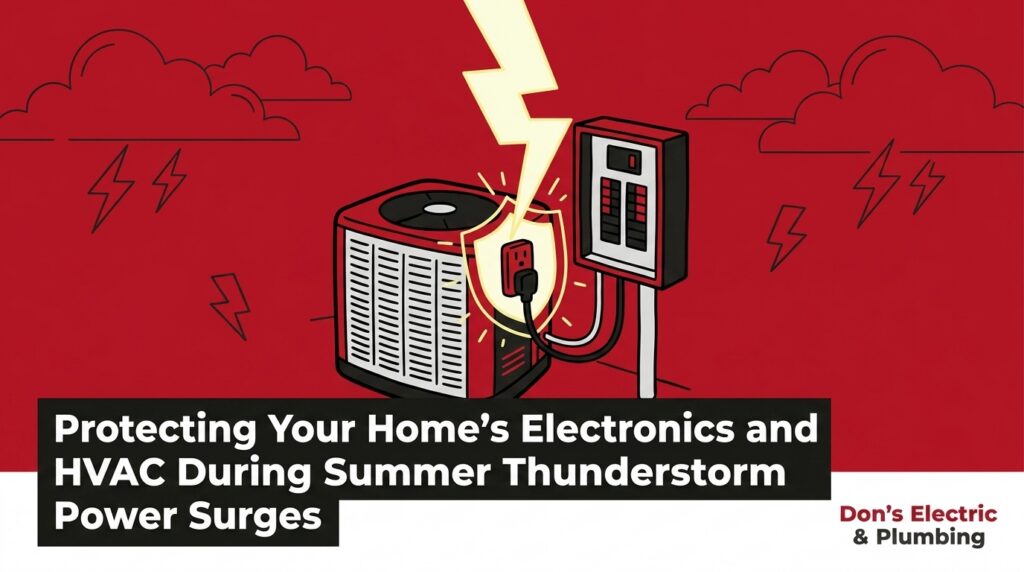
The Hidden Threat of Late-Afternoon Storms to Your Home’s Electrical Grid
Before the heavy weather hits, protecting your home’s electronics during summer thunderstorm power surges should be at the top of your seasonal to-do list. July in the Mohawk Valley brings intense heat and high humidity, creating the perfect atmospheric conditions for sudden, severe weather. Hot, stagnant summer days can rapidly destabilize, transforming into violent storm cells with little to no warning. In our years serving the Canajoharie community, we’ve seen how this rapid onset catches many homeowners entirely off guard, leaving their most expensive appliances and comfort systems fully exposed to catastrophic voltage spikes.
The concrete problem our team at Don’s Electric & Plumbing typically sees is a dangerous over-reliance on basic, point-of-use power strips. While these strips might stop a minor daily fluctuation, they leave major hardwired systems completely vulnerable when late-afternoon July electrical storms roll through the region. Upgrading from these basic plug-in strips to comprehensive, panel-level defense is the only way to truly secure your property. To establish a baseline of your current vulnerabilities, scheduling professional electrical and plumbing services is the most effective next step for comprehensive home defense.
Understanding the Anatomy of a Lightning-Induced Voltage Spike
To understand why standard defenses fail so spectacularly, you have to look at the sheer magnitude of a lightning strike. A typical strike can carry up to 300 million volts and 30,000 amps of electricity. This is a staggering amount of energy that actively seeks the path of least resistance to the ground. When you compare a massive storm-induced surge with the everyday minor voltage fluctuations caused by large appliances cycling on and off, the difference in destructive potential is astronomical.
A pattern we see often at Don’s Electric & Plumbing is homeowners assuming that their house must take a direct hit for damage to occur. The reality is that lightning does not need to strike your roof to destroy your appliances. When lightning hits a nearby utility pole, transformer, or even the ground miles away, it induces massive electrical surges that travel through the local grid. These extreme surges follow buried lines and local infrastructure right into the residential wiring of homes across Canajoharie NY.
Direct vs. Induced Surges
Understanding how voltage enters your home helps clarify why localized protection is inadequate. Surges generally fall into two categories during a severe weather event:
- Direct strikes: These occur when lightning physically contacts your home’s exterior, roof, or the utility pole directly feeding your property. The energy instantly overwhelms the electrical panel, often causing immediate structural fires and catastrophic melting of wires.
- Induced surges: These are far more common. Lightning strikes the ground or nearby infrastructure, and the residual energy travels through buried utility lines, coaxial cables, and grounding systems, silently entering your home and overloading sensitive circuits.
| Surge Type | Typical Voltage | Primary Cause | Risk to Home Systems |
|---|---|---|---|
| Daily Grid Fluctuations | 120V – 240V | Large appliances cycling on/off | Low (gradual wear and tear) |
| Grid Switching | Up to 1,000V | Utility company rerouting power | Moderate (can damage small electronics) |
| Induced Lightning Surge | 10,000V – 50,000V+ | Nearby lightning strikes | High (destroys microprocessors and boards) |
| Direct Lightning Strike | Up to 300,000,000V | Direct contact with property | Catastrophic (fire hazard, total system failure) |
The False Security of Standard Plug-In Power Strips
Our team frequently encounters the common misconception that buying a standard surge protector strip from a local hardware store is sufficient for storm protection. These point-of-use devices are rated in joules, which measure how much energy the strip can absorb before it fails. A typical strip might be rated for 1,000 to 2,000 joules. When a massive spike hits the grid during late-afternoon July electrical storms, that joule rating is exceeded in a fraction of a millisecond, blowing right past the strip and into your television or computer.
The operational reality of summer weather: Homeowners are rarely standing by their outlets, waiting to manually unplug devices when rapid weather changes occur. You might be at work, running errands, or simply asleep. Relying on manually disconnecting your devices is not a viable strategy for long-term protection.
Furthermore, the internal components of a power strip—specifically the Metal Oxide Varistors (MOVs)—degrade over time. Every small fluctuation they absorb chips away at their capacity. Often, they fail silently. The strip will still supply power to your devices, tricking you into thinking you are protected, even though the surge protection mechanism is completely dead. Most importantly, power strips only protect what is physically plugged into them, leaving the vast majority of your home’s infrastructure entirely exposed.

Why Hardwired Systems Like HVAC Control Boards Are Sitting Ducks
The most significant blind spot in residential electrical defense is the equipment that cannot be plugged into a power strip. Central air conditioning units, furnaces, water heaters, and integrated smart home hubs are hardwired directly into your electrical panel. Because they bypass point-of-use strips entirely, these vital systems are sitting ducks when grid fluctuations occur.
Modern home comfort systems are no longer just mechanical; they rely heavily on highly sensitive microprocessors. HVAC control boards orchestrate everything from blower motor speeds to refrigerant metering. These delicate circuits operate on precise voltage parameters. When a surge travels from the main electrical panel directly to a dedicated 240V appliance circuit, it instantly fries these microprocessors.
Leveraging our dual electrical and HVAC expertise at Don’s Electric & Plumbing, we frequently see exactly how electrical faults instantly compromise mechanical cooling systems. A fried control board doesn’t just mean a broken wire; it means the entire air conditioning system shuts down. This creates a compounding issue, as losing home cooling capabilities during the hottest, most humid weeks of the year forces homeowners into uncomfortable and potentially unsafe living conditions while waiting for emergency repairs. Protecting your HVAC control boards is just as critical as protecting your computers and televisions.
The Physics of Panel-Level Surge Interception
The definitive solution to securing your home is stopping the voltage spike before it ever enters your branch circuits. Whole-home surge protection devices (SPDs) are installed directly at the main electrical panel. When these devices detect a massive voltage spike entering from the utility lines, they act as a high-speed pressure relief valve.
Instead of trying to absorb millions of volts, the whole-home SPD safely shunts the excess electrical energy directly to the home’s grounding system, channeling it harmlessly into the earth. This mechanism of action protects all the hardwired systems in the house, including those sensitive HVAC control boards. This forms the foundation of “layered protection.” The panel-level device knocks down the massive external spikes, while your point-of-use strips handle the minor internal fluctuations caused by your own appliances.
Because this involves working directly with the main utility feed, our licensed electricians strongly warn that this is never a do-it-yourself project. Attempting panel modifications without a licensed professional carries extreme safety risks, including electrocution and property damage. Understanding the hidden fire risks of DIY electrical panel upgrades is critical before attempting any electrical work.
The Importance of Proper Grounding
A whole-home surge protector is only as effective as the home’s grounding system. If the excess energy has nowhere to go, the SPD cannot do its job.
- The grounding rod: The physical metal rod driven into the earth outside your home must be properly bonded and free of corrosion.
- Professional inspection: A licensed electrician must verify that your grounding system meets current electrical codes, ensuring the shunted energy has a clear, low-resistance path away from your home’s interior wiring.
A Seasonal Preparedness Checklist for Your Electrical System
Over our years of serving the Mohawk Valley, we’ve found that preparing your property for peak storm season requires actionable, proactive steps. Completing these tasks before the peak humidity and storm activity of mid-summer arrives will keep your home resilient against unpredictable weather patterns.
- Review your insurance policies: Check your homeowner’s insurance for specific clauses regarding surge and lightning damage coverage. Know what is covered before a disaster strikes.
- Audit existing plug-in surge protectors: Walk through your home and check the indicator lights on your power strips. If the “protected” light is off or flickering, the internal MOVs are depleted, and the strip must be replaced immediately.
- Trim exterior vegetation: Ensure trees and heavy branches are trimmed safely away from the overhead utility lines entering your home. Falling branches are a primary cause of localized surges and outages during late-afternoon July electrical storms.
- Schedule a professional panel evaluation: Have a licensed professional inspect your main electrical panel, check the integrity of your grounding system, and evaluate your current surge protection capabilities before the height of storm season.
Bridging the Gap Between Electrical Safety and Home Comfort
True protection requires a holistic view of your home’s infrastructure. Electrical resilience directly dictates HVAC reliability. You cannot have a dependable, efficient cooling system if the electrical foundation powering it is vulnerable to the elements. Our team at Don’s Electric & Plumbing knows firsthand that an expert understanding of both plumbing, HVAC, and electrical systems is required to fully protect a modern home in Canajoharie NY.
When you bridge this gap, you secure more than just wires and microprocessors. You ensure that your family remains comfortable, your investments hold their value, and your daily life is not interrupted by sudden mechanical failures. Knowing that your hardwired investments are shielded from unpredictable weather provides significant peace of mind as the summer storm season approaches.
Secure Your Home’s Electronics Before the Next Storm Hits
Weather is unpredictable, but your home’s electrical defense is entirely controllable. Do not wait for a catastrophic failure during the next heatwave to realize your current power strips are inadequate. Proactive steps taken today can save thousands of dollars in ruined appliances and emergency HVAC replacements.
If you are unsure whether your Canajoharie NY home is equipped to handle the next major weather event, it is time to contact our licensed electricians at Don’s Electric & Plumbing for a professional panel and surge protection assessment. Secure your home’s electronics and comfort systems today, before the next storm rolls in.
Frequently Asked Questions
Will a surge protector protect against a direct lightning strike?
The short answer is no; a direct lightning strike carries too much energy for any standard residential surge protector to stop completely. Direct strikes can exceed hundreds of millions of volts, which will bypass standard defenses and often cause physical damage to the structure. However, whole-home surge protectors are highly effective at stopping the much more common induced surges caused by nearby lightning strikes.
Should I unplug my TV and computers during a thunderstorm?
Yes, manually unplugging sensitive electronics is the only foolproof way to guarantee they will not be damaged by a power surge. If the device is physically disconnected from the wall, the electrical current cannot reach it. While whole-home surge protectors provide excellent defense, unplugging high-value items during severe, active lightning storms adds an extra layer of absolute security.
How do I protect my AC unit and HVAC control boards from a power surge?
Because HVAC systems are hardwired directly into your electrical panel, you cannot use standard plug-in power strips to protect them. In our experience, the only effective way to protect AC units and delicate control boards is by installing a whole-home surge protector at the main electrical panel. This device intercepts incoming voltage spikes and shunts them to the ground before they can travel down the dedicated 240V circuits to your mechanical equipment.
Does a whole house surge protector really work?
Yes, whole-house surge protectors are highly effective at regulating the power entering your home and blocking massive external spikes. They work by detecting excess voltage and instantly redirecting it into the earth via your home’s grounding wire. They are a proven, code-compliant technology used to protect expensive hardwired appliances and sensitive smart home infrastructure.
What are the signs that a power surge has damaged my electronics?
If you notice a burning smell near your outlets, that usually means a surge has melted internal wiring or components. Other common signs include devices that refuse to power on, blinking clocks on appliances, tripped circuit breakers that won’t reset, or HVAC systems that blow warm air because the control board is unresponsive. If you see scorch marks on your wall outlets, a severe surge has definitely occurred.
Can a power surge travel through plumbing or cable lines?
Yes, electrical surges will follow any conductive path of least resistance to find the ground. This includes coaxial cable lines, telephone wires, and even metal plumbing pipes if they are not properly bonded. This is why comprehensive surge protection must account for all utility entry points, not just the main electrical service line.