


Why Does the AC Keep Tripping the Breaker on the Hottest Days?
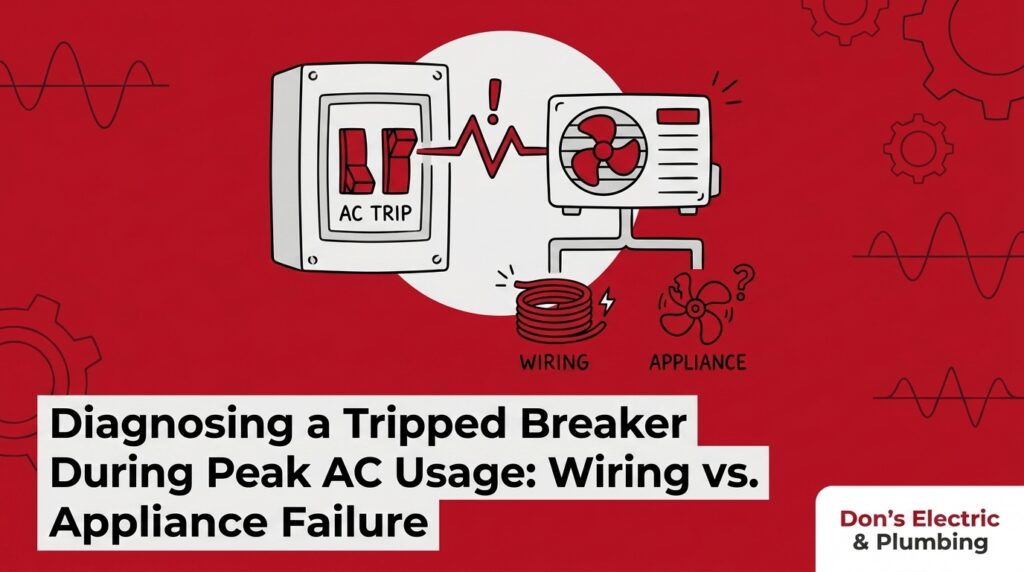
Why does the power always seem to cut out at the absolute worst possible time? If you are dealing with a sudden cooling loss, you are likely looking for answers on Diagnosing a Tripped Breaker During Peak AC Usage: Wiring vs. Appliance Failure. Losing power to your air conditioner during 95-degree peak summer heat is a stressful, concrete problem that demands an immediate solution. Here in Canajoharie, our team at Don’s Electric & Plumbing sees firsthand how Upstate NY summer heatwaves are notorious for sudden temperature spikes, creating intense household urgency when the indoor temperature starts climbing fast.
Before you panic, understanding the root cause is the first step. Whether your home requires comprehensive electrical and HVAC services or just a simple filter change, a logical diagnostic sequence can isolate the issue without guesswork. The primary diagnostic dilemma always comes down to one core question: is your heavy air conditioning appliance pulling too much power, or is your home’s electrical panel failing to deliver the electricity safely?
The quick takeaway: A tripped breaker is a safety mechanism doing exactly what it was designed to do. It prevents electrical fires. However, figuring out why it tripped requires looking closely at both the mechanical health of your cooling system and the physical condition of your circuit breakers.
The Physics of Your Electrical Panel During a Heatwave
To understand why your system fails on the hottest days, you have to look at how circuit breakers actually function. Standard residential circuit breakers are thermal-magnetic devices. This means they rely on heat to trigger their internal safety mechanisms. When electricity flows through a wire, it generates heat. If too much electricity flows, a bimetallic strip inside the breaker bends from the excess heat, physically snapping the circuit open and cutting the power.
Ambient Heat vs. Electrical Heat
The internal temperature of the breaker is not the only factor at play. The ambient temperature surrounding your electrical panel matters just as much. When 95-degree peak summer heat settles over Upstate New York, we often find that the air inside a Canajoharie garage, basement, or utility room heats up significantly. This external heat transfers to the metal components inside your electrical panel.
Because the breaker is already sitting in a hot environment, it takes far less electrical heat to bend that internal bimetallic strip. The breaker’s actual trip threshold is temporarily lowered by the weather. When you run the air conditioner for hours on end to fight the heat, you risk overloading your home electrical system because the combined ambient heat and electrical heat push an aging breaker past its limits.
The 80 Percent Continuous Load Rule
The National Electrical Code (NEC) has specific guidelines for appliances that run for long periods. Any electrical device that operates for three hours or more is classified as a “continuous load.” Central air conditioners easily fall into this category during July heatwaves.
The NEC 80% Rule states:
- A continuous load must not exceed 80% of the circuit breaker’s maximum rating.
- If you have a dedicated 20-amp breaker for an AC component, that component should pull no more than 16 amps of continuous current.
- If a system pulls 18 amps on a 20-amp breaker for four straight hours, the breaker will eventually overheat and trip, even though it never crossed the 20-amp maximum.
This rule exists precisely because continuous heat degrades electrical components over time. Proper sizing of the dedicated circuit is vital for keeping your system online during peak usage.
Appliance Failure: When the Air Conditioner Pulls Too Much Power
Sometimes, the electrical panel is in perfect condition, and the fault lies entirely with the HVAC equipment. When mechanical components wear out, they require significantly more electrical energy to perform the same amount of work. This excess power demand travels straight back to the electrical panel, resulting in a tripped breaker.
Understanding Locked Rotor Amps (LRA)
Every air conditioning compressor has two different electrical ratings: Running Load Amps (RLA) and Locked Rotor Amps (LRA). RLA is the normal amount of electricity the system uses while actively cooling your home. LRA is the massive surge of power required to jump-start the heavy compressor motor from a dead stop.
The compressor amp draw at startup is always the most stressful electrical event in your home. Normally, this surge lasts for less than a second. However, if the compressor is mechanically failing, binding up, or struggling against high refrigerant pressures, the motor physically cannot turn. When the motor is “locked,” it continues pulling that massive LRA current—which can be 5 to 7 times the normal running current. The breaker detects this massive, prolonged surge and trips instantly to prevent the wiring from melting.
Failing Capacitors and Hard Starts
In our daily service calls, the most common cause our technicians find for high compressor amp draw at startup is a failing dual run capacitor. The capacitor acts like a heavy-duty battery that delivers a precise jolt of electricity to help the compressor motor start spinning.
Symptoms of a bad capacitor include:
- A humming or buzzing sound: The outdoor unit receives power but the motor cannot start.
- Intermittent tripping: The breaker holds during the cool morning but trips during the afternoon heat.
- Delayed cooling: The indoor fan blows warm air while the outdoor unit struggles to engage.
When the capacitor weakens, the compressor is forced to pull all of its startup power directly from your home’s electrical panel, which easily overwhelms the breaker.
Airflow Restrictions and Overheating
Many homeowners are surprised to learn that a dirty air filter can cause an electrical breaker to trip. The process is a chain reaction of thermal stress. When an air filter is heavily clogged with dust and pet dander, the indoor blower motor has to work twice as hard to pull air through the system.
Simultaneously, the lack of warm return air flowing over the indoor evaporator coil causes the refrigerant inside to remain too cold. This cold refrigerant travels back outside to the compressor. The compressor is forced to pump liquid instead of vapor, causing it to overwork, overheat, and draw excess amperage until the breaker finally cuts the power.
Wiring and Panel Issues: Recognizing a Weakened Breaker
If the air conditioner checks out perfectly, the diagnostic focus must shift to the electrical infrastructure. Electrical panels are not invincible. Decades of heavy summer usage take a physical toll on the metal components inside the breaker box.
Thermal-Magnetic Breaker Fatigue
Standard circuit breakers have a finite lifespan. Every time a breaker trips, and every time it is subjected to 95-degree peak summer heat while carrying a heavy continuous load, the internal bimetallic strip weakens slightly. Over ten or fifteen years, this strip loses its precise calibration.
A fatigued breaker will suffer from “nuisance tripping.” This means the breaker will snap open even when the air conditioner is pulling a completely normal, safe amount of electricity. The breaker has simply become too sensitive and can no longer hold the load it was rated for.
Loose Connections and Arcing
Electrical wires expand slightly when they get hot and contract when they cool down. Over thousands of heating and cooling cycles, the terminal screws holding the wires inside the breaker panel can slowly back out and become loose.
The danger of loose connections:
- High resistance: Electricity struggles to jump across the tiny gap of a loose connection.
- Micro-arcing: The electricity sparks across the gap, generating intense, localized heat.
- Panel damage: This heat travels directly into the breaker, causing it to trip, and can eventually melt the plastic casing of the breaker itself.
Securing these connections requires professional intervention. Getting top rated electric repair ensures that all terminal lugs are torqued to the manufacturer’s exact specifications, eliminating the risk of hidden arcing.
Safe Diagnostic Steps for Homeowners
When you lose cooling during a heatwave, the instinct is to march down to the basement and forcefully flip the breaker back on. However, dealing with high-voltage appliances requires strict safety protocols. Follow these actionable steps to safely assess the situation without putting your home at risk.
- Turn off the thermostat: Before touching the electrical panel, go to your thermostat and set the system to “OFF”. You never want a heavy appliance trying to draw power the exact second you flip a breaker.
- Reset the breaker exactly once: Open your electrical panel. Locate the tripped breaker (it will be resting in the middle position, neither fully ON nor fully OFF). Push it firmly to the OFF position until it clicks, then push it firmly to the ON position. Never reset a breaker multiple times. If it trips again immediately, you have a hard short circuit. Forcing it on can cause a catastrophic electrical fire.
- Inspect the indoor air filter: Pull out your HVAC filter. If you hold it up to a light and cannot see any light shining through, it is severely restricted. Replace it immediately to rule out airflow-induced overheating.
- Listen to the outdoor unit: Turn the thermostat back to “COOL”. Walk outside and listen to the condenser. If you hear a loud buzzing or clicking every few seconds, but the fan blades are not spinning, the compressor amp draw at startup is failing. Turn the system off immediately to prevent permanent motor damage.
- Keep the panel closed: Never remove the metal dead-front cover of your electrical panel to inspect the wires yourself. High-voltage bus bars carry enough current to cause fatal injury.
If your system fails these basic checks and the breaker refuses to hold, you need professional intervention. Scheduling same day electric repair ensures the problem is diagnosed before the heat of the day peaks.
The Diagnostic Dilemma: Solving the Root Cause Without Guesswork
The most frustrating scenario for a homeowner is paying a diagnostic fee to an HVAC technician, only to be told, “The AC is fine, you need to call an electrician.” Days later, the electrician arrives, inspects the panel, and says, “The panel is fine, your AC is pulling too many amps.” This finger-pointing wastes time, money, and leaves you sweating in your living room.
Don’t guess whether it’s an HVAC or electrical issue. Because we’ve spent years working on local homes, our team knows this frustration well. As a multi-trade contractor, Don’s Electric & Plumbing is uniquely equipped to diagnose the true root cause without finger-pointing between different companies. A dual-trade expert can test both the mechanical appliance and the electrical infrastructure during a single visit.
Comparing the Symptoms
| Symptom Observed | Likely Appliance Failure | Likely Electrical Failure |
|---|---|---|
| Breaker trips instantly upon startup | Grounded compressor or hard short in wiring | Dead short in the dedicated circuit wire |
| Breaker trips after 3-4 hours of running | Dirty filter causing slow overheating | Weakened thermal-magnetic breaker fatigue |
| Outdoor unit buzzes loudly before tripping | Failed run capacitor or locked rotor | Low voltage reaching the disconnect box |
| Breaker feels hot to the touch in the panel | Compressor pulling excessive running amps | Loose terminal connection causing arcing |
By measuring the exact compressor amp draw at startup and simultaneously testing the voltage drop at the breaker panel, a multi-trade professional eliminates the guesswork. This holistic approach saves time and ensures that the root cause is permanently resolved.

Frequently Asked Questions About AC and Electrical Trips
Should I call an electrician or HVAC for AC tripping breaker?
You should call a multi-trade contractor who handles both electrical and HVAC services to avoid paying for two separate diagnostic visits. If you must choose one, starting with an electrician is often safer to verify the integrity of your electrical panel and ensure there are no fire hazards before assuming the air conditioner is completely dead. They can quickly test the breaker’s capacity under a load.
Why does my AC trip the breaker on hot days?
Your AC trips the breaker on hot days due to a combination of prolonged continuous electrical loads and elevated ambient temperatures. When the air surrounding your electrical panel heats up, it lowers the trip threshold of the thermal-magnetic breaker inside. Furthermore, the air conditioner runs for longer cycles to fight the heat, generating continuous electrical heat that eventually pushes a weakened breaker past its limit.
How to tell if a circuit breaker is weak?
You can tell a circuit breaker is weak if it feels unusually hot to the touch, trips under completely normal electrical loads, or fails to reset firmly with a solid click. A weakened breaker may also emit a faint buzzing sound or smell slightly like burning plastic. If a breaker frequently trips but the appliance it serves tests perfectly normal, the breaker’s internal bimetallic strip is likely fatigued.
Is it safe to reset a tripped AC breaker?
It is generally safe to reset a tripped AC breaker exactly one time to see if a temporary power surge caused the fault. However, if the breaker immediately trips again, it is extremely dangerous to repeatedly force it back on. Continuously resetting a tripping breaker bypasses its safety function and can cause catastrophic damage to the compressor motor or ignite an electrical fire inside your walls.
How long does an AC breaker typically last?
A standard circuit breaker typically lasts between 15 to 30 years under normal operating conditions. However, breakers dedicated to heavy continuous loads like air conditioners can wear out much faster, especially in regions with intense summer heatwaves. Frequent tripping, power surges, and loose connections can significantly reduce a breaker’s safe operational lifespan.
Can a dirty air filter cause the breaker to trip?
Yes, a severely dirty air filter can cause the breaker to trip by heavily restricting the airflow through the system. This restriction forces the indoor blower motor to work harder and causes the indoor evaporator coil to freeze. The frozen coil sends cold liquid refrigerant back to the outdoor compressor, causing the compressor to overheat, draw excess amperage, and eventually trip the electrical breaker.
Getting the Right Fix for Your Home Cooling and Power
When you are faced with Diagnosing a Tripped Breaker During Peak AC Usage: Wiring vs. Appliance Failure, taking a calm, methodical approach is essential. A clear diagnostic sequence helps isolate the issue directly to the electrical panel or the mechanical appliance. Whether your system is struggling against 95-degree peak summer heat or dealing with decades of electrical fatigue, ignoring the warning signs only leads to more expensive repairs.
Emphasize long-term safety by relying on professional testing rather than temporary DIY resets. A thorough evaluation of both your home’s electrical infrastructure and your cooling system’s compressor amp draw at startup will provide the definitive answers you need. Secure your home’s comfort and safety by scheduling an expert diagnostic evaluation today.