


Why New York State Electrical Code Requirements for Homeowners Matter
Understanding New York State electrical code requirements for homeowners could be the difference between a safe home and a serious hazard. Non-compliant residential wiring is a leading cause of house fires across the United States — and New York has specific rules that go beyond the national baseline.
Here are the key code requirements every New York homeowner should know:
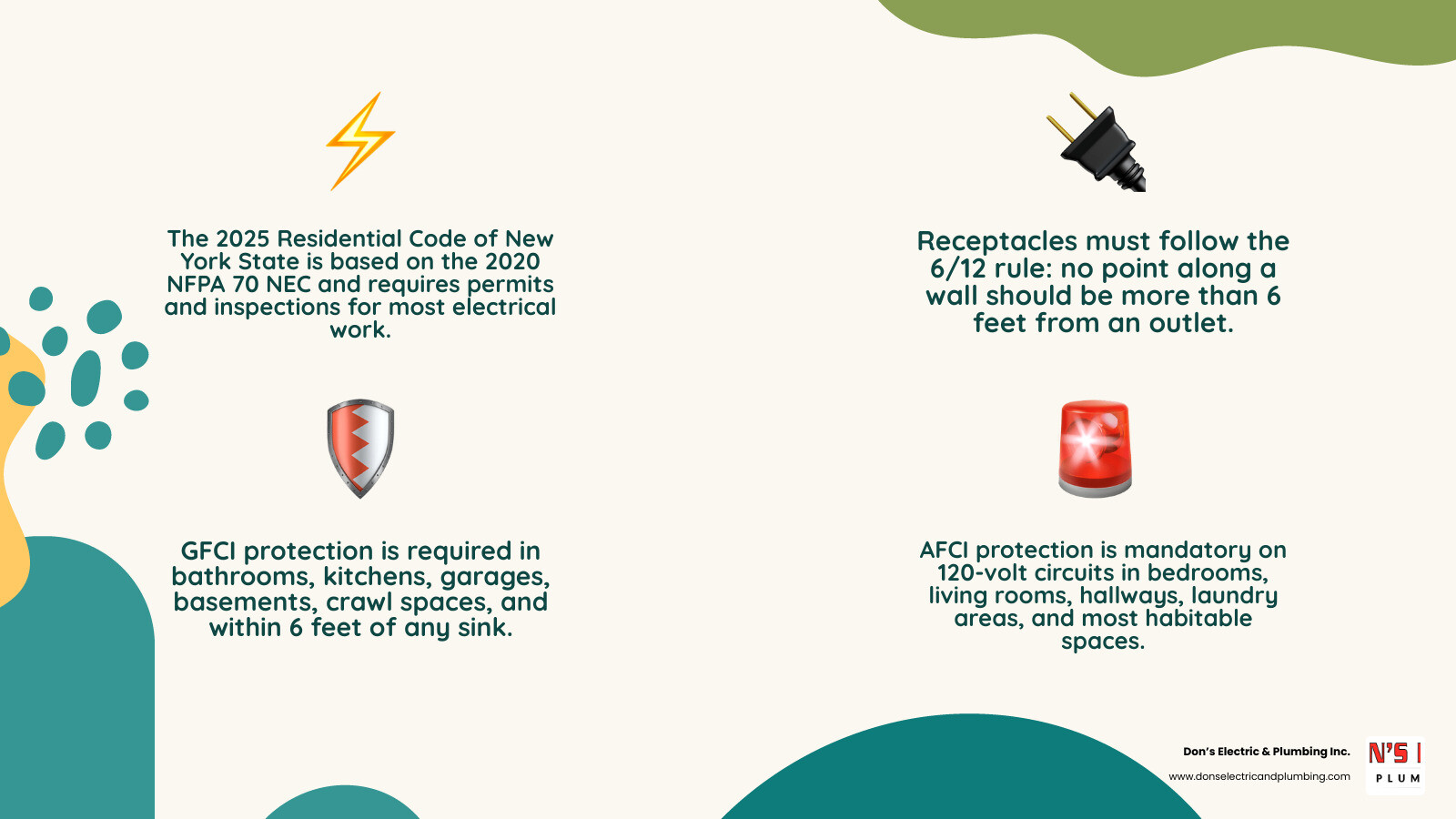
- Current code: The 2025 Residential Code of New York State (based on the 2020 NFPA 70 NEC) governs most of the state; New York City uses its own 2025 NYC Electrical Code, effective December 21, 2025
- Outlet spacing: No point along any wall should be more than 6 feet from a receptacle (the 6/12 rule)
- Kitchen countertops: Receptacles must be spaced no more than 24 inches apart and served by at least two 20-amp circuits
- GFCI protection: Required in bathrooms, kitchens, garages, outdoors, basements, crawl spaces, and within 6 feet of any sink
- AFCI protection: Required on 120-volt branch circuits serving bedrooms, living rooms, hallways, laundry areas, and most other living spaces
- Tamper-resistant receptacles: All standard receptacles in a home must be tamper-resistant (TR) type
- Permits and inspections: Most electrical work beyond simple fixture swaps requires a permit and a licensed electrician — no blanket DIY exemption exists in New York State
- Solar installations: Photovoltaic systems require permits, inspections, and utility Permission to Operate (PTO) before activation
- Hallways: Any hallway longer than 10 feet must have at least one receptacle outlet
- Dedicated circuits: Major appliances like electric ranges, clothes dryers, and dishwashers require their own dedicated circuits
Whether you’re renovating a kitchen, finishing a basement, or just replacing old outlets, knowing these rules protects your family, your home’s resale value, and your insurance coverage.
New york state electrical code requirements for homeowners terms you need:
- consequences of electrical work without a permit
- do i need a permit for electrical work in new york
- new york building code for home electrical work
Understanding the New York State Electrical Code Requirements for Homeowners
When it comes to home improvement, electricity is the one area where you absolutely cannot afford to wing it. In New York, safety guidelines are structured to prevent electrical shocks, overloads, and house fires. The primary framework governing residential structures across upstate New York—including Montgomery, Fulton, Herkimer, and Schoharie counties—is the 2025 Residential Code of New York State.
This state code incorporates the standards of the National Electrical Code (NEC), specifically the 2020 NFPA 70, with state-specific amendments. While the NEC is updated every three years by the National Fire Protection Association, New York adopts and amends these versions to fit the unique environmental and structural needs of our local communities.
Familiarizing yourself with these rules is essential for any renovation. If you are planning an upgrade, reading up on Mastering the New York Residential Electrical Code will give you a solid foundation before you start pulling permits or hiring a team.
How NYS Code Differs From the National Electrical Code (NEC)
While the National Electrical Code serves as the baseline for safety across the country, New York State does not always adopt every NEC update immediately or without changes. Instead, the state reviews the NEC and implements specific amendments that make sense for New York’s diverse climate and housing stock.
For instance, down in New York City, the local government enforces its own distinct set of guidelines. The 2025 NYC Electrical Code took full effect on December 21, 2025, bringing highly specific updates to the five boroughs. However, for homeowners in our neck of the woods—such as Canajoharie, Broadalbin, and Sharon Springs—we follow the statewide Uniform Code. The state-level amendments focus heavily on local climate resilience, specific wiring methods, and streamlined permitting processes for rural and suburban properties.
How Local Municipal Codes Interact with New York State Electrical Code Requirements for Homeowners
One of the most common points of confusion for homeowners is who actually enforces the code. While the State of New York establishes the overarching building and electrical standards, the primary responsibility for administration and enforcement lies with your local municipality.
Your town, village, or county building department acts as the Authority Having Jurisdiction (AHJ). This means that if you live in Palatine, Minden, or Middleburgh, your local code enforcement officer is the person who issues permits, reviews plans, and conducts the physical inspections. Local jurisdictions can also enforce stricter requirements than the state baseline. For example, some municipalities may restrict the use of certain wiring materials or have specific requirements for trench depth when running power to an outdoor garage. Always check with your local building office before starting any project.
Room-by-Room Receptacle and Spacing Rules
Have you ever had to use three different extension cords just to plug in a lamp across the room? Electrical codes are designed to eliminate this exact inconvenience, which is actually a major fire hazard. The code dictates exactly where outlets must be placed to ensure you never have to stretch a cord too far.
| Room Area | Maximum Spacing Along Wall / Countertop | Key Requirement |
|---|---|---|
| General Living Space | 12 feet (6-foot rule) | No point on a wall can be more than 6 feet from an outlet. |
| Kitchen Countertops | 4 feet (24-inch rule) | No point along the wall line can be more than 24 inches from an outlet. |
| Hallways | At least 1 outlet | Required if the hallway is over 10 feet long. |
| Bathrooms | Within 36 inches of sink | Must be on a dedicated 20-amp circuit with GFCI protection. |
General Wall Spacing and the 6/12 Rule
For habitable rooms—such as bedrooms, living rooms, and family rooms—the state code enforces the classic 6/12 rule. This rule states that a receptacle must be installed so that no point measured horizontally along the floor line of any wall space is more than 6 feet from an outlet.
Practically, this means you can place an outlet, walk 12 feet along the wall, and place the next one. This ensures that any standard 6-foot appliance cord can reach an outlet without the use of an extension cord. Any wall space that is 2 feet or wider must have its own outlet. Additionally, floor receptacles only count toward this spacing requirement if they are located within 18 inches of the wall.
For transition spaces, the rules are slightly different. A hallway that is over 10 feet long is required to have at least one general-purpose outlet to prevent homeowners from running cords through doorways.
Kitchen Countertop and Work Surface Spacing
Kitchens are high-energy zones that require much stricter spacing rules due to the abundance of small, high-draw appliances like blenders, toasters, and coffee makers.
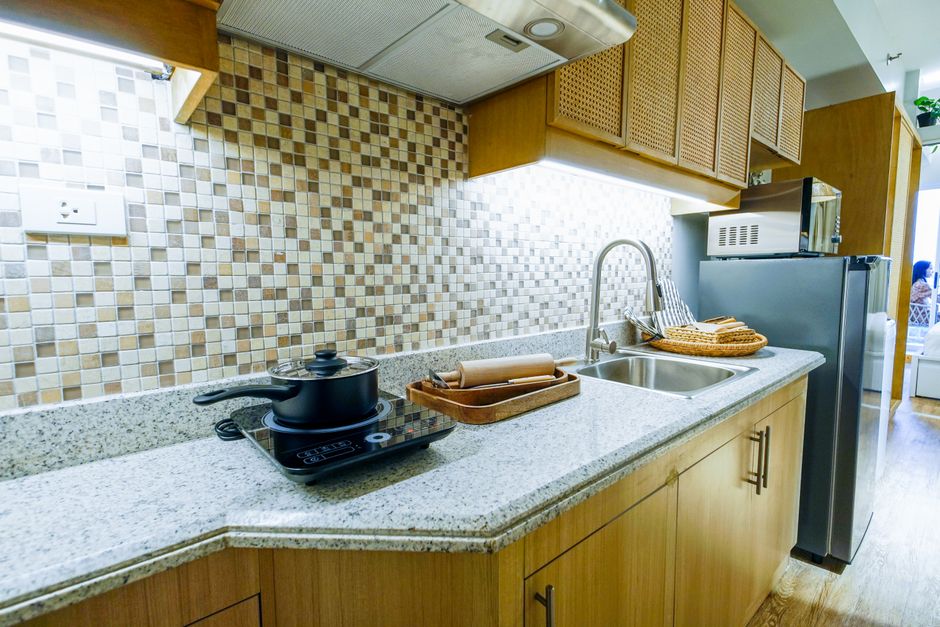
Along kitchen countertops, the spacing rule drops from 12 feet down to 4 feet. This is known as the 24-inch rule: no point along the countertop wall space can be more than 24 inches from a receptacle outlet. Any countertop space that is 12 inches or wider requires an outlet.
To power these devices safely, the code mandates that kitchen countertop receptacles must be supplied by at least two dedicated 20-amp small-appliance branch circuits. These circuits cannot serve any lighting fixtures or outlets in other rooms. If you have a kitchen island or a peninsular countertop, you must also install at least one receptacle to serve these work surfaces, ensuring cords do not drape over the edges where children could pull them.
GFCI and AFCI Protection Requirements
Modern electrical codes rely heavily on advanced safety devices to protect your home from two distinct electrical dangers: shocks and fires. These are handled by GFCIs and AFCIs.
GFCI Protection Mandates for Wet and Damp Areas
A Ground-Fault Circuit-Interrupter (GFCI) is designed to protect people from electrical shock. It constantly monitors the balance of electrical current moving through a circuit. If it detects even a tiny leak of current—such as electricity flowing through water or a person—it cuts the power in milliseconds.
Under the New York State code, GFCI protection is strictly mandated for 125-volt through 250-volt receptacles in the following locations:
- Bathrooms: All receptacles, which must also be located within 36 inches of the outside edge of each sink basin.
- Kitchens: All receptacles serving the countertop surfaces, as well as any outlet within 6 feet of the kitchen sink.
- Garages and Accessory Buildings: All receptacles in both finished and unfinished garage spaces.
- Outdoors: All exterior outlets, which must be installed no higher than 6 feet 6 inches above the ground and feature weatherproof covers.
- Basements and Crawl Spaces: All receptacles in unfinished basements and crawl spaces at or below grade level.
AFCI Protection for Residential Branch Circuits
While GFCIs protect people from shocks, Arc-Fault Circuit-Interrupters (AFCIs) protect homes from electrical fires. An arc fault occurs when electricity jumps across damaged or loose wires (often caused by a nail driven through a wall or a frayed appliance cord), creating intense heat that can easily ignite surrounding wood or insulation.
The state code requires AFCI protection for all 120-volt, single-phase, 10-, 15-, and 20-ampere branch circuits supplying outlets in almost all living areas. This includes bedrooms, family rooms, dining rooms, living rooms, sunrooms, libraries, dens, closets, hallways, and laundry areas. AFCI protection is typically achieved by installing specialized AFCI circuit breakers directly in your main electrical panel.
Tamper-Resistant Receptacles and Safety Devices
If you have young children or grandchildren visiting your home in Fulton or Schoharie County, you know they love to explore. To prevent children from inserting keys, hairpins, or paperclips into electrical outlets, New York State requires all standard 15-amp and 20-amp, 125-volt receptacles in residential spaces to be tamper-resistant (TR).
Tamper-resistant receptacles look identical to standard outlets but feature built-in, spring-loaded safety shutters behind the entry slots. These shutters will only open when equal pressure is applied to both slots simultaneously—such as when you plug in a standard two-pronged electrical plug. If a child attempts to stick an object into just one slot, the shutter remains locked, preventing contact with live electrical parts.
Lighting, Switches, and Dedicated Appliance Circuits
A safe electrical system requires a careful balance between general-use lighting and the heavy electrical loads demanded by modern household appliances.
Lighting Outlets and Switch Locations
New York State code ensures that you never have to walk into a dark room to find a light switch. At least one wall-switch-controlled lighting outlet must be installed in every habitable room, kitchen, bathroom, hallway, and attached garage.
For stairways, safety is paramount. If a stairway has six or more risers (steps), the code requires a wall switch at both the top and bottom of the stairs to control the lighting. This prevents homeowners from having to navigate dark stairs to turn off a light. Similarly, any walk-in closets or utility spaces must have a light fixture installed, though these must follow strict clearance rules to keep hot lightbulbs away from combustible clothing or storage boxes.
Dedicated Circuits for Major Household Appliances
Not all outlets are created equal. High-draw appliances draw so much current that they can easily overload a standard shared circuit, tripping your breakers constantly. For safety and reliability, the code requires dedicated circuits—meaning a single circuit that serves only one specific appliance—for major household systems:
- Electric Ranges and Cooktops: Typically require a heavy-duty 240-volt, 40-amp or 50-amp circuit.
- Clothes Dryers: Require a dedicated 240-volt, 30-amp circuit.
- Dishwashers and Trash Compactors: Must have their own dedicated 120-volt circuits, and the dishwasher circuit must be GFCI-protected.
- Garages: Newly constructed garages require at least one dedicated 120-volt, 20-amp circuit that serves only the garage receptacles.
- HVAC Equipment: Furnaces, heat pumps, and central air conditioning systems require dedicated circuits sized to the equipment’s specific electrical load.
Permits, Inspections, and Solar Regulations
Many homeowners wonder if they can skip the paperwork and just get to work. However, skipping the permitting process can have serious long-term consequences for your wallet and your safety.
Navigating Permits and Inspections for New York State Electrical Code Requirements for Homeowners
In New York, any electrical work that involves adding a new circuit, running new wiring, upgrading an electrical panel, or installing major equipment requires a permit from your local building department. If you are wondering about the specific rules for your next home improvement project, take a look at our guide on when you need a permit for New York electrical projects.
Once a permit is issued, the work must undergo a strict inspection sequence:
- Rough-In Inspection: This occurs after all boxes, cables, and conduits are installed, but before the walls are closed up with drywall or insulation. The inspector verifies wire sizing, box depth, and proper securing of cables.
- Service Inspection: If you are upgrading your electrical panel (for example, from 100-amp to 200-amp service), the inspector must approve the new panel and grounding system before the utility company will connect the power.
- Final Inspection: This takes place after the drywall is finished, all outlets, switches, and light fixtures are installed, and the system is fully operational.
Trying to bypass this process can lead to severe fines, municipal stop-work orders, and major hurdles when you eventually try to sell your home. Learn more about the consequences of electrical work without a permit in New York to protect your investment.
Electrical Code Requirements for Solar Panel Installations
Solar energy is booming across upstate New York, from the hills of Schoharie County to the valleys of Montgomery County. However, installing solar panels involves connecting a powerful generator directly to your home’s electrical system.
All solar installations must comply with both the NYS Residential Code and NEC Article 690. Key requirements include:
- UL Listed Equipment: All solar panels, inverters, and rapid-shutdown devices must be listed and labeled by an approved testing laboratory.
- Rapid Shutdown Capability: Solar systems must feature an easily accessible emergency shutoff switch that allows firefighters to quickly de-energize the solar array on your roof in the event of an emergency.
- Utility Approval: Before your solar system can be turned on, the local utility provider (such as National Grid or NYSEG) must conduct an interconnection review and issue Permission to Operate (PTO).
Frequently Asked Questions about NYS Electrical Codes
What is the current New York State Electrical Code and when did it take effect?
The current statewide standard is the 2025 Residential Code of New York State, which incorporates the 2020 edition of the National Electrical Code (NFPA 70) with specific New York amendments. For those living in the five boroughs of New York City, the separate 2025 NYC Electrical Code took full effect on December 21, 2025.
Can a homeowner do their own electrical work in New York?
There is no universal state-level rule that allows or prohibits DIY electrical work. Instead, this is decided entirely by your local municipality. Some towns in our region allow homeowners to perform electrical work on their primary, owner-occupied residence, provided they obtain a permit and pass all required inspections. Other municipalities restrict all electrical work strictly to licensed electrical contractors. Always consult your local building inspector first.
How many outlets can be on a single 20-amp circuit?
For general-purpose lighting and receptacle circuits, a 20-amp circuit can support up to 10 outlets. This calculation is based on a safety standard where each outlet is assumed to draw 1.5 amps, and the total continuous load on the circuit is limited to 80% of its maximum capacity (which is 16 amps for a 20-amp circuit).
Conclusion
Navigating the complexities of local and state electrical codes can feel overwhelming, but these rules exist to keep your home comfortable, efficient, and—most importantly—safe. From the 6/12 spacing rule to the strict requirements of GFCI and AFCI protection, keeping your home compliant is the best way to protect your family and your property value.
While we handle everything from residential electrical upgrades to specialized plumbing regulations, including Navigating New York Regulations for Commercial Well and Plumbing Repairs, our passion is keeping local homes safe. Since 1984, Don’s Electric & Plumbing Inc. has been the trusted, family-owned choice for homeowners throughout Montgomery, Fulton, Schoharie, Herkimer, and Hamilton counties. We stand behind our work with a 100% satisfaction guarantee, offering emergency services and flexible financing options to fit your budget.
Don’t guess when it comes to the safety of your home’s wiring. Schedule professional electrical services with Don’s Electric & Plumbing Inc. today, and let our family take care of yours!