


Your Pets Are Changing How Often Your HVAC Filter Needs to Be Replaced
How pets affect how often you change your filter is one of the most overlooked parts of home HVAC maintenance — and getting it wrong can quietly cost you money, comfort, and clean air.
Here’s the short answer:
| Household Type | Recommended Filter Change Frequency |
|---|---|
| No pets | Every 90 days |
| One small or light-shedding pet | Every 60 days |
| One large dog or multiple pets | Every 30-45 days |
| Heavy shedders or allergy sufferers | Every 15-30 days |
If you have a dog or cat at home, the standard 90-day filter replacement rule simply doesn’t apply to you. Pets shed fur and microscopic skin flakes called dander continuously. That material gets pulled into your HVAC system every time air circulates through your home. According to industry data, pet households can reach filter capacity in roughly half the time of pet-free homes — sometimes in as little as 15 to 30 days instead of the typical 30 to 90.
There are now an estimated 163.6 million cats and dogs living in U.S. homes. That’s a lot of fur in a lot of filters. And in a place like Canajoharie, NY — where windows stay shut for much of the year and your furnace runs hard through long winters — that buildup happens even faster.
This guide breaks down exactly what the right filter schedule looks like for your household, which filter types work best for pet owners, and what warning signs to watch for before your HVAC system starts to struggle.
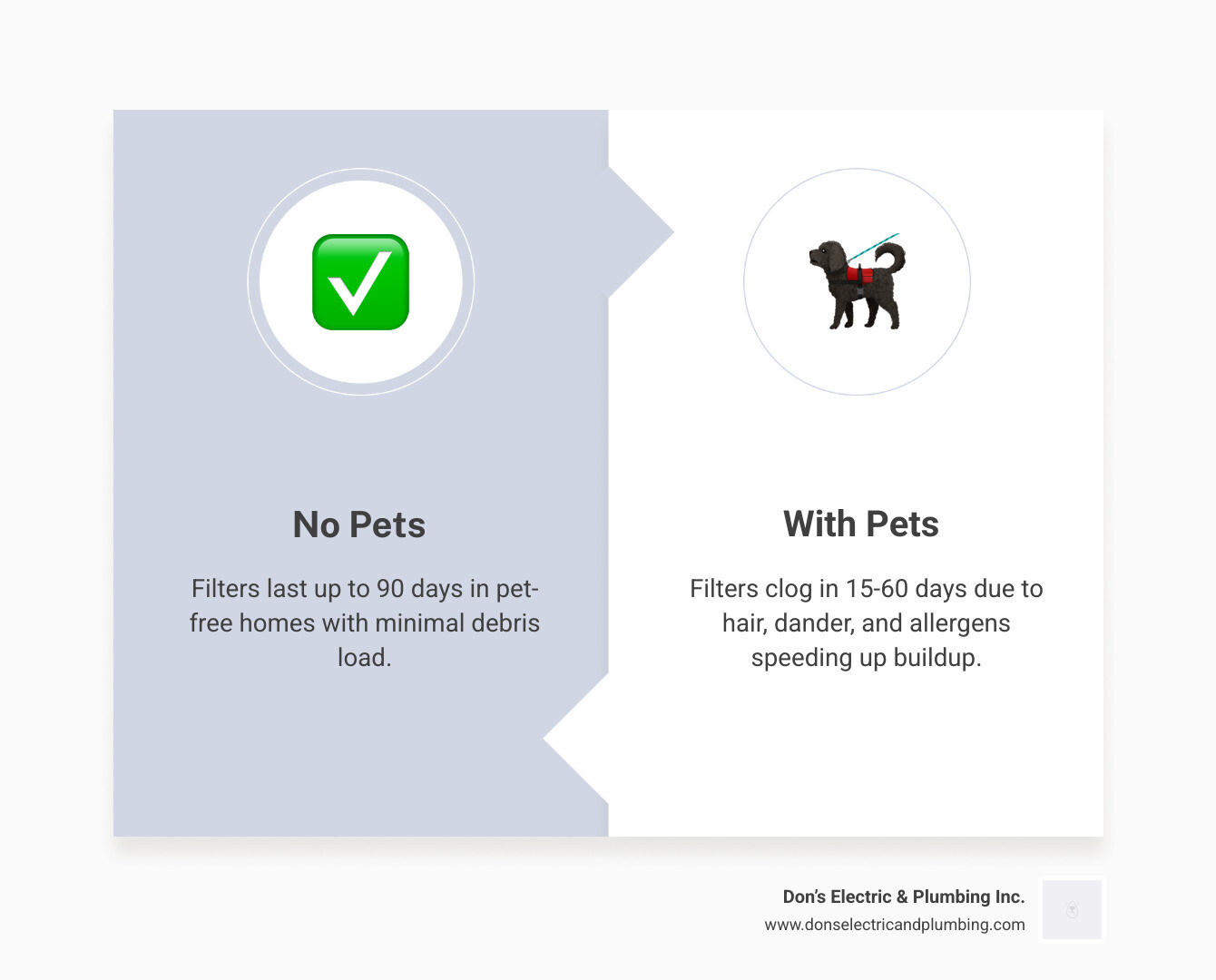
How Pets Affect How Often You Change Your Filter
Pets do not just leave hair on the couch. They also load your HVAC filter faster than most homeowners expect.
Every time your system runs, return vents pull in indoor air along with floating pet hair, dander, dust, and whatever your dog tracked in after a romp through the yard. Some of that debris settles in ducts, but a lot of it lands on the filter. As buildup increases, airflow drops. Then your furnace or AC has to work harder to move the same amount of air.
That is the core of how pets affect how often you change your filter: more debris in the air means faster filter loading, more airflow restriction, and more frequent replacement.
For a pet-free home, replacing the filter every 90 days is a common baseline. For a pet household, monthly checks are the smarter rule. In many homes with dogs or cats, the filter will be ready for replacement long before the manufacturer’s maximum timeline.
Why pet hair and dander clog filters faster
Pet hair is the obvious culprit, but dander is often the bigger issue.
Hair is larger and easier to see. It can mat across the filter surface and block airflow quickly, especially near the center where air velocity is strongest. Dander is much smaller. These tiny skin flakes stay airborne longer and get trapped deeper in pleated filter media. Together, they fill up the filter much faster than ordinary household dust alone.
A few reasons this happens so quickly:
- Pets shed every day, even when it is not obvious
- Dander is lightweight and easily pulled into return vents
- Active pets stir up settled dust and hair from floors and furniture
- Pleated filters catch more particles, which is good for air quality but means they can load faster in pet homes
- In winter and summer, longer HVAC runtime means more air moving through the filter
The result is a filter that may look dingy gray, fuzzy, or matted far sooner than expected.
Baseline schedule: pet-free homes vs homes with pets
Here is a practical schedule we recommend homeowners use as a starting point:
- No pets: every 90 days
- One pet: about every 60 days
- One large dog or multiple pets: every 30 to 45 days
- Heavy shedders, multiple pets, or allergy households: every 15 to 30 days
Manufacturer timelines are a baseline, not a guarantee. A filter rated for three months may not last three months in a home with two shedding dogs, a cat, and a furnace running daily through a Montgomery County winter.
The safest habit is simple: inspect the filter every month, no matter what the packaging says.
The Right Filter Change Schedule for Your Pet Household
The right schedule depends on more than whether you own a pet. It also depends on how many pets live in the home, how much they shed, how large your house is, how often the system runs, and whether anyone has allergies or asthma.
Here is a useful quick-reference table.
| Pet Household Situation | Suggested Replacement Timing |
|---|---|
| One small or low-shedding pet | Every 60 days |
| One large dog | Every 30-45 days |
| Two or more pets | Every 20-45 days |
| Heavy-shedding breed | Every 15-30 days |
| Pets plus allergies or asthma | Every 15-30 days |
| Heavy shedding season or heavy winter HVAC use | Check monthly, often replace sooner |
A larger house may spread particles over more space, but it may also have more return vents and longer system runtime. A smaller home with two pets can actually load a filter very quickly because the concentration of hair and dander is higher.
How pets affect how often you change your filter based on number, size, and breed
Not all pets affect filters the same way.
One small, light-shedding pet may only shorten the filter cycle from 90 days to 60 days. But one large dog can have the same impact as multiple smaller pets if it sheds heavily and spends lots of time indoors near return vents.
A few general patterns:
- One small pet: usually every 60 days
- One large dog: often every 30 to 45 days
- Two or more pets: often every 20 to 45 days
- Heavy shedders: often monthly, sometimes sooner
Breeds known for heavier shedding, like Huskies or German Shepherds, can shorten filter life dramatically. Long-hair breeds and double-coated breeds tend to create more visible fur, while some short-hair breeds may shed finer material that still ends up in the filter even if you notice less of it on the floor.
Cats can be tough on filters too, especially in smaller homes. Fine fur and dander circulate easily, and if you have multiple cats, the filter may load faster than many homeowners expect.
How pets affect how often you change your filter during shedding season and winter
Spring and fall shedding season can turn a normal filter schedule upside down.
When your pet “blows coat,” the filter may fill with visible fur much faster than usual. This is a good time to move from a 60-day schedule to a 30-day schedule, or from 30 days to checking every couple of weeks.
Winter matters too, especially in Canajoharie, Palatine, Minden, Broadalbin, and nearby communities where the heating season is long. Closed windows mean less fresh-air dilution indoors. Meanwhile, your furnace may run for extended periods, constantly pulling airborne pet material through the filter.
During colder months, we suggest:
- Checking the filter every 30 days at minimum
- Inspecting sooner during peak shedding periods
- Watching for gray discoloration, matted fur, or weak airflow
- Keeping spare filters on hand so replacement is easy
When allergies mean you should replace filters sooner
If someone in the home has allergies or asthma, the filter schedule should usually get tighter.
Research commonly cites that up to 3 in 10 Americans are allergic to cats and dogs. In those homes, waiting until a filter looks completely clogged is not a good strategy. Pet dander is small enough to trigger symptoms before the filter appears dramatically dirty.
A practical range for allergy households with pets is every 15 to 30 days, especially if you notice:
- More sneezing or congestion indoors
- Itchy eyes
- Asthma flare-ups
- Dust building up faster than usual
- A stale or musty indoor smell
Cleaner filters can help support better indoor air quality, but they work best along with regular vacuuming, grooming, and the right filter type.
Choosing the Best HVAC Filter for Homes With Pets
Picking the right filter matters almost as much as changing it on time.
A poor-quality filter may let too much pet dander pass through. An overly restrictive filter may strain a system that is not designed for it. For most homes with pets, the goal is balance: strong particle capture without creating airflow problems.

Best MERV rating for pet owners
MERV stands for Minimum Efficiency Reporting Value. Higher numbers capture smaller particles.
For many pet-owning households, a MERV 8 to 11 filter is the sweet spot. It usually offers a good balance between dander capture and healthy airflow.
If someone in the home has allergies, a MERV 11 to 13 filter may be worth considering, because it does a better job trapping smaller particles like pet dander and pollen. But higher is not always better. Not every residential HVAC system can handle a very high-efficiency filter without airflow issues.
In general:
- MERV 8-11: good fit for many homes with pets
- MERV 11-13: often helpful for pet allergies, if the system can support it
- Above that: usually needs careful compatibility review
How filter type changes replacement frequency
Filter type affects both performance and how often you may need to replace it.
Fiberglass filters:
- Lowest capture ability
- Tend to miss finer dander
- Usually not the best choice for pet homes
Pleated filters:
- Better surface area
- Better particle capture
- Commonly the best all-around option for homes with pets
High-efficiency media filters:
- Stronger filtration for fine particles
- May last longer in some systems because of increased surface area
- Still need regular checks in pet homes
HEPA-style or true HEPA filtration:
- Excellent at trapping ultrafine particles
- Not always compatible with standard residential forced-air HVAC systems
- Can reduce airflow if the system is not designed for them
One important point: a better filter may capture more pet dander, but that also means it can load up faster. That is why monthly inspection is still essential.
When to ask for help with airflow or indoor air quality
If you keep changing filters and the house still feels dusty, stuffy, or uncomfortable, the problem may be bigger than the filter alone.
You may be dealing with:
- Low return airflow
- Duct leakage
- Poor filter fit
- An HVAC system using the wrong filter type
- Indoor air quality problems that need a broader solution
If that sounds familiar, take a look at our HVAC service areas or learn more about our cooling services in Canajoharie. We help homeowners across our local service area find practical indoor air quality and airflow solutions that fit their homes.
Signs Your Air Filter Needs Replacing Sooner Than Expected
Even the best schedule should bend to real-world conditions. If your filter is showing clear signs of overload, replace it early.
Common warning signs include:
- The filter looks dingy gray
- You can see pet hair stuck across the surface
- Dust shows up quickly on furniture
- Airflow from vents feels weak
- Your system runs longer than usual
- The house smells musty or stale
- Allergy symptoms get worse indoors
Dirty filters can also raise energy use because the system must work harder to move air. Research cited in this topic area often puts the energy penalty for a clogged filter in the 5% to 15% range.
How to visually inspect your filter in under a minute
A quick visual check is one of the best habits a pet owner can build.
- Turn off the HVAC system.
- Find the filter slot, usually at the return grille or near the air handler or furnace.
- Slide the filter out carefully.
- Check the arrow direction so you can reinstall the new one correctly.
- Look for gray discoloration, edge dust, or matted fur.
- Hold it up to the light or use a flashlight. If light barely passes through, it is probably time to replace it.
- Write the installation date on the new filter.
You do not need to wait for it to look terrible. In pet homes, even moderate buildup can reduce performance.
What happens if you wait too long to change it
A neglected filter can create a chain reaction.
For air conditioners:
- Restricted airflow can contribute to frozen coils
- Cooling performance can drop
- Run times can get longer
For furnaces:
- Airflow problems can cause overheating
- Components may experience added strain
- Comfort can become uneven from room to room
For the household:
- More dust and pet allergens stay in circulation
- Respiratory irritation may get worse
- Indoor air can feel stale
- System lifespan may shorten over time
If your system is already struggling, explore our furnace repair services or AC repair services. A dirty filter is simple, but the problems it causes are not always small.
Simple Ways Pet Owners Can Extend Filter Life and Improve Indoor Air
You cannot stop pets from being pets. We would not recommend trying to explain airflow science to a Labrador anyway.
But you can reduce how much hair and dander reaches the filter.
Housekeeping habits that reduce hair and dander at the source
These habits help a lot:
- Brush pets weekly, or more often during heavy shedding
- Bathe or groom them on a schedule that fits their breed and skin needs
- Vacuum floors and upholstery often, ideally with a HEPA-equipped vacuum
- Damp dust hard surfaces instead of dry dusting
- Wash pet bedding regularly
- Clean around return vents and registers
- Mop hard floors instead of just sweeping, which can stir dander back into the air
Bedroom rules can help too. Keeping pets off bedding or out of sleeping areas may reduce overnight allergen exposure for sensitive family members.
Home comfort habits that support cleaner airflow
A few HVAC-friendly habits can stretch filter life and improve comfort:
- Set a monthly reminder to inspect the filter
- Keep spare filters in the house
- Make sure the filter fits snugly
- Keep return vents unobstructed
- Maintain indoor humidity around 30% to 50%
- Use ventilation wisely when outdoor conditions allow
- Schedule regular HVAC maintenance
If you want more help tracking airflow or diagnosing comfort issues, visit our HVAC troubleshooting page or browse our HVAC system FAQ.
Frequently Asked Questions About Pet Hair, Dander, and Filter Changes
How often should you change your HVAC air filter if you have one dog or one cat?
In many homes, every 60 days is a solid starting point for one dog or one cat. But that assumes average shedding and no major allergy concerns. We still recommend checking the filter monthly. A large dog, a heavy shedder, or a smaller home may push that schedule closer to 30 to 45 days.
Can a higher MERV filter help with pet allergies?
Yes, often. A MERV 11 to 13 filter can capture smaller particles like pet dander more effectively than a basic filter. The catch is airflow. Your system needs to be able to handle that filter without strain, so compatibility matters. If you are unsure, we can help you choose a filter that supports both air quality and equipment health.
Should you change filters even sooner if the house still feels dusty?
Yes. If the home still feels dusty, the schedule may need adjustment to every 15 to 45 days depending on the pets, the season, and whether the system is running heavily. It can also point to duct leakage, return airflow issues, or a filter that is not trapping fine particles well enough.
Conclusion
Pets make a home better. They just make filters worse.
The good news is that once you understand how pets affect how often you change your filter, the fix is pretty straightforward: inspect monthly, replace based on real buildup, and choose a filter that fits both your household and your HVAC system.
For most homes without pets, a 90-day schedule is reasonable. For pet owners, 60 days is often the minimum, and many households need 30 to 45 days or even 15 to 30 days during shedding season or when allergies are involved.
At Don’s Electric & Plumbing Inc., we have been helping local homeowners stay comfortable since 1984. As a family-owned and operated company, we are proud to serve Canajoharie and surrounding communities with dependable HVAC support, indoor air quality solutions, emergency service, financing options, and our 100% guarantee.
If you want help choosing the right filter, improving airflow, or keeping your heating and cooling system running strong in a pet-friendly home, learn more about our HVAC maintenance plans.