


Is It Time to Upgrade? LED vs Fluorescent Lighting for Older Homes Explained
When it comes to LED vs fluorescent lighting for older homes, the short answer is this: LEDs are the stronger choice for safety, efficiency, and long-term savings — but making the switch in an older home takes more planning than a simple bulb swap.
Here’s a quick comparison to help you decide:
| Feature | LED | Fluorescent |
|---|---|---|
| Energy use | Up to 75% less than fluorescent | Higher energy draw |
| Lifespan | 15,000–50,000 hours | 7,000–15,000 hours |
| Heat output | Very low | Releases ~80% of energy as heat |
| Mercury content | None | Yes — requires special disposal |
| Brightness stability | Stays consistent for years | Can lose 20–30% brightness in year one |
| Flicker | Minimal (quality products) | Common — linked to headaches and eye strain |
| Fixture compatibility | Requires ballast check | Designed for ballast-driven fixtures |
| Availability (as of 2026) | Widely available | Increasingly restricted or discontinued |
Older homes across Schoharie, Montgomery, and Fulton counties often still run on fluorescent fixtures installed decades ago — some with wiring and ballasts that have never been touched. These homes have unique challenges that newer construction simply doesn’t face. Aging ballasts, brittle wiring insulation, and shallow electrical boxes can all turn what looks like a simple lighting upgrade into a job that needs a trained eye.
There’s also a comfort and safety angle. Around 30% of people working under fluorescent lights report headaches or eye strain from the flicker effect. For aging eyes especially, the quality of light inside a home matters more than most people realize. And with fluorescent tubes becoming harder to source — and outright restricted in parts of the world — waiting too long to plan an upgrade could leave you scrambling.
This guide walks through everything homeowners need to know: the real differences between LED and fluorescent, what makes older homes tricky to retrofit, and how to choose the right path forward — safely and confidently.
LED vs Fluorescent Lighting for Older Homes: The Big Differences That Matter
At a glance, both options light a room. In real life, they behave very differently, especially in older fixtures and older electrical systems.
| Category | LED | Fluorescent |
|---|---|---|
| Efficiency | Roughly 50% more efficient than fluorescent in many applications | Less efficient, with additional ballast losses |
| Typical lifespan | 15,000 to 50,000 hours | 7,000 to 15,000 hours |
| Light output over time | More stable for years | Often drops 20% to 30% in the first year |
| Flicker potential | Low with quality drivers and compatible controls | Common, especially as ballasts age |
| CRI and color options | Wide range, often CRI 80+ | More limited and often less flattering |
| Heat | Very low heat at lamp surface | Runs warmer |
| Hazard if broken | No mercury | Contains mercury and needs careful cleanup/disposal |
| Best fit for old homes | Usually better long term, if properly installed | Increasingly harder to maintain |
Energy Use and Lifespan in Real-World Older Homes
On paper, LEDs win on efficiency. In older homes, they usually win by even more.
Why? Because fluorescent fixtures do not just power the tube. They also rely on a ballast, and ballasts waste energy too. So even if a fluorescent setup still works, it may be drawing more power than homeowners expect. LEDs avoid much of that waste, especially in direct-wire installations or new integrated fixtures.
Lifespan matters just as much. LEDs typically last 15,000 to 50,000 hours, while fluorescent lamps usually land around 7,000 to 15,000 hours. A good LED lamp can also last three to five times longer than a CFL. That means fewer ladder trips, fewer tube changes, and fewer moments of standing in a dim laundry room wondering why the light is buzzing like it is auditioning for a horror movie.
Light Quality, Flicker, and Comfort for Aging Eyes
This is where homeowners often notice the difference first.
Fluorescents can flicker, hum, and shift color as they age. Research shows about 30% of people working under fluorescent lights report headaches or eye strain tied to flicker. Older ballasts make that problem worse. Aging eyes are especially sensitive to inconsistent light, glare, and poor contrast.
LEDs usually offer:
- More stable light output
- Better color rendering
- More color temperature options
- Faster full brightness in cold spaces like garages or basements
If you have ever installed a cheap, too-cool LED and thought the room looked a little haunted, you are not imagining it. The fix is usually better product selection, not going back to fluorescent. In older homes, we often recommend warm white or neutral white lighting and, where appropriate, diffuser covers to soften the more directional nature of LED light.
Safety and Environmental Differences Inside Vintage Spaces
Older homes deserve extra attention to safety, and lighting is part of that.
LEDs produce very little heat compared with older technologies. That matters in enclosed fixtures, closets, low-clearance ceilings, and areas with aging insulation nearby. Lower heat can help reduce stress on older components and lower burn risk when changing lamps.
Fluorescent tubes also contain mercury. If one breaks, cleanup is more complicated, and disposal should follow proper rules. That is not ideal in family homes, especially where children, pets, or storage areas are involved.
LEDs also tend to be more durable because they are solid-state lighting, not fragile glass tubes filled with gas.
Why Fluorescent Lighting Is Being Phased Out and What That Means for Older Homes
Fluorescent lighting is not disappearing overnight, but by 2026 it is clearly on the way out.
The big reason is mercury. As efficiency standards and environmental regulations tighten, mercury-containing lamps are becoming less attractive to manufacturers and regulators. Some regions have already restricted certain fluorescent products, and even where products are still legal, supply is getting thinner.

Why Finding Fluorescent Tubes and Ballasts Is Getting Harder
The challenge for older homes is not just the tube. It is the whole support system.
Homeowners may still find replacement fluorescent lamps for now, but the selection is shrinking. Ballasts are an even bigger headache. In many older homes, the ballast may be 20 years old or more, which is often where retrofit failures begin. A failing ballast can cause:
- Delayed startup
- Buzzing
- Dim light
- Random shutoffs
- Premature tube failure
And if the fixture uses a magnetic ballast, compatibility with modern LED retrofit tubes may be limited or nonexistent.
What Homeowners Should Do Before Their Next Tube Burns Out
The best time to plan a lighting upgrade is before you are standing in the dark.
We recommend a simple room-by-room inventory:
- Count your fluorescent fixtures.
- Note tube size and quantity.
- Check whether each fixture has a ballast and how old it may be.
- Identify problem areas like kitchens, hallways, stairwells, basements, and utility rooms.
- Decide which fixtures are worth retrofitting and which are ready for replacement.
If a key fixture fails unexpectedly, especially in an older home, fast help matters. For emergency lighting concerns, homeowners can read more here: Need light in a pinch? Emergency lighting solutions in Canajoharie, NY.
Retrofitting Old Fluorescent Fixtures: What Makes Older Homes Tricky
Retrofitting is often possible, but older homes love surprises. Usually the unwelcome kind.
Common retrofit challenges include:
- Magnetic ballasts instead of electronic ballasts
- Brittle wire insulation
- Cloth-covered wiring
- Shallow electrical boxes
- Weak or missing grounding
- Hidden corrosion inside fixtures
- Old sockets, also called tombstones, that are cracked or heat-damaged
- Breakers that already trip under normal household load
In vintage homes, the light fixture may not be the only issue. The fixture can be the clue that reveals a bigger electrical problem.
Are Plug-and-Play LED Tubes Compatible, or Is Ballast Bypass Better?
This is one of the most common questions we hear.
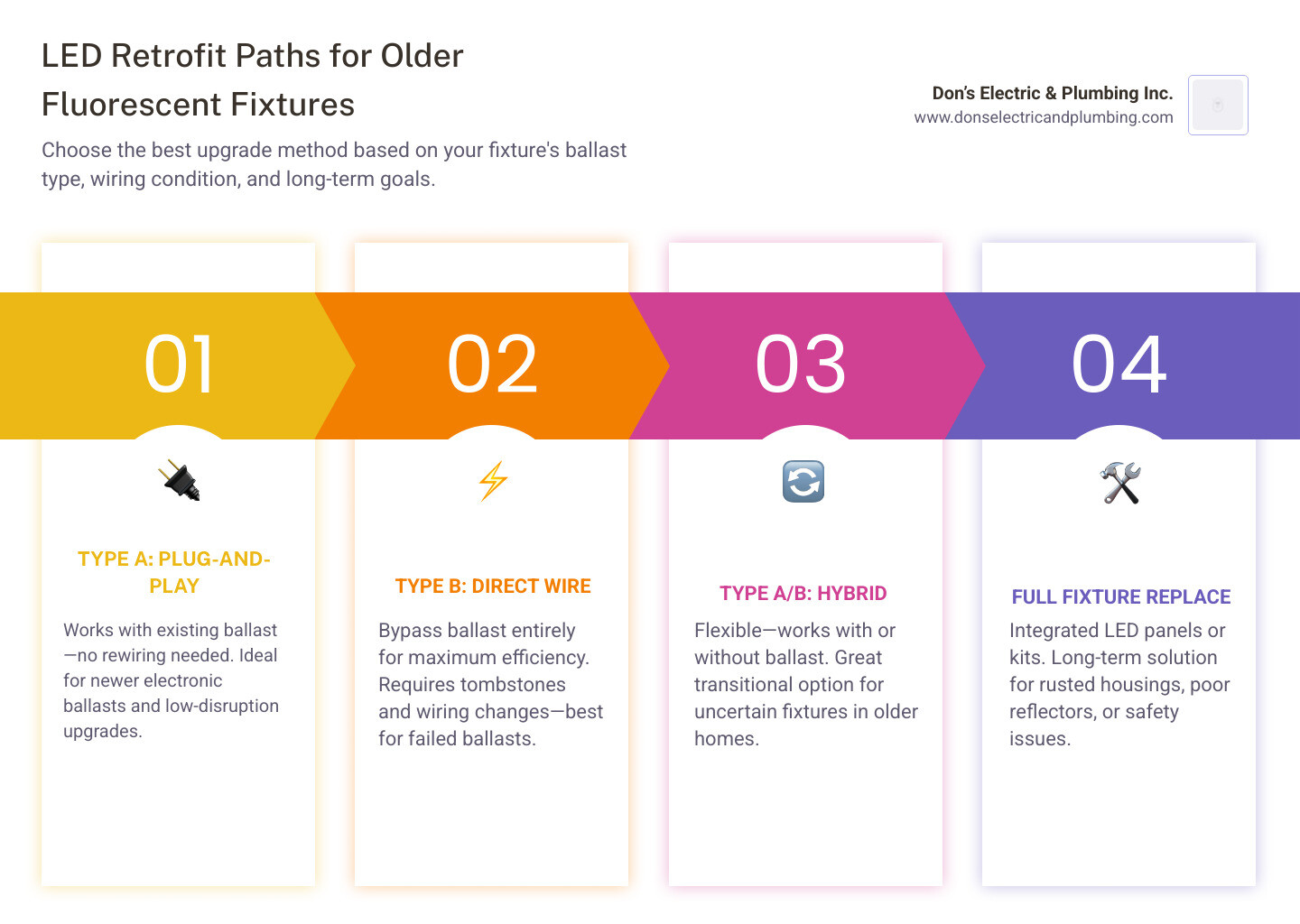
There are three main retrofit tube types:
- Type A: Plug-and-play LED tubes that work with a compatible existing ballast
- Type B: Ballast-bypass or direct-wire tubes that remove the ballast from the circuit
- Type A/B: Hybrid tubes that can often work either way
Plug-and-play sounds easiest, but it is not always the best option in older homes. It only works if the ballast is compatible and healthy. If the ballast is old, the LED tube may flicker, fail early, or shut off after an hour of use. That kind of problem is often blamed on the LED, but the ballast is usually the real troublemaker.
Ballast bypass is often the better long-term solution because it removes the aging ballast from the equation. But it is not a DIY guess-and-go project. Direct-wire LED tubes must be installed correctly, with the proper sockets and wiring configuration. Some require non-shunted tombstones. Some are single-ended. Some are double-ended. Mixing them up is a good way to create a safety hazard.
When Older Wiring and Panels Need Attention First
LEDs draw less power, so they do not usually overload old wiring by themselves. In fact, lower wattage is generally easier on the system. But switching to LED can uncover pre-existing issues, such as:
- Ungrounded circuits
- Aluminum branch wiring
- Overfilled or undersized boxes
- Loose connections
- Outdated breakers or fuse panels
- Shared neutrals and other legacy wiring conditions
So, do older electrical systems need upgrades to support LEDs safely? Sometimes yes, but not because LEDs are too demanding. It is because the home may already have unsafe wiring conditions that should be addressed before any fixture work moves forward.
If you own a historic or older home, these resources are worth reading:
- How to keep your historic home from blowing a fuse
- Don’t get zapped by these old wiring warning signs
Common LED Retrofit Problems in Old Fixtures and How to Avoid Them
Most LED complaints come down to compatibility, product quality, or fixture condition.
Common problems include:
- Flickering from incompatible ballast or dimmer
- Buzzing from failing components
- Overheating in enclosed or damaged housings
- Poor light spread from using bare directional tubes in fixtures designed around fluorescent diffusion
- Polarity or wiring issues in direct-wire conversions
- Intermittent shutoff caused by magnetic ballast problems
- Socket failure from old brittle tombstones
To avoid these problems:
- Verify ballast type before buying tubes
- Check dimmer compatibility
- Inspect sockets and wiring for heat damage
- Use quality lamps with appropriate color temperature and CRI
- Replace damaged diffusers
- Have a licensed electrician evaluate vintage fixtures before conversion
For people sensitive to flicker, this matters even more. Poor-quality or failing LED drivers can also strobe, so fixture and product selection should be done carefully.
Best LED Upgrade Options for Older Homes
There is no one-size-fits-all answer. The best choice depends on the fixture, wiring, room use, and your long-term plans.
Best upgrade paths include:
- Type A tubes for newer, compatible electronic-ballast fixtures
- Type B direct-wire tubes for long-term reliability when the fixture body is still in good shape
- Type A/B hybrid tubes when flexibility matters
- Full fixture replacement when the housing, reflector, ballast, or sockets are failing
- Magnetic retrofit kits in select cases where preserving the look of a fixture matters
When a Tube Swap Makes Sense
A simple tube swap can make sense when:
- The fixture is in good physical condition
- The ballast is newer and compatible
- The space is a garage, basement, closet, or utility area
- You want a lower-disruption upgrade
- You need a short-term solution while planning larger electrical work
This approach can be practical, but we still recommend confirming compatibility first. In older homes, assumptions are expensive in time and frustration, even when we are not talking dollars.
When Full Fixture Replacement Is the Smarter Long-Term Move
Sometimes the smarter move is to replace the whole fixture.
That is often true when you have:
- A failed or very old ballast
- Rust inside the housing
- Cracked sockets
- Yellowed or brittle diffuser covers
- Poor reflector performance
- A fixture that never gave great light to begin with
Full replacement usually improves reliability and light quality at the same time. It also gives us a chance to inspect the box, connections, grounding, and surrounding wiring.
Some integrated LED fixtures are sleek and efficient, but they do have a tradeoff: when the light engine fails, the whole fixture may need replacement. In some homes, we prefer serviceable fixtures that use replaceable lamps or modules, especially where long-term maintenance matters.
For homeowners planning fixture replacement, start here: Lighting installation in Cobleskill, NY
Choosing the Right Brightness and Color Temperature
To replace fluorescent lighting well, think in lumens, not watts.
For most older homes, we recommend:
- 2700K for cozy living areas and vintage ambiance
- 3000K for a warm, clean look in kitchens and hallways
- 3500K for balanced neutral light in work areas
- 4000K for utility rooms, garages, laundry rooms, and task-heavy spaces
A CRI of 80 or higher is a good baseline. Higher CRI helps colors look more natural, which is useful in kitchens, bathrooms, sewing rooms, and anywhere detailed work happens.
A few tips:
- Match brightness to the room’s purpose, not the old tube wattage
- Use warmer tones in historic interiors to keep charm intact
- Add diffusers where LED directionality feels harsh
- Mix color temperatures thoughtfully rather than making every room bright white
For more lighting ideas in older homes, see Esperance, NY: all the lighting services you need to know.
Long-Term Benefits of Switching to LED in an Older Home
Once the upgrade is done correctly, the benefits are hard to ignore.
LED upgrades can deliver:
- Lower energy use
- Fewer lamp replacements
- Less maintenance
- Better visibility in everyday spaces
- Cooler operation
- No mercury disposal concerns
- Improved comfort for aging eyes
- Better support for smart controls and occupancy sensors
- A more updated feel without sacrificing an older home’s character
Where Homeowners Notice the Biggest Improvements First
The first rooms that usually feel better after an LED upgrade are the ones that were hardest on fluorescent lighting to begin with:
- Kitchens
- Basements
- Garages
- Laundry rooms
- Hallways
- Stairwells
- Workshops
- Exterior security areas
These are spaces where instant-on performance, better color quality, cooler operation, and stronger visibility make an immediate difference.
Rebates, Incentives, and Planning a Professional Upgrade
Depending on the product and program availability, some homeowners may qualify for rebates or incentive programs tied to efficient lighting upgrades. We suggest looking for:
- ENERGY STAR qualified products
- Utility rebate programs
- Seasonal efficiency promotions
- Financing options for larger home improvement projects
Professional planning matters in older homes because lighting upgrades may overlap with panel concerns, breaker issues, or wiring repairs. A proper evaluation should include:
- Fixture condition
- Ballast type
- Socket condition
- Grounding
- Box fill and support
- Switch and dimmer compatibility
- Breaker and panel behavior
Helpful related reading:
Frequently Asked Questions About LED vs Fluorescent Lighting for Older Homes
Do LEDs always work in old fluorescent fixtures?
No. LED tubes must match the fixture setup. Some work with compatible ballasts, some require ballast bypass, and some can do either. Old magnetic ballasts, worn sockets, and damaged wiring can all prevent a safe or reliable retrofit.
Will switching to LED overload or damage old house wiring?
Usually no. LEDs use less power than fluorescent lighting, so the electrical load is lower. But older wiring issues can still be present and should be inspected. LEDs do not create those problems, but they also do not magically fix them.
Is it better to keep the old fixture or replace it completely?
It depends on condition. If the housing is solid, the wiring is sound, and the fixture still suits the space, a retrofit can work well. If the ballast is failing, the reflector is poor, the sockets are damaged, or the fixture is simply worn out, replacement is usually the better long-term solution.
Conclusion
When homeowners compare LED vs fluorescent lighting for older homes, LEDs usually come out ahead for efficiency, comfort, safety, and simpler maintenance. The catch is that older homes are rarely simple. Vintage fixtures can hide aging ballasts, brittle wiring, grounding issues, and compatibility problems that make a professional upgrade the safest path.
At Don’s Electric & Plumbing Inc., we help homeowners across our service area modernize lighting without losing sight of what makes older homes special. Since 1984, our family-owned team has focused on practical, safe solutions backed by a 100% guarantee, with emergency service and financing options available when needed.
If your fluorescent fixtures are flickering, humming, dimming, or just ready for retirement, learn more about your next step here: Lighting installation in Cobleskill, NY