


What SEER2 Rating Should I Look For in 2026?
What SEER2 rating should I look for depends on where you live, how much you use your system, and your budget — but here’s a quick answer for most homeowners:
| Your Situation | Recommended SEER2 Range |
|---|---|
| Tight budget, low cooling use (Northern states) | 13.4 – 14.3 SEER2 |
| Most homeowners — best balance of cost vs. savings | 15 – 17 SEER2 |
| Heavy cooling use, qualify for tax credits | 17 – 18 SEER2 |
| Maximum efficiency, hot/humid climate, long-term stay | 19 – 20+ SEER2 |
For New York homeowners in Schoharie, Montgomery, and Fulton counties, the sweet spot is typically 15–17 SEER2 — enough to qualify for federal incentives while keeping upfront costs manageable.
If you’ve been shopping for a new air conditioner or heat pump recently, you’ve probably noticed the term “SEER2” showing up everywhere — and it can be confusing, especially when older units still carry the original “SEER” label. These two numbers are not the same, and mixing them up can lead to a poor buying decision that costs you real money over the lifetime of your system.
SEER2 is the updated federal efficiency standard that went into effect on January 1, 2023, replacing the older SEER rating system. It stands for Seasonal Energy Efficiency Ratio 2, and it measures how efficiently a central air conditioner or heat pump cools your home over an entire cooling season. Think of it like the miles-per-gallon rating on a car — the higher the number, the less energy the system uses to do the same job. And just like fuel economy, the rating that makes sense for you depends on how much driving — or in this case, cooling — you actually do.
What makes SEER2 different is how it’s measured. The new testing process uses more realistic conditions that better reflect what actually happens inside a real home with real ductwork. That means the numbers are slightly lower than the old SEER ratings, but they’re more accurate and more honest about what you’ll actually experience.
For homeowners across Schoharie, Montgomery, and Fulton counties, understanding SEER2 is especially important right now. New federal standards are in place, utility bills keep climbing, and there are meaningful rebates and tax credits available — but only if your new system meets specific efficiency thresholds. Choosing the wrong rating could mean leaving money on the table or overspending on efficiency you’ll never fully use.
Understanding SEER2 vs. Legacy SEER Ratings
To understand why you see different numbers on HVAC equipment today, we have to look back at the Department of Energy’s 2023 mandate. Before this change, the original SEER testing was conducted under laboratory conditions that didn’t quite match reality. It assumed your ductwork was perfectly designed and had almost no resistance to airflow—a scenario that rarely exists in a real home in Canajoharie or Sharon Springs.
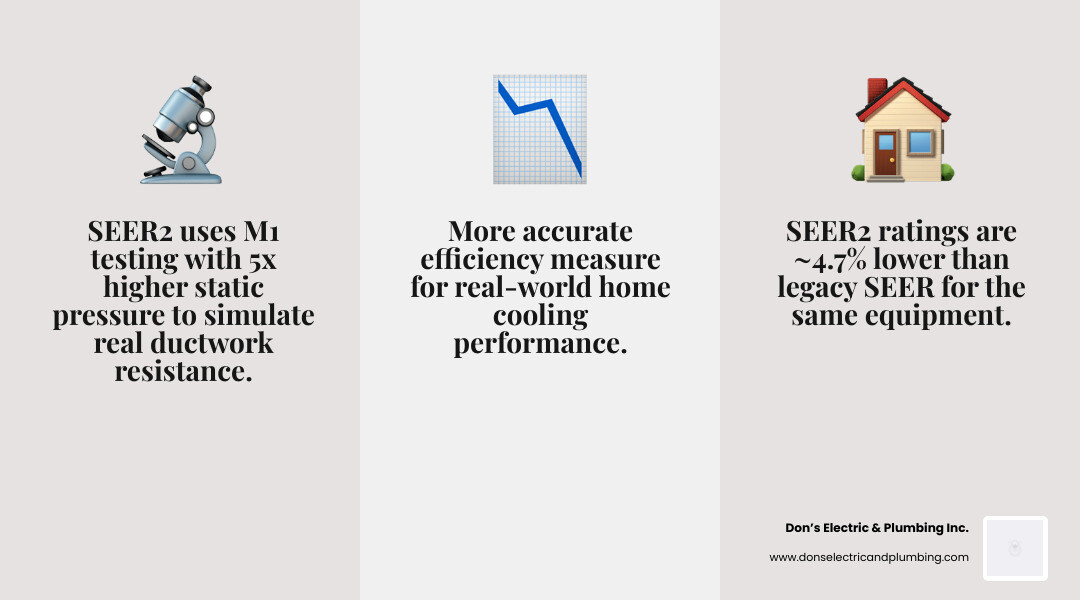
The transition to SEER2 introduced the M1 testing procedure. This new protocol increases the external static pressure—the resistance the blower motor has to push against—by five times. Because the system has to work harder during the test to move air through simulated ductwork, the resulting efficiency numbers are lower. Generally, a SEER2 rating is about 4.7% lower than the legacy SEER rating for the same piece of equipment. For example, an old 15 SEER unit would likely be re-rated as a 14.3 SEER2 unit today.
While the numbers look lower on paper, the equipment isn’t actually less efficient; the ruler used to measure it just got more accurate. If you are currently dealing with an older system that requires frequent AC Repair in Cobleskill, NY, you are likely running a unit with a SEER rating as low as 10 or 12. Upgrading to even a base-model SEER2 system today can reduce your cooling energy consumption by up to 37.5%.
What SEER2 rating should I look for in New York’s climate?
Geography plays a massive role in determining which efficiency rating is right for your wallet. The Department of Energy divides the U.S. into regions, and New York falls into the Northern region.
In our neck of the woods—from the rolling hills of Schoharie County to the Mohawk Valley in Montgomery County—the federal minimum for a new central air conditioner is 13.4 SEER2. This is lower than the requirements in the South because our cooling season is much shorter. However, “minimum” doesn’t always mean “best.”
When asking yourself what seer2 rating should i look for in Fulton or Herkimer County, you have to consider our humid summers. While we don’t have the 100-degree heat of Arizona, we do have high moisture levels that can make a home feel swampy. Higher SEER2 units, particularly those in the 16 to 18 range, often come with advanced features that handle dehumidification much better than base-model units.
If you are considering an Energy-Efficient Heat Pump in Canajoharie, the efficiency equation changes slightly. Heat pumps are rated for both cooling (SEER2) and heating (HSPF2). Since we rely heavily on heating in upstate New York, looking for a higher rating is often more beneficial here than it would be for a homeowner in a milder climate.
Maximizing ROI: Rebates, Tax Credits, and Energy Savings
Investing in a higher SEER2 rating is a balance between what you pay today and what you save over the next 15 years. HVAC operation typically accounts for one-third to one-half of a homeowner’s total energy bill. By choosing a more efficient system, you are essentially “pre-paying” for your utilities at a discount.
Consider the cumulative savings over a typical 15-year lifespan. Moving from a 14 SEER2 unit to an 18 SEER2 unit can result in energy savings between $3,000 and $4,500. In moderate climates like ours, an 18 SEER2 unit can save approximately $230 per year in cooling costs compared to a basic 14 SEER2 model.
| Efficiency Tier | Estimated Annual Cooling Cost | 10-Year Savings (vs. 14 SEER2) |
|---|---|---|
| 14 SEER2 (Minimum) | $850 | $0 |
| 16 SEER2 (Mid-Range) | $720 | $1,300 |
| 18 SEER2 (High Efficiency) | $620 | $2,300 |
| 20 SEER2 (Premium) | $540 | $3,100 |
Note: Estimates based on average New York utility rates and typical seasonal usage.
When planning an HVAC Installation in Minden, it’s important to look at the “payback period”—the amount of time it takes for energy savings to cover the extra upfront cost of a premium unit. For most 16 SEER2 systems, this period is typically between 3 to 6 years.
Determining what SEER2 rating should I look for to qualify for rebates
One of the biggest reasons to aim for a higher rating in 2026 is the availability of federal incentives. The Inflation Reduction Act (IRA) and the 25C tax credit have changed the math for many homeowners.
To qualify for the federal tax credit, which provides up to $2,000 for heat pumps, the system must generally meet “ENERGY STAR Most Efficient” standards. For a Ductless Heat Pump in Cobleskill, this often requires a SEER2 of at least 16. If you are installing a split ducted heat pump, you should look for a SEER2 rating of at least 16 to ensure you are eligible for these significant rebates. For central air conditioners, the threshold is often higher, typically requiring a SEER2 of 17 or higher and an EER2 of 12 or higher to qualify for the best incentives.
Deciding what SEER2 rating should I look for based on compressor type
The SEER2 rating is often a reflection of the technology inside the cabinet. There are three main types of compressors, and each impacts your comfort and noise levels differently:
- Single-Stage: These are either 100% on or 100% off. They are like a light switch. They are the least expensive but usually carry the lowest SEER2 ratings (13.4–14.3).
- Two-Stage: These have a “high” and a “low” setting. Most of the time, they run on the lower, more efficient setting. These usually land in the 15–17 SEER2 range.
- Variable-Speed (Inverter): These are the gold standard. They can adjust their speed in tiny increments, running at anywhere from 30% to 100% capacity. These systems achieve 18–20+ SEER2 ratings.
Beyond the energy savings, a variable-speed system provides incredible comfort. While a standard single-stage unit might operate at 75 decibels (about the sound of a vacuum cleaner), a premium variable-speed system can operate as low as 55 decibels—quieter than a normal conversation. This makes a huge difference if your outdoor unit is located near a patio or bedroom window. Furthermore, because they run for longer cycles at lower speeds, they are much better at removing humidity and maintaining a rock-steady temperature. If you are also upgrading to an Energy-Efficient Furnace in Canajoharie, pairing it with a variable-speed cooling system creates the ultimate indoor environment.
Why Installation Quality is as Critical as the SEER2 Rating
There is a dirty secret in the HVAC industry: the number on the yellow EnergyGuide sticker is only a “potential” rating. To actually achieve 18 SEER2, the system must be installed perfectly.

Poor installation quality can reduce a unit’s rated efficiency by 20% to 30%. This means a poorly installed 20 SEER2 unit could actually cost more to run than a properly installed 16 SEER2 system. One of the biggest culprits is ductwork. Leaky or poorly designed ducts can reduce overall system efficiency by 10% to 20%. Before we install any new system, we recommend a thorough evaluation of your home’s “lungs.”
Professional calibration—ensuring the refrigerant charge is exact and the airflow is balanced—is the only way to ensure you get what you paid for. This is why a long-term HVAC Maintenance Plan in Cobleskill, NY is so valuable; it ensures that as the system ages, it continues to operate at that high efficiency level you invested in.
Frequently Asked Questions about SEER2 Ratings
What is the federal minimum SEER2 for 2026?
For the Northern region (including all of New York), the minimum standard for residential central air conditioners is 13.4 SEER2. For split-system heat pumps, the national minimum is slightly higher at 14.3 SEER2. While you may still see some older 13.0 SEER units available in existing inventory, any new equipment manufactured today must meet these higher SEER2 benchmarks.
Can a high SEER2 unit reduce indoor noise?
Absolutely. High SEER2 ratings are almost always achieved using two-stage or variable-speed compressors. Because these units don’t have to “clunk” on at full blast every time the thermostat calls for cooling, they operate much more quietly. Premium systems often include sound-dampening blankets and swept-wing fan blades to keep noise levels around 55dB, whereas older, less efficient units can be as loud as 75dB or more.
Does a higher SEER2 rating help with humidity?
Yes, and this is one of the biggest benefits for New York homeowners. High-efficiency units (16 SEER2 and above) typically run longer, slower cycles. Instead of a quick blast of cold air that satisfies the thermostat but leaves the air damp, these units pull moisture out of the air continuously. This superior dehumidification means you can often set your thermostat a few degrees higher and still feel more comfortable, saving even more on your utility bills.
Conclusion
Choosing the right SEER2 rating isn’t just about picking the highest number; it’s about finding the “sweet spot” where your upfront investment meets long-term value and daily comfort. For most families in our service area—from Little Falls to Esperance—a system in the 15 to 17 SEER2 range provides the best return on investment, especially when you factor in federal tax credits.
At Don’s Electric & Plumbing Inc., we’ve been a family-owned and operated fixture in Canajoharie since 1984. We understand the specific challenges of New York’s climate, from the humid July afternoons to the sub-zero January nights. We offer a 100% satisfaction guarantee and financing options to help you get the efficiency your home deserves.
Whether you need a quick repair or a full system upgrade, our team is ready to help you solve the efficiency equation. Ready to see how much you could save? Contact us today for an expert AC Installation Service Canajoharie NY.