


What Flickering Lights Mean for Your Wiring — and When to Worry
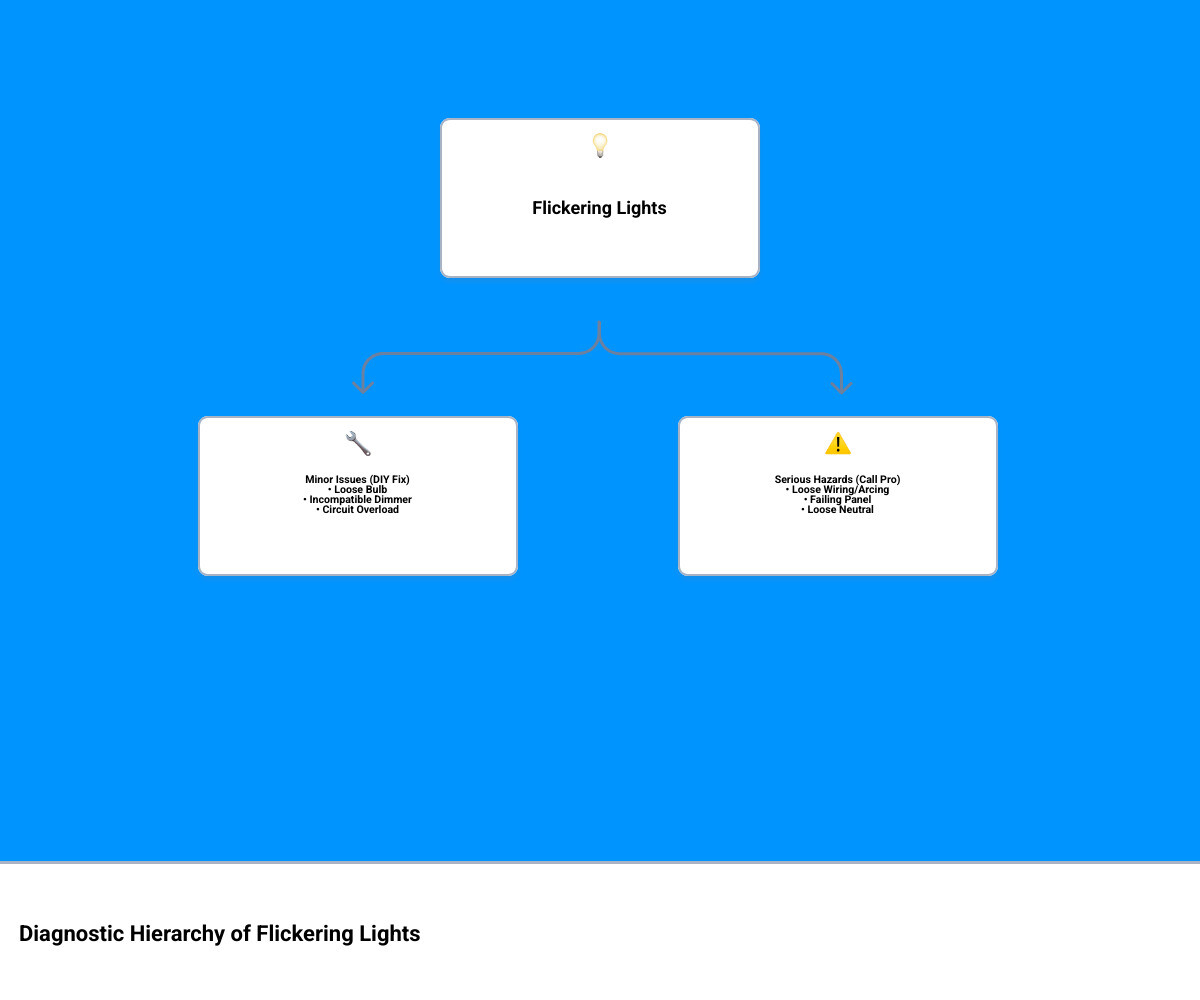
Flickering lights what it means for your wiring comes down to this: the cause determines the danger level. Most flickering falls into one of a few clear categories:
- Loose or failing bulb — usually harmless, quick to fix yourself
- Incompatible dimmer switch — common with LED bulbs, not a safety emergency
- Circuit overload — lights dim when a large appliance starts up; worth investigating
- Loose wiring or bad connection — can cause arcing and is a genuine fire hazard
- Failing electrical panel or loose neutral — whole-house flickering; call a professional immediately
- Utility grid issue — flickering across multiple homes; contact your utility provider
That flicker in your ceiling light might be nothing more than a bulb that needs tightening. Or it could be your home’s electrical system sending you an early warning of something serious. Electrical issues are the leading cause of house fires in the U.S., resulting in nearly 500 deaths and over a billion dollars in property damage every year. The tricky part is that a minor symptom and a dangerous one can look exactly the same from where you’re standing.
At Don’s Electric & Plumbing Inc., we’ve been helping homeowners across Schoharie, Montgomery, and Fulton counties — including Canajoharie, Cobleskill, and Gloversville — sort out exactly this kind of problem since 1984. Whether it’s a simple fix or a wiring issue that needs professional eyes, knowing what you’re dealing with is always the right first step.
Common Causes of Flickering Lights in Your Home

Before you assume the worst about your home’s infrastructure, it is important to check the small things. Statistics show that loose connections account for more than half of all single-fixture flickering issues. In fact, loose light bulbs alone are responsible for approximately 30% of isolated flickering service calls.
Over time, simple vibrations from footsteps upstairs or nearby traffic can cause a bulb to back out of its socket just enough to break the electrical contact. This creates an intermittent connection that manifests as a flicker. Another common culprit is socket corrosion. If moisture or dust gets into the fixture, it can create a layer of “gunk” that prevents the bulb from seating properly.
When you notice a single lamp or fixture acting up, your first move should be a DIY bulb tightening. Turn off the power, let the bulb cool, and ensure it is snug. If that doesn’t work, try swapping the bulb with a known working one. If the problem persists, you might be dealing with common home electrical hazards like a faulty fixture or a worn-out internal socket tab. These components don’t last forever, and a cheap fixture may fail much sooner than the wiring behind it.
Flickering lights what it means for your wiring and safety
When flickering isn’t limited to a single bulb, we need to talk about flickering lights what it means for your wiring. This is where the situation can transition from a nuisance to a danger. The primary concern with wiring-related flickering is a phenomenon called “arcing.”
Arcing occurs when electricity “jumps” across a gap in a loose or damaged connection. This isn’t just a tiny spark; arcing can reach temperatures exceeding 10,000°F. At that heat level, structural wood, plastic insulation, and nearby dust can ignite instantly. If you ignore these signs, you are essentially allowing a small fire to start and stop behind your walls every time the lights blink.
| Symptom | Potential Cause | Risk Level |
|---|---|---|
| Single bulb flickers | Loose bulb or bad socket | Low |
| Lights flicker when it’s windy | Loose service drop connection | High (Fire/Surge Risk) |
| Lights flicker in multiple rooms | Loose neutral or failing panel | Emergency |
| Flickering with burning smell | Active arcing and insulation melting | Immediate Danger |
If you notice that touching a switch causes a flicker, or if you hear a faint crackling sound, you are likely witnessing insulation breakdown. Understanding the risks of a repeatedly tripping breaker is vital here, as your safety devices are trying to tell you that the circuit is no longer stable.
Why Lights Flicker When Large Appliances Turn On
Have you ever noticed the kitchen lights dip for a split second when the refrigerator kicks on? Or perhaps the living room lights dim when your central AC starts a cycle? This is usually due to “inrush current.”
Large appliances, especially those with motors like AC compressors or washing machines, can draw five to eight times their normal operating current the moment they start up. This massive, temporary surge “starves” the rest of the circuit of voltage, causing your lights to dim. While a brief dip (less than a second) is often considered normal in older homes, persistent or deep dimming is a sign that your system is struggling.
Identifying an overloaded circuit and flickering lights what it means for your wiring
If your lights stay dim or flicker throughout the entire time the microwave or space heater is running, you are likely dealing with an overloaded circuit. Most standard household circuits are designed to handle 15 to 20 amps. Modern kitchens, however, can easily demand 45 amps if multiple high-wattage appliances are running at once.
In homes built before 1980, the electrical panels were simply not designed for the sheer number of gadgets we use in May 2026. Overloaded circuits contribute to about 13% of home electrical fires. If your lights are constantly reacting to your appliances, it’s a sign that your breaker keeps tripping because the system is at its limit. Installing dedicated circuits for high-draw appliances is often the best way to protect your wiring and stop the flicker.
Troubleshooting LED vs. Incandescent Bulb Issues
As we move further into 2026, almost every home in Montgomery County has made the switch to LEDs. However, LEDs are much more sensitive than the old incandescent bulbs we grew up with. While an incandescent bulb has a simple filament that can “ride out” minor voltage dips, an LED is an electronic component with a complex driver.
The most common cause of LED flickering is a hardware mismatch. If you put a modern LED bulb on an old TRIAC dimmer (the kind designed for incandescent bulbs), you will likely see waveform distortion. Research shows that 78% of consumer-grade LED lights exhibit this distortion when paired with older dimming technology.
Solving LED dimmer issues and flickering lights what it means for your wiring
To stop the “strobe light” effect, you generally need a dimmer switch labeled as “C.L” or “LED+.” These are designed to handle the low wattage and electronic nature of LED drivers. Furthermore, quality matters. Approximately 90% of inexpensive LED drivers fail flicker tests after just three years of operation, whereas premium drivers have a much higher success rate.
If your LEDs are flickering even without a dimmer, they might be reacting to “dirty power” or minor voltage fluctuations that you wouldn’t have even noticed with old bulbs. Keeping a safety checklist can help you track whether the flicker is happening at specific times of day, which helps us diagnose if the issue is your bulb or your utility’s power quality.
When to Call a Professional for Electrical Repairs
Knowing when to put down the screwdriver and pick up the phone is the most important part of home maintenance. While tightening a bulb is a great DIY task, messing with your electrical panel is not.
You should call us immediately if you experience any of the following:
- Whole-house flickering: If every light in the house blinks at once, you likely have a loose neutral wire at the main panel or the utility “weatherhead.” This can cause a “floating neutral,” which sends dangerous voltage imbalances through your electronics.
- Burning smells or ozone: If you smell melting plastic or a “metallic” scent near your outlets, turn off the main breaker immediately.
- Buzzing or sizzling: Your electrical system should be seen, not heard. Sounds from the panel or switches indicate active arcing.
- Discolored outlets: Scorch marks or outlets that feel warm to the touch are precursors to a fire.
Sometimes, you can troubleshoot a tripped breaker on your own, but if the flickering is accompanied by these red flags, it’s time for a professional. Your breaker box might be broken, and replacing an outdated panel is a lot cheaper than dealing with the aftermath of a fire.
Frequently Asked Questions about Flickering Lights
Is a flickering light a fire hazard?
It certainly can be. While a loose bulb isn’t a major threat, flickering caused by loose wiring or arcing is a leading cause of the 47,000+ home electrical fires reported annually. Arcing creates intense heat that can ignite wood and insulation without ever tripping a standard breaker.
Why do my lights flicker during a storm in Montgomery County?
If you live in areas like Palatine or Minden, you know our New York storms can be fierce. Flickering during a storm usually indicates a “utility-side” issue. Wind can cause the service drop (the wires connecting the pole to your house) to sway, straining the connections. It could also be tree branches contacting power lines or a failing neighborhood transformer. If your neighbors’ lights are also flickering, it’s a utility problem.
Can I fix flickering lights myself?
You can safely tighten bulbs, clean light sockets (with the power off!), and replace standard light bulbs. You might even feel comfortable replacing a dimmer switch if you have experience. However, any issue involving the electrical panel, main service lines, or hidden wiring behind walls should be handled by a licensed professional to ensure insurance compliance and, most importantly, your family’s safety.
Conclusion
Don’s Electric & Plumbing Inc. has been a staple of the Canajoharie community since 1984. As a family-owned and operated business, we take the safety of our neighbors in Schoharie, Montgomery, and Fulton counties seriously. We know that flickering lights what it means for your wiring can be a confusing topic, but you don’t have to guess.
Whether you are in Sharon Springs, Broadalbin, or Little Falls, our team is ready to provide the expert diagnosis you need. We offer a 100% satisfaction guarantee, financing options to fit your budget, and 24/7 emergency services for those moments when a flicker turns into a “must-fix-now” situation. Don’t let a small warning sign turn into a major hazard.
Schedule your professional electrical inspection in Canajoharie today and let us give you the peace of mind that comes with a safe, stable home electrical system.