


Do You Need a Permit for Electrical Work in New York? Here’s the Short Answer
Do you need a permit for electrical work in New York? In most cases, yes — and the exact rules depend heavily on where in the state you live. Here’s a quick breakdown:
| Project Type | Permit Required? |
|---|---|
| Panel upgrade or service change | Yes, almost universally |
| New branch circuit or wiring | Yes |
| EV charger or generator installation | Yes |
| Rewiring or major renovation | Yes |
| One-for-one outlet or switch swap | Generally no |
| Like-for-like light fixture replacement | Generally no |
| Low-voltage maintenance (no new wiring) | Generally no |
Key facts to know right away:
- New York State does not issue a single statewide electrician license — rules are set by each local municipality
- In New York City, virtually all electrical work requires a permit filed by a licensed Master Electrician — homeowners cannot self-permit under any circumstances
- In upstate New York (including Montgomery, Schoharie, and Fulton counties), permit and licensing rules vary by town, but inspections are required for all electrical work regardless
- Performing electrical work without a required permit can result in fines, failed home inspections, and even insurance claim denials
Whether you’re planning a panel upgrade, adding circuits for a home addition, or installing a standby generator, understanding your local permit requirements protects your home, your family, and your investment. The rules can feel complicated — especially when requirements differ not just between NYC and upstate New York, but sometimes between neighboring towns in the same county.
This guide breaks it all down so you know exactly what’s required before your next electrical project.
Do I Need a Permit for Electrical Work in New York: State and Local Requirements
Navigating the legalities of home improvement in the Empire State can feel like a maze. The foundation of these rules is the New York State Uniform Fire Prevention and Building Code. This state-level framework establishes the minimum safety standards for all construction, but the actual “boots on the ground” enforcement is handled by your local Authority Having Jurisdiction (AHJ)—usually your town or village building department.
In our neck of the woods, from Canajoharie to Sharon Springs, the rules are quite different from the high-density regulations of the five boroughs. While New York City operates under its own highly restrictive Electrical Code (currently transitioning under Local Law 128), residents in Montgomery and Schoharie counties follow the National Electrical Code (NEC) as adopted by the state.
One of the most important things to realize is that even if your specific town doesn’t require a formal “building permit” for a small electrical job, New York law still requires that the work meets safety standards. This is why Common Electrical Issues Why You Legally Cant Fix Everything is such a vital concept for homeowners to understand. Even a “simple” fix can become a legal liability if it bypasses the required inspection process.
NYC vs. Upstate NY: The Permit Divide
| Requirement | New York City (NYC) | Upstate NY (Montgomery/Schoharie/Fulton) |
|---|---|---|
| Who can pull a permit? | Only a Licensed Master Electrician | Licensed Electricians or sometimes Homeowners |
| DIY Electrical Work? | Strictly Prohibited | Allowed in some towns (with inspection) |
| Permit Filing System | DOB NOW: Build (Online) | Local Building Department Paperwork |
| Inspection Type | DOB Electrical Unit Inspectors | Third-Party Approved Agencies (e.g., Atlantic-Inland) |
Common Residential Projects That Require Official Approval
If you are doing anything more than swapping out a decorative plate, you likely need to involve the local authorities. Major projects change the “load” or the “infrastructure” of your home’s electrical system, and that is where the risk of fire or failure is highest.
Panel Upgrades and Service Changes
Upgrading from an old 100-amp service to a modern 200-amp service is one of the most common reasons homeowners ask, “do i need a permit for electrical work in new york?” The answer is a resounding yes. This project involves the utility company (like National Grid or NYSEG), your main breaker box, and the grounding system of your home. If you suspect Is Your Breaker Box Broken A Guide To Panel Replacement is in your future, a permit ensures that the new equipment can handle your home’s modern energy demands safely.
New Branch Circuits and Rewiring
Adding a new circuit for a finished basement, a kitchen remodel, or a home office requires a permit. This ensures the wire size is correct for the breaker and that the circuit is properly protected by AFCI (Arc-Fault Circuit Interrupter) technology, which is now a standard requirement for most living areas. Similarly, full rewiring projects—especially in our beautiful historic homes—must be documented to prove that outdated “knob and tube” or ungrounded wiring has been safely decommissioned.

When dealing with more complex systems, such as those found on rural properties with wells, the regulations can overlap. For instance, Navigating New York Regulations For Commercial Well And Plumbing Repairs often involves both electrical and plumbing permits to ensure the pump and pressure systems are wired to withstand the elements and heavy use.
Do I need a permit for electrical work in New York for minor repairs?
The good news is that “maintenance” generally doesn’t require a mountain of paperwork. If you are doing a “one-for-one” swap—meaning you are replacing an existing outlet with a new outlet, or a broken light switch with a fresh one—you typically do not need a permit.
However, there is a fine line between a swap and an alteration. If you are moving the location of the outlet, adding a second outlet to the same wall, or upgrading a standard fixture to a high-wattage chandelier that requires new support, you’ve crossed into “permit territory.” We always tell our neighbors: Dont Be A Hero And Call An Electrician For These Jobs because what looks like a simple swap can sometimes reveal scorched wires or improper grounding that needs a professional eye.
Do I need a permit for electrical work in New York for home generator installation?
In areas like Broadalbin or Little Falls, where winter storms can knock out power for days, standby generators are a lifesaver. Because these units involve a “transfer switch” that connects directly to your home’s main electrical panel, a permit is mandatory.
This isn’t just about the wiring; it’s about safety. A permit and subsequent inspection verify that the generator is far enough away from windows (to prevent carbon monoxide poisoning) and that the transfer switch prevents “backfeeding” electricity into the utility lines, which could be fatal for line workers. For those of us living in older structures, it’s also about learning How To Keep Your Historic Home From Blowing A Fuse when the generator kicks in and starts powering heavy appliances.
The Risks of Skipping the Permitting Process
It might be tempting to save a little time and hire an unlicensed “handyman” to do your electrical work under the table. In New York, this is a gamble that rarely pays off.
- Insurance Claim Denials: This is the big one. If an electrical fire occurs and your insurance company discovers the work was done without a permit or by an unlicensed individual, they have the legal right to deny your claim. You could be left paying for a total loss out of pocket.
- Stop-Work Orders: If a building inspector sees an unpermitted van at your house or notices new conduit while driving by, they can issue a Stop-Work Order. This halts your project immediately and often results in fines that are double or triple the original permit fee.
- Property Resale Issues: When you go to sell your home in Montgomery or Schoharie County, the buyer’s home inspector will look at your electrical panel. If they see brand-new work but no “Certificate of Approval” from an inspection agency on file with the town, it can stall the sale or force you to tear out finished walls so the work can be inspected “after the fact.”
- Safety Hazards: Without an inspection, you have no way of knowing if a wire is pinched, a ground is loose, or a circuit is overloaded. These are the Top Reasons Older Home Breakers Keep Tripping, and they are often the precursors to an electrical fire.
How to Navigate Inspections and Licensing in Montgomery and Schoharie Counties
In our service area—including towns like Canajoharie, Palatine, and Sharon Springs—the process is a bit unique. Most local building departments do not have a “staff electrician” to perform inspections. Instead, they rely on NYSEG-approved third-party inspection agencies.
The Inspection Process
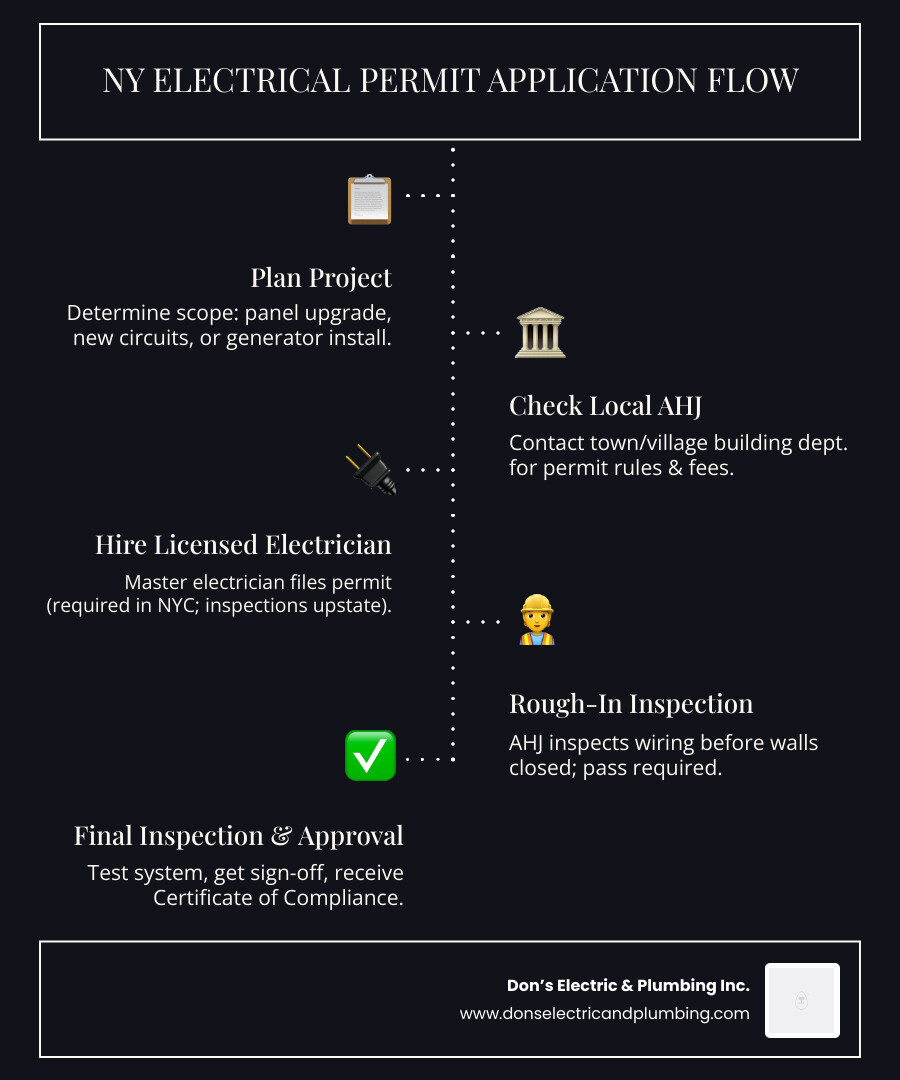
Once we (or another licensed contractor) pull the permit from your town hall, the work proceeds in stages:
- The Rough-In: This happens before the drywall goes up. An inspector from an agency like Atlantic-Inland or a similar approved provider will come out to verify that the wires are the right gauge, the boxes are secure, and everything is routed correctly.
- The Final: After the walls are closed and the fixtures are installed, the inspector returns to test the outlets and ensure the breakers are labeled and functioning.
The Certificate of Approval
After the final inspection, the agency issues a “Certificate of Approval.” This document is sent to your local building department, which then allows them to issue a Certificate of Occupancy or simply “close out” the permit. Without this certificate, the job isn’t legally finished.
As a family-owned business serving this area since 1984, we handle this “red tape” for our customers every day. We know which inspectors work in Ephratah and who to call for a quick sign-off in Middleburgh.
Frequently Asked Questions about New York Electrical Permits
Can a homeowner perform their own electrical work in New York?
This is a “yes, but” answer. In many upstate New York municipalities, a homeowner is allowed to perform electrical work on their own primary residence (the home they live in). However, you are still legally required to obtain a permit and have the work inspected by an approved agency. You cannot perform work for hire on someone else’s home without a license. In NYC, the answer is a flat “no”—only a Licensed Master Electrician can touch the wiring.
Does the 2025 NYC Electrical Code affect residents in Upstate New York?
While Local Law 128 is specific to New York City, it often signals what is coming for the rest of the state. New York State typically adopts the latest version of the National Electrical Code (NEC) every few years. The 2025 updates in the city emphasize expanded AFCI and GFCI protection. While you might not be under those exact rules today in Herkimer or Fulton County, following those higher standards is always a smart move for safety and future-proofing your home.
What is the difference between a building permit and an electrical permit?
A building permit is the “umbrella” permit for a project (like an addition or a deck). An electrical permit is a specific sub-permit (often called an “electrical filing”) that covers the wiring. In some small towns, these are combined into one application, while in larger areas, they are separate processes with separate fees and inspectors.
Your Trusted Partner for Safe, Permitted Electrical Work
At Don’s Electric & Plumbing Inc., we’ve spent over 40 years helping our neighbors in Canajoharie and the surrounding counties keep their lights on and their homes safe. We aren’t just technicians; we are members of this community who understand the local codes and the importance of doing things the right way.
Whether you’re in Montgomery, Schoharie, Fulton, Herkimer, or Hamilton County, we provide:
- 100% Satisfaction Guarantee: We stand behind every wire we pull.
- 24/7 Emergency Service: Because electrical issues don’t wait for business hours.
- Full Permit Management: We handle the applications and the inspectors so you don’t have to.
- Family-Owned Expertise: Serving our area since 1984 with honest, neighborly advice.
Don’t let the complexity of New York electrical permits stop your next home improvement project. Let us handle the technical details and the legal requirements so you can enjoy your home with total peace of mind.
Ready to start your project safely? Schedule your professional electrical service today