


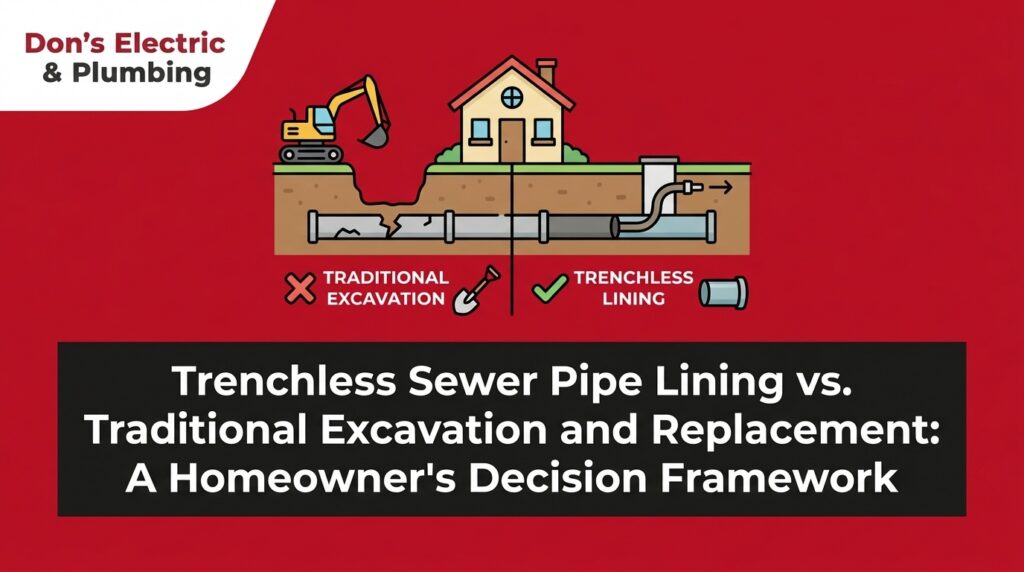
Myth: Fixing a Broken Sewer Line Always Means Destroying Your Front Yard
The widespread belief is that replacing a failing sewer line means kissing your lawn, driveway, and landscaping goodbye. When evaluating Trenchless Sewer Pipe Lining vs. Traditional Excavation and Replacement, most homeowners immediately picture a massive backhoe tearing through their front yard. You discover a major blockage, and the dread sets in as you imagine the sheer destruction required to fix it. However, the assumption that massive property damage is unavoidable is a myth. Modern plumbing technology has evolved, offering sophisticated alternatives to the traditional trenching methods of the past.
If you are exploring options for residential plumbing repair, understanding these two distinct approaches is your first step toward protecting your property.
A typical pattern we see in older homes involves root-infested clay sewer lines that begin backing up persistently in early fall. When the plunge and the snake no longer keep the drains flowing, you are faced with a critical decision. You must weigh the material investment of modern epoxy lining against the massive disruption and restoration efforts required by traditional digging. Making this choice before the harsh winter weather arrives is essential to avoid compounding the problem. This guide provides an objective, detailed comparison to help you navigate this significant property decision with confidence.
Why Older Clay Pipes Fail as Temperatures Drop
To understand why a sewer replacement is necessary in the first place, you have to look at what is buried underground. For decades, vitrified clay was the standard material for residential sewer lines. If your property was built before the 1980s, there is a very high probability that your wastewater flows through a jointed clay pipe. While clay is resistant to chemical degradation, it is inherently rigid and brittle. Over time, the earth around these pipes shifts, settles, and applies immense pressure to the joints. Once a microscopic hairline crack develops, the structural integrity of the line is compromised, setting the stage for major blockages.
These blockages rarely happen overnight. They are the result of a slow, progressive failure that often accelerates during specific times of the year. Understanding these seasonal triggers can help you spot the warning signs before a complete system failure occurs. For instance, knowing how flushable wipes impact your main sewer line is important, but even the best drain habits cannot stop the relentless pressure of nature.
The Threat of Early Fall Root Intrusion
The biological drive of trees: In September and early fall, trees and large shrubs sense the changing seasons. As surface water becomes scarce and temperatures begin to drop, root systems actively seek out deep sources of warmth and moisture to store nutrients for the long winter ahead. Your sewer line is essentially a warm, nutrient-rich underground river.
Aggressive infiltration: Even the tiniest hairline crack in a clay pipe joint emits vapor. Tree roots follow this vapor trail, penetrating the pipe and expanding rapidly once inside. What starts as a hair-like root quickly grows into a thick, dense mass that catches household waste, creating a formidable blockage.
Secondary blockages: Once roots have infiltrated the line, they act like a net. Toilet paper, grease, and other debris snag on the root mass, eventually bringing wastewater flow to a complete halt and causing raw sewage to back up into your lowest drains.
Soil Shifting and Frost Heave
The freeze-thaw cycle: Upstate New York is known for its harsh, deeply penetrating freeze-thaw cycles. As the ground freezes, the moisture in the soil expands. This expansion causes the earth to physically shift and lift—a process known as frost heave.
Pressure on rigid clay: Expanding and contracting soil puts immense, uneven pressure on rigid clay pipes. Because clay cannot flex or bend with the shifting earth, the repeated stress of frost heave eventually shatters older pipe joints.
The urgency of timing: Addressing compromised lines before the ground freezes solid in late fall is crucial. Once the soil turns to ice, not only does the pipe face maximum pressure, but any required excavation becomes exponentially more difficult and disruptive.
Traditional Excavation: The Reality of Digging Up Your Property
For generations, there was only one way to replace a broken sewer line: dig it up. Traditional excavation remains a highly effective and sometimes unavoidable method, but it is important to understand exactly what the process entails. This is not a surgical procedure; it is a heavy construction project that takes place right outside your front door.
Traditional excavation requires heavy machinery—usually an excavator or a backhoe—to dig a deep trench along the entire length of the sewer line, from your foundation all the way to the municipal connection at the street. In older Canajoharie NY properties, these lines can run directly beneath mature trees, custom hardscaping, and paved driveways. The sheer scale of the disruption is often the most overwhelming aspect for homeowners. If you find yourself in need of emergency plumbing repair during the colder months, the reality of this disruption becomes even more pronounced.
Furthermore, attempting traditional excavation once the incoming winter ground freezes makes the project significantly more difficult. Frozen soil acts like concrete, requiring heavier equipment, extending the timeline, and increasing the overall wear and tear on your property.
The Excavation Process Explained
- Locating and marking: The project begins by mapping the exact path of the sewer line and bringing in utility companies to mark underground gas, water, and electrical lines to prevent accidental strikes.
- Trenching the property: Heavy machinery is brought in to excavate the earth. This trench must reach the depth of the pipe, which can be anywhere from three to ten feet deep. Anything in the path of the trench—lawns, sidewalks, garden beds, or driveway asphalt—must be removed and set aside or destroyed.
- Removing the old pipe: The shattered clay or cast-iron pipe is physically extracted from the trench and hauled away.
- Laying and grading new PVC: Modern, durable PVC piping is laid in the trench. The technicians must ensure the slope (the grade) is perfect so that gravity can effectively carry wastewater away from the home.
- Backfilling: Once the new pipe is inspected and tested, the trench is filled back in with soil. The dirt is compacted, leaving a raw, unlandscaped scar across the property.
Trenchless Pipe Lining: Curing a New Pipe from the Inside Out
If traditional excavation is a sledgehammer, trenchless sewer pipe lining is a scalpel. Also known as Cured-In-Place Pipe (CIPP), this advanced method allows technicians to repair a failing sewer line without digging a massive trench. Instead of removing the old, broken pipe, trenchless lining uses the existing pipe as a host, creating a brand-new, structurally sound pipe right inside the old one.
The primary advantage of trenchless lining is the preservation of the property’s surface. Because the process typically only requires one or two small access holes, your driveway, patio, and mature landscaping remain completely undisturbed. For homes dealing with root-infested clay sewer lines, the epoxy resin creates a seamless, joint-free interior. Without joints, tree roots have absolutely no entry points, permanently solving the root intrusion problem.
Beyond the lack of destruction, the speed of completion is a massive benefit. While traditional digging can drag on for many days, trenchless lining is often completed in just one to two days. Furthermore, the structural lifespan of the CIPP epoxy liner is rated for up to 50 years by industry standards like NASSCO, making it a highly durable, long-term solution.
How the Epoxy Resin Process Works
Hydro-jetting the line: Before any lining can occur, the host pipe must be completely clear. Technicians use high-pressure hydro-jetting equipment to scour the inside of the clay pipe, cutting away massive root balls, clearing scale, and washing away debris. The pipe must be returned to its original internal diameter.
Inserting the epoxy liner: A specialized, flexible felt tube is saturated (wet out) with a powerful, two-part epoxy resin. This flexible liner is then inserted into the cleaned sewer line, often using air or water pressure to invert it, meaning it turns inside out as it travels down the pipe, pressing the resin directly against the old clay walls.
Inflation and curing: Once the liner is perfectly positioned, a calibration tube is inflated inside it. This holds the epoxy-soaked felt tightly against the interior of the old pipe. The resin is then left to cure and harden structurally. After a few hours, the calibration tube is removed, leaving behind a smooth, rock-hard, seamless pipe.
Side-by-Side Comparison: Evaluating Your Repair Options
When deciding between these two methods in September or early fall, seeing the facts laid out clearly can help clarify the decision. Both methods will ultimately leave you with a functioning sewer system, but the journey to get there—and the aftermath—are vastly different.
| Decision Factor | Trenchless Epoxy Lining (CIPP) | Traditional Excavation |
|---|---|---|
| Completion Time | Typically 1 to 2 days, minimizing downtime and disruption to your daily life. | Several days to weeks, depending on the depth of the pipe, soil conditions, and obstacles. |
| Landscape Impact | Minimal. Usually requires only one or two small access pits. Preserves trees, driveways, and gardens. | Severe. Requires a full-length trench. Destroys anything directly above the sewer line path. |
| Long-Term Durability | Creates a seamless, jointless pipe rated for up to 50 years. Completely root-proof. | Uses durable PVC with glued joints. Highly effective, but joints can theoretically fail decades down the line. |
| Weather Dependency | Highly flexible. Can be performed effectively even as ground temperatures drop. | Highly dependent. Very difficult, disruptive, and labor-intensive once the winter ground freeze sets in. |

Factoring in the Hidden Impact of Landscape Restoration
When weighing your options, it is incredibly easy to focus solely on the base repair process. However, the true impact of traditional excavation extends far beyond the pipe itself. The “hidden costs” of property destruction are often the most stressful and time-consuming parts of the entire ordeal.
Replacing mature landscaping: In older Canajoharie NY properties, the landscaping has often been established for decades. A 30-year-old oak tree or a carefully curated perennial garden cannot simply be bought and replaced overnight. When a backhoe tears through these areas, the loss of mature greenery permanently alters the curb appeal and character of the home.
Rebuilding hardscaping: Sewer lines frequently run under driveways, custom paver patios, and concrete walkways. Traditional excavation requires cutting through these materials. Once the trench is backfilled, the soil will continue to settle for months. You cannot immediately pour new concrete or lay new asphalt without risking severe cracking as the earth sinks. This leaves you with a gravel patch and the looming task of hiring a paving contractor down the road.
The total project impact: The disruption of having a torn-up property, the mud tracked into the house, the noise of heavy machinery, and the time spent managing multiple restoration contractors all add up. While the epoxy materials used in trenchless lining represent a significant upfront material consideration, preserving the property, avoiding the stress of restoration, and keeping your daily life intact often balances the equation for homeowners.
Making the Right Call: When to Line and When to Dig
Despite the incredible benefits of CIPP technology, trenchless lining is not a magic bullet for every single plumbing disaster. There are specific physical limitations that dictate which method must be used. An honest, comprehensive assessment is critical to ensuring you do not invest in a lining process that is doomed to fail.
Trenchless lining requires a host pipe to hold the shape of the epoxy while it cures. If the old clay pipe has fully collapsed, there is no tunnel left to line. Similarly, if the pipe has developed a severe “belly” (a sagging section that holds standing water) or if the joints have completely misaligned and offset, trenchless lining cannot fix the slope. The liner will simply follow the incorrect slope of the broken pipe, and the drainage issues will persist. In these severe cases, traditional excavation is the only viable option to physically remove the damaged section and restore the proper grade.
As a family-owned, multi-trade company, we believe in providing honest, comprehensive assessments to help homeowners choose the most effective and least disruptive method for their specific situation, rather than pushing a one-size-fits-all approach. If you need expert plumbing repair services, knowing the exact condition of your line is paramount.
The Crucial Role of Camera Inspections
Visualizing the damage: The only way to know definitively whether your pipe is a candidate for lining or requires excavation is through a high-definition sewer camera inspection. This allows technicians to see the exact extent of the root damage.
Identifying structural disqualifiers: The camera reveals structural collapses, severe bellies, or massive offsets that would disqualify the line from trenchless methods.
Mapping the problem: The camera also features a locating beacon, allowing the technician to map the exact depth and location of the problem from above ground, taking the guesswork out of the repair strategy.
Frequently Asked Questions
Is trenchless sewer replacement better than traditional?
For most homeowners, trenchless sewer replacement is considered the preferred option when the existing pipe is structurally sound enough to act as a host. It preserves your landscaping, requires significantly less time to complete, and prevents future root intrusion by creating a seamless interior. However, traditional excavation is “better”—and indeed necessary—if the pipe has completely collapsed or lost its proper downward slope.
How long does trenchless sewer lining last?
Trenchless sewer lining is a highly durable, long-term solution. The Cured-In-Place Pipe (CIPP) epoxy resins used in the process are incredibly strong and resistant to chemical corrosion and tree root penetration. Industry organizations, such as NASSCO, rate the structural lifespan of these epoxy liners for up to 50 years, making them just as durable as a brand-new PVC pipe.
Can all sewer pipes be lined?
No, not all sewer pipes are candidates for trenchless lining. The process requires the existing host pipe to be mostly intact to hold the shape of the liner while the epoxy cures. If the old pipe has suffered a massive structural collapse, has severe sags (bellies) that hold standing water, or features heavily disjointed sections, the line cannot be lined and must be traditionally excavated.
What are the disadvantages of trenchless sewer repair?
The primary disadvantage of trenchless sewer repair is that it cannot fix the slope or grade of a pipe. If your sewer line was installed improperly or has sunk deep into the earth creating a belly, the flexible liner will simply follow that incorrect path. Additionally, the specialized equipment and high-quality epoxy resins represent a significant material investment, though this is often offset by the savings in landscape restoration.
Will trenchless sewer repair fix a collapsed pipe?
No, trenchless repair cannot fix a fully collapsed pipe. The method relies on inflating a calibration tube inside the existing pipe to press the epoxy against the walls. If the pipe is crushed, the equipment cannot pass through, and there is no structural tunnel left to mold the new pipe against. Complete collapses require traditional digging.
How do tree roots affect older clay sewer lines in the fall?
In the fall, trees actively seek out moisture and nutrients to store for the dormant winter months. Older clay sewer lines, which often have microscopic cracks at their rigid joints, emit warm moisture vapors that attract these roots. The roots aggressively infiltrate these cracks, expanding inside the pipe and creating dense blockages that catch debris and cause severe sewage backups.
Secure Your Sewer System Before the Winter Freeze
Dealing with a failing sewer line is stressful, but understanding your options puts you back in control. Whether your property is a perfect candidate for minimally invasive epoxy lining or requires traditional methods to correct severe structural issues, acting before the deep freeze sets in is your best defense. For an honest assessment and expert plumbing and leak repair, a thorough camera inspection will provide the clear, objective breakdown you need to make the right choice for your home.