


The Silent Insulator Draining Your Heating System’s Power: How Hard Water Scaling Destroys the Efficiency of Your Home’s Boiler
A layer of mineral buildup no thicker than a dime is exactly how hard water scaling destroys the efficiency of your home’s boiler, forcing your system to waste up to 15 percent of your heating fuel. If your hydronic heating system is running nonstop but your home still feels chilly, the problem might not be a broken part. Instead, you could be dealing with a hidden thermal barrier baking onto the inside of your equipment.
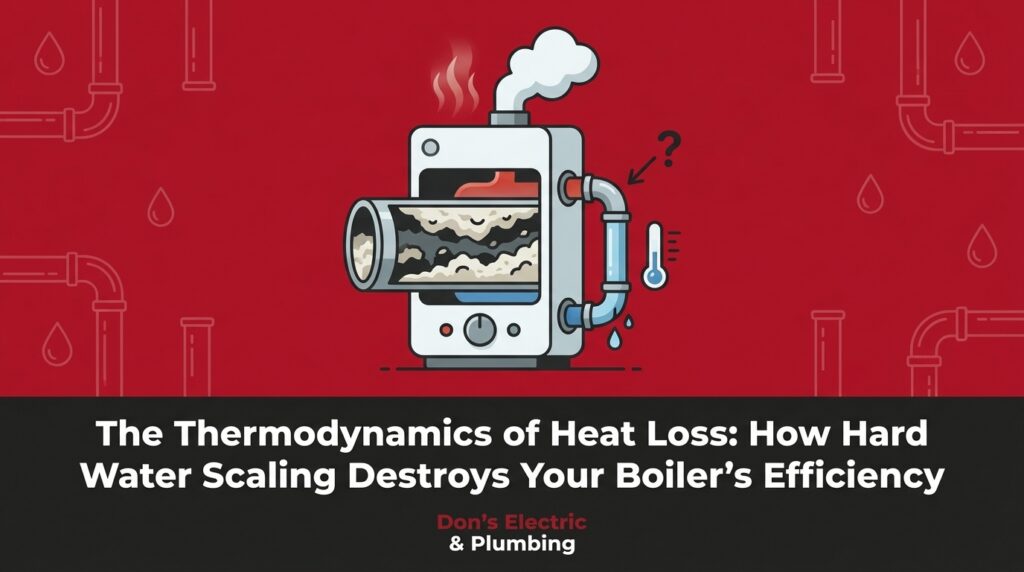
Your boiler works by transferring thermal energy from a burner, through a metal heat exchanger, and into the water that circulates through your home’s radiators or baseboards. Metals like copper and steel are exceptional conductors. However, when hard water flows through that system, it leaves behind dissolved minerals. Over time, these minerals accumulate and harden into a chalky layer of scale. This calcium buildup acts as a powerful thermal insulator, trapping the heat in the combustion chamber and preventing it from reaching the water.
At Don’s Electric & Plumbing, we’ve seen firsthand how ignoring this buildup forces Canajoharie NY homeowners into a difficult decision: address the scaling proactively, or pay for wasted fuel every time the thermostat calls for heat. If you are looking for professional plumbing repair or reliable gas heater repair, our team knows that addressing this hidden insulation is the first step toward restoring your system’s performance.
The Hidden Cost of Ignored Maintenance
The immediate impact: When scale forms on the heat exchanger, the burner has to fire longer and hotter just to push the same amount of heat through that chalky barrier. The water takes much longer to reach its target temperature. Because the system runs longer, it consumes significantly more gas, oil, or electricity to do the exact same job it did when it was brand new.
The long-term damage: Beyond the immediate fuel waste, this continuous operation puts immense strain on every moving part inside the boiler unit. The metal of the heat exchanger itself can overheat, warp, or crack because the water is no longer able to absorb the heat fast enough to cool the metal down. What starts as a minor drop in efficiency quickly escalates into a major mechanical failure.
The Physics of Boiler Scale: Why Calcium Blockages Are More Than Just Clogs
To understand why scale is so destructive, you have to look at the basic thermodynamics of your heating system. Hard water is simply water that contains high levels of dissolved minerals, primarily calcium and magnesium. In our years of servicing local heating systems, we’ve found that Upstate New York groundwater naturally carries a heavy load of these minerals, meaning Canajoharie homes are inherently prone to this specific thermodynamic issue.
When cold hard water sits in a pipe, the minerals mostly stay dissolved. However, high temperatures change the chemical behavior of these elements. As the boiler heats the water, the calcium and magnesium precipitate out of the liquid state. They crystallize and bake directly onto the hottest surfaces they can find—which is always the surface of the heat exchanger. This process explains how hard water accelerates plumbing fixture decay across your entire house, but the effect is magnified inside a high-temperature boiler.
The thermal conductivity problem: Thermal conductivity measures how easily heat passes through a material. The metals used to build boilers are chosen specifically for their high conductivity. Calcium carbonate, on the other hand, is a terrible conductor. It literally insulates the water from the fire.
| Material | Thermal Conductivity (Watts per meter-Kelvin) | Impact on Heat Transfer |
|---|---|---|
| Copper | ~400 W/mK | Excellent. Transfers heat instantly to the water. |
| Carbon Steel | ~50 W/mK | Very Good. Standard for heavy-duty boiler construction. |
| Calcium Carbonate (Scale) | ~2.2 W/mK | Extremely Poor. Acts as a thick thermal blanket blocking heat. |
Because scale has drastically lower thermal conductivity than copper or steel, even a fraction of an inch creates a massive bottleneck. Tackling this buildup during the September pre-heating season ensures your system has a clean surface to transfer heat before the deep cold sets in.

Recognizing the Warning Signs of a Scaled Hydronic System
Because the heat exchanger is sealed inside the boiler cabinet, you cannot simply look at it to see if scale is forming. However, the system will give you distinct physical and auditory clues that it is struggling to transfer heat. Our technicians at Don’s Electric & Plumbing frequently hear from Canajoharie homeowners who notice these signs early in the fall but brush them off as normal operational quirks. Catching these symptoms early can save you from a total breakdown.
- Kettling noises and popping sounds:
If your boiler sounds like a percolating coffee pot or a whistling tea kettle, you are hearing the direct result of scale buildup. When a thick layer of calcium coats the heat exchanger, water can become trapped in microscopic pockets underneath or within the rough scale layer. Because this trapped water is in direct contact with the overheated metal, it boils rapidly and turns to steam. The expanding steam bubbles burst through the scale layer, creating a distinct rumbling, popping, or “kettling” noise. This is a severe warning sign that the metal is overheating.
- Noticeably reduced heat output at the radiators:
If your thermostat is set to 70 degrees, but your baseboards or radiators only feel lukewarm to the touch, thermal insulation is likely the culprit. The boiler is firing, but the heat is going up the exhaust flue instead of into the circulating water. You might notice that certain rooms take hours to warm up, or that the house never quite reaches the comfortable temperature you set.
- Frequent and rapid short cycling:
A boiler should turn on, run continuously until the house reaches the target temperature, and then shut off. If your system turns on for just a few minutes, shuts off, and then turns right back on, it is “short cycling.” This happens because the scale prevents the water from absorbing the heat, causing the internal temperature sensors inside the boiler jacket to register an unsafe heat spike. The safety controls shut the burner down to prevent a fire. Once the metal cools slightly, it fires back up. This rapid on-and-off cycling destroys electronic components and wastes massive amounts of fuel.
If you notice any of these symptoms, it is time to look into residential heating services to diagnose the exact extent of the blockage.
The Compounding Effect of Fuel Waste During Deep Freezes
A slight drop in efficiency might go unnoticed during a mild autumn afternoon. However, the severity of this thermal barrier becomes painfully obvious when the temperature plummets. Upstate New York’s freezing winters require continuous, high-capacity heating. When your boiler is forced to overcome the thermal barrier of scale during periods of high demand, the fuel waste multiplies rapidly.
The continuous operation penalty: When the outside air is 10 degrees Fahrenheit, your home loses heat to the environment very quickly. To keep the inside comfortable, the boiler must deliver a high volume of thermal energy. If 15 percent of that energy is blocked by scale, the boiler simply has to run 15 percent longer to make up the difference. During a deep freeze, this means the system might never actually shut off. It runs continuously, burning gas or oil nonstop, just to maintain a baseline temperature.
The Domino Effect on System Components
Continuous operation does more than just spin your utility meter. It accelerates the wear and tear on every critical component in the hydronic loop. The circulator pumps, which are designed to run in cycles, are forced to operate 24/7. The gas valves, ignition modules, and blower motors are pushed past their intended duty cycles. By scheduling an inspection during the September pre-heating season, you ensure that the system enters the most demanding time of the year with a clean heat exchanger, preventing this destructive domino effect.
Addressing Root Causes: The Connection Between Plumbing and Heating
One of the biggest mistakes a homeowner can make is treating a scaled boiler purely as a mechanical breakdown. The scale is a symptom; the water quality is the disease. Fixing the boiler symptom requires addressing the plumbing root cause.
The Problem: Many homeowners pay for a professional flush to remove the scale from their boiler, only to have the kettling noises return a year later. This happens because the hydronic system occasionally takes on fresh makeup water from the home’s main supply to maintain proper pressure. If that incoming water is hard, it introduces a fresh batch of calcium and magnesium right back into the freshly cleaned boiler.
The Cause: Whole-home water quality directly impacts the longevity of hydronic heating equipment. In areas like Canajoharie NY, untreated groundwater is packed with dissolved minerals. Every time a valve opens to add a few gallons of water to the heating loop, the scale-building process starts all over again.
The Solution: Comprehensive solutions require evaluating both the water supply and the heating appliance. Because our team at Don’s Electric & Plumbing handles both trades, we always recommend a unified approach. True efficiency requires addressing the heating equipment with a proper descaling procedure while simultaneously protecting the system with residential plumbing repair solutions like whole-home water softeners or dedicated boiler feed water treatments. Flushing the boiler only solves half the problem if hard water keeps refilling the system.
Why Boiler Descaling is Strictly a Job for Licensed Professionals
When homeowners realize that scale is causing their heating issues, some are tempted to look for a quick DIY fix. However, hydronic heating systems are complex, pressurized vessels. Attempting to descale a boiler without professional training is incredibly dangerous and can result in catastrophic damage to the equipment or severe injury.
The chemical risks: Professional descaling involves circulating specialized acidic solutions through the heat exchanger to dissolve the calcium carbonate. These chemicals must be mixed to precise ratios depending on the severity of the scale and the specific metals used in the boiler. If the mixture is too weak, it won’t remove the scale. If it is too strong, or left in the system for too long, it will literally eat through the copper or steel heat exchanger, destroying the entire boiler. Furthermore, these acids must be perfectly neutralized and flushed out before the system is fired back up.
The pressure hazards: Hydronic systems operate under high pressure (often 12 to 15 psi or more) and extreme temperatures. Improper flushing can cause several dangerous scenarios:
- Dislodged chunks: DIY flushing often breaks off large chunks of scale rather than dissolving them. These solid rocks of calcium then travel through the pipes and jam inside circulator pump impellers, seizing the motors.
- Blocked relief valves: The most dangerous scenario occurs when dislodged scale blocks the pressure relief valve. This valve is the only thing preventing the boiler from over-pressurizing. If it gets plugged with calcium debris, the boiler becomes a severe safety hazard.
- Airbound loops: Opening the system to flush it introduces air. If this air is not properly bled out of every zone, the system will become “airbound,” meaning water cannot circulate at all, leaving you with zero heat.
Handling this maintenance during the September pre-heating season ensures a licensed professional can safely isolate the boiler, apply the correct chemical treatments, and verify that all safety valves are clear and functioning before winter arrives.
Frequently Asked Questions About Hard Water and Boiler Efficiency
Understanding how water quality impacts your heating system can be confusing. Here are the most common questions homeowners in Canajoharie NY and the surrounding regions ask about boiler scaling.
Does limescale affect boiler efficiency?
Yes, limescale acts as a thermal insulator on the heat exchanger, significantly reducing the system’s ability to transfer heat to the water and increasing fuel consumption. Because calcium does not conduct heat well, the burner has to run much longer to push thermal energy through the scale layer. This directly translates to wasted heating fuel and longer wait times for your home to warm up.
Why does hard water cause boiler kettling?
Scale buildup traps water against the extremely hot heat exchanger, causing localized boiling that produces a rumbling or popping noise known as kettling. As the trapped water turns to steam, it expands violently and bursts through the mineral crust. This noise is a clear warning that the internal metal components are overheating and failing to transfer heat properly.
How do I know if my boiler has scale?
Common indicators include kettling noises, reduced heat output at baseboards or radiators, and a noticeable increase in fuel usage without a change in thermostat settings. You might also notice the boiler short-cycling, turning on and off rapidly because the internal temperature sensors detect overheating before the house actually gets warm.
Can hard water ruin a heating system?
Over time, untreated hard water can cause severe scale buildup that restricts flow, damages the heat exchanger, and leads to premature system failure. The constant overheating stresses the metal, leading to cracks, while the restricted flow forces circulator pumps to work past their limits until they burn out entirely.
Is it safe to descale a boiler myself?
No, descaling requires handling pressurized systems and specialized chemicals that must be perfectly neutralized to avoid destroying the boiler’s internal components. It requires a licensed professional. Incorrectly flushing a boiler can dislodge solid chunks of scale that block critical safety mechanisms, like the pressure relief valve, creating a serious hazard in your home.
Secure Your Home’s Heating Efficiency Before the First Freeze
A heating system is only as good as its ability to transfer warmth into your living space. When a thermal barrier stands in the way, you pay the price in wasted energy and excessive wear and tear. Acting before winter hits prevents emergency breakdowns during peak cold, ensuring your equipment operates exactly as the manufacturer intended.
A professional descale restores heat transfer efficiency by stripping away the insulating calcium layer, allowing the burner to heat the water quickly and effectively. By scheduling this vital maintenance during the September pre-heating season, you give your system the best chance to handle the grueling months ahead without faltering. Additionally, upgrading to a high-efficiency system or adding qualifying water quality equipment may make you eligible for generally applicable energy rebates or tax credits—we always advise checking with your utility provider or tax professional for current programs.
Explore professional heating maintenance options to protect your system and keep your home comfortable. Whether you need an efficiency inspection or comprehensive gas heater repair, addressing these issues early is how hard water scaling destroys the efficiency of your home’s boiler no longer has to be a worry for your household.