


Why Outdoor Lighting Is Your Home’s First Line of Defense Against Crime and Accidents
How to choose outdoor lighting for safety and security comes down to five key decisions: the right light type, the right brightness, the right color temperature, the right placement, and the right power source. Here’s a quick-reference summary:
- Choose the right type – Motion-sensor floodlights for driveways and entries; dusk-to-dawn lights for perimeters; pathway lights for walkways
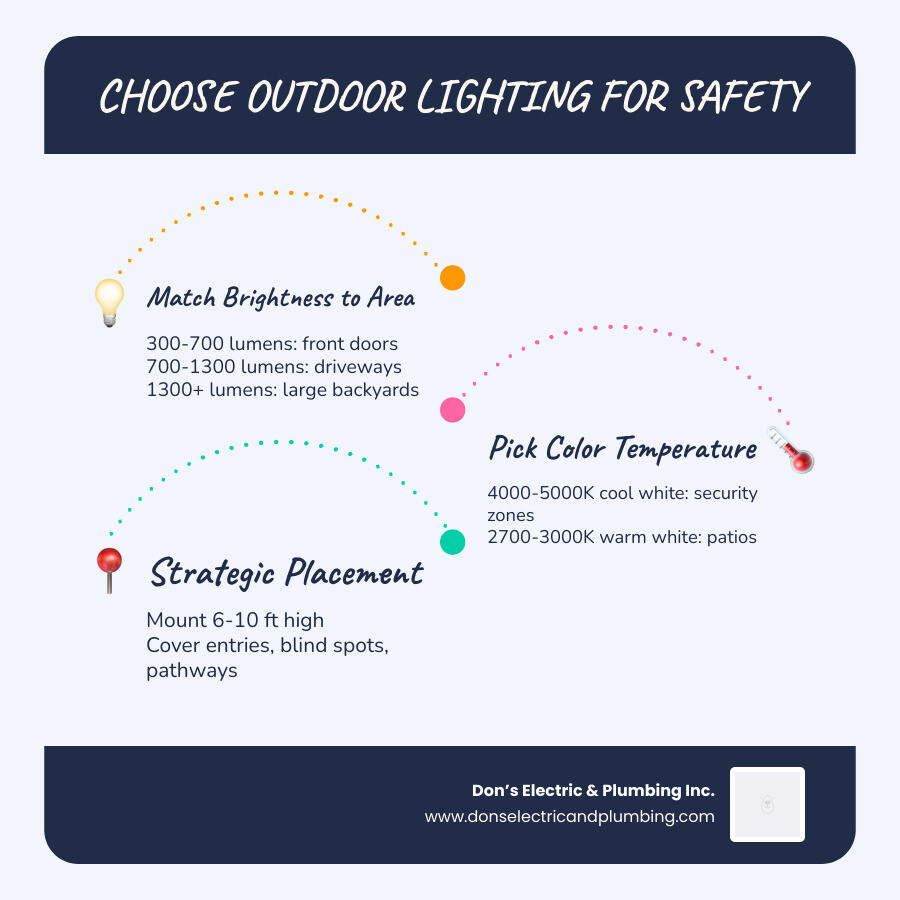
- Match brightness to the area – 300-700 lumens for front doors; 700-1,300 lumens for driveways; 1,300+ lumens for large backyards
- Pick the right color temperature – 4,000K-5,000K (cool white) for security zones; 2,700K-3,000K for aesthetic areas like patios
- Place lights strategically – Mount 6-10 feet high at all entry points, blind spots, and along pathways
- Select a reliable power source – Hardwired LED for primary security zones; solar for supplemental or remote areas
When the sun goes down, your home becomes more vulnerable. Burglars rely on darkness, and a poorly lit property is an open invitation. Research shows that homes without proper outdoor lighting are targeted by burglars three times more often than well-lit properties. When good lighting is paired with other security measures, a home becomes up to 50 times less likely to be burglarized.
But security isn’t the only concern. With more than 8 million fall-related injuries occurring every year in the United States, dark driveways, unlit steps, and shadowy walkways are genuine physical hazards for your family and guests.
The good news is that choosing the right outdoor lighting doesn’t have to be complicated. Whether you’re protecting your front door in Cobleskill or lighting a long driveway in Montgomery County, the right combination of fixtures, brightness, and placement makes a measurable difference — both in crime deterrence and everyday safety.
Why Strategic Illumination is Your First Line of Defense

At Don’s Electric & Plumbing Inc., we’ve been helping our neighbors stay safe since 1984. Over the decades, we’ve seen how lighting acts as a “silent guardian.” It’s not just about seeing your keys; it’s about creating a psychological barrier that makes an intruder feel exposed before they ever reach your door.
The Psychology of Deterrence
Criminals look for the path of least resistance. A home shrouded in shadows offers concealment, allowing someone to tinker with a lock or peer through a window unnoticed. When a motion sensor snaps on, it creates a “surprise party” effect—sudden visibility that triggers immediate psychological pressure. This exposure often causes a would-be intruder to abandon their plans. In fact, studies have shown that housing developments that upgraded to modern LED lighting saw a 39% reduction in night-time crimes.
Beyond Crime: Preventing Falls and Accidents
Safety isn’t just about keeping people out; it’s about keeping your family safe while they’re in. Icy New York winters in places like Sharon Springs or Middleburgh make pathway visibility a necessity. Proper lighting eliminates the “black holes” on your property where ice patches or stray garden tools might hide. By choosing Middleburghs brightest solutions a comprehensive look at local lighting services, you ensure that every step from the car to the porch is clearly illuminated.
Supporting Your Surveillance
If you have security cameras, they are only as good as the light available to them. While many cameras have night vision, “ambient” security lighting provides the contrast needed for facial recognition and license plate identification. Good lighting and high-quality surveillance work in synergy to provide a complete record of any activity on your property.
How to Choose Outdoor Lighting for Safety and Security
Selecting the right hardware is the foundation of a secure home. If you are wondering how to choose outdoor lighting for safety and security, you need to look past the decorative housing and focus on the technical specs.
LED vs. Solar vs. Hardwired: The Power Debate
| Feature | Hardwired LED | Solar-Powered | Battery-Operated |
|---|---|---|---|
| Reliability | Excellent (Constant power) | Variable (Weather dependent) | Good (Until battery drains) |
| Brightness | High (Up to 3,000+ lumens) | Moderate (Usually <1,000) | Low to Moderate |
| Installation | Professional required | DIY-friendly | DIY-friendly |
| Best Use | Primary security zones | Remote sheds/fences | Temporary lighting |
For primary security, we almost always recommend hardwired LED fixtures. They provide consistent brightness regardless of how much sun we got that day in Fulton County. Plus, LEDs are incredibly energy-efficient, using up to 80% less energy than old halogen bulbs. If you’re looking for lighting installation cobleskill ny, our team can ensure your hardwired system is integrated perfectly into your home’s electrical panel.
Understanding Lumens and IP Ratings
Brightness is measured in lumens, not watts. For a front porch, 300 to 700 lumens is usually enough to see a visitor clearly without blinding them. For a large backyard or driveway, you’ll want 1,300 to 2,000+ lumens.
Equally important is the IP (Ingress Protection) rating. This tells you how well the light stands up to our Upstate NY weather. Look for at least an IP65 rating, which means the fixture is protected against dust and heavy rain. If the light will be in a spot where snow piles up against it, an IP67 rating is even better.
Color Temperature and Housing Materials
The “color” of your light is measured in Kelvins (K).
- 2,700K – 3,000K (Warm White): Great for patios and landscaping; feels cozy.
- 4,000K – 5,000K (Cool White/Daylight): Best for security. It provides high contrast, making it easier to see movement and detail on camera.
When it comes to durability, avoid cheap plastic housings that crack in the freezing cold of Broadalbin. Opt for cast aluminum or high-impact polycarbonate. Working with the best lighting installer broadalbin ensures you get fixtures that can handle the elements year after year.
Optimal Placement Strategies for Entryways and Perimeters
A bright light in the wrong place is just a spotlight for a burglar to work by. Strategic placement is what turns a light into a security feature.
Priority One: Entry Points
Every door—front, back, and side—needs dedicated lighting. We recommend mounting fixtures 6 to 10 feet high. This height is high enough to prevent someone from easily reaching up and unscrewing the bulb, but low enough to provide a wide, usable beam of light. For those in Minden, our emergency lighting repair minden services often find that lights mounted too high (over 15 feet) actually lose their motion-sensing effectiveness.
Eliminating Blind Spots
Walk around your home at night. Where are the shadows? Side yards, areas behind large shrubs, and the far corners of the garage are prime real estate for intruders. Use overlapping coverage so that as a person moves from one zone to another, they are always under a light. This prevents “black holes” where someone could hide just out of reach of a single floodlight.
Driveways and Walkways
Driveways should be lit with wide-angle floodlights, ideally triggered by motion. This alerts you when a vehicle enters your property. For walkways, use low-level path lights spaced about 6 to 8 feet apart. This provides a continuous line of light for safety without creating the “airport runway” look. If you’re looking for a balance of safety and curb appeal, check out Canajoharies best deals on lighting service quality you can afford to see how we mix security with style.
Advanced Features and Smart System Integration
The year 2026 has brought some incredible advances in how we manage our home safety. Lighting is no longer just a “dumb” switch on the wall; it’s an integrated part of your smart home ecosystem.
Motion Sensors and Dual-Zone Technology
Modern motion sensors are much smarter than they used to be. Old sensors would trigger every time a deer walked by or a branch blew in the wind. Newer dual-zone sensors can distinguish between the heat signature of a human and a small animal, reducing false alarms by over 50%. You can also adjust the sensitivity and the detection zone (up to 240 degrees) to make sure you’re only catching movement on your property, not the neighbor’s.
The Power of Dusk-to-Dawn and Photocells
Dusk-to-dawn lights use small sensors called photocells to detect light levels. They automatically turn on when the sun sets and off when it rises. This is a “set it and forget it” security measure that ensures your home never looks vacant, even if you’re away on vacation.
Smart Integration and Geofencing
By connecting your lights to a smart hub or Wi-Fi, you gain total control from your phone.
- Geofencing: Your driveway lights can automatically turn on the moment your smartphone’s GPS detects you are turning onto your street.
- Occupancy Simulation: When you’re away, your lights can turn on and off in a random pattern to make it look like someone is home.
- Camera Synergy: If your smart doorbell detects motion, it can instantly trigger your overhead floodlights to get a clearer picture of the visitor.
For residents in Salisbury, finding expert lighting solutions salisburys premier service providers means getting a system that is both high-tech and easy to use.
Frequently Asked Questions
How many lumens are required to choose outdoor lighting for safety and security?
For general security, we recommend a range based on the area’s size and purpose. Entryways and front doors typically need 300 to 700 lumens to identify visitors clearly. Driveways and garages require more power, usually 700 to 1,300 lumens, to cover the wider area. If you have a large backyard or a high-risk dark corner, you may want a floodlight that produces 2,000 or more lumens. The goal is “useful brightness”—you want to see clearly without creating so much glare that you actually blind yourself or your neighbors.
What color temperature should I choose outdoor lighting for safety and security?
For pure security and safety, 4,000K to 5,000K (Cool White/Daylight) is the winner. This range provides the crispest contrast, which is vital for facial recognition and helping your CCTV cameras capture clear footage. However, many homeowners find this light a bit “harsh” for relaxing areas. A great compromise is to use 2,700K to 3,000K (Warm White) for decorative landscape and patio lighting, while keeping the high-intensity motion lights at 5,000K for the security zones.
How do I maintain my outdoor security lights for long-term reliability?
Maintenance is key to ensuring your lights don’t fail when you need them most.
- Clean the Sensors: Dust, spiderwebs, and dirt can block motion sensors and photocells. Wipe them with a soft, damp cloth every few months.
- Lens Wiping: Keep the glass or plastic lenses clean to ensure maximum light output.
- Check for Corrosion: In our humid NY summers, metal fixtures can corrode. Look for rust and ensure seals are still tight.
- Inspect Batteries: If you use solar or battery-backed units, replace the batteries every 3-5 years. If you ever find yourself in the dark, remember we offer need light in a pinch emergency lighting solutions in canajoharie ny to get your security system back online fast.
Conclusion
Choosing the right outdoor lighting is one of the most cost-effective ways to protect your home and your family. By focusing on the right brightness, strategic placement, and modern LED technology, you create a property that is both welcoming to guests and intimidating to intruders.
At Don’s Electric & Plumbing Inc., we take pride in being a family-owned and operated part of the community since 1984. Whether you live in Montgomery, Fulton, Schoharie, Herkimer, or Hamilton County, we are here to help you design a lighting system that fits your needs and your budget. From same-day service to our 100% satisfaction guarantee, we treat your home’s safety as if it were our own.
Ready to light up your home’s defense? Schedule your outdoor lighting consultation with Don’s Electric & Plumbing today!