


Why Knowing How Often Should You Change Your HVAC Air Filter Saves You Money and Headaches
How often should you change your HVAC air filter depends on several factors, but here is a quick answer to get you started:
| Filter Type | Typical Replacement Frequency |
|---|---|
| Fiberglass (1-inch) | Every 30 days or less |
| Pleated (1-inch) | Every 60-90 days |
| Pleated (4-inch) | Every 6 months |
| High-capacity (5-inch) | Every 12 months |
| Washable | Clean every 30 days |
| HEPA | Every 6-12 months |
Adjust sooner if you have:
- Pets in the home (every 60 days)
- Multiple pets or allergy sufferers (every 20-45 days)
- Young children (every 60 days)
- Poor outdoor air quality or nearby construction (check monthly)
Most homeowners don’t think about their HVAC air filter until something goes wrong — the system starts blowing weak air, energy bills creep up, or the house smells a little off. By then, the filter is usually long overdue for a change.
The truth is, a clogged filter doesn’t just hurt your air quality. It forces your entire HVAC system to work harder than it should, which can shorten its lifespan and lead to costly repairs. According to the U.S. Department of Energy, simply replacing a dirty, clogged filter can improve your system’s efficiency by 5 to 15%.
For homeowners in Montgomery County and across the surrounding area, staying on top of this one simple task is one of the easiest ways to protect your home comfort system year-round.
How Often Should You Change Your HVAC Air Filter?
When we talk to our neighbors in Canajoharie and Palatine about maintenance, the most common question is: “Do I really need to change it every month?” The answer is rarely a simple yes or no. While the 90-day rule is a popular benchmark, it is more of a guideline than a law.
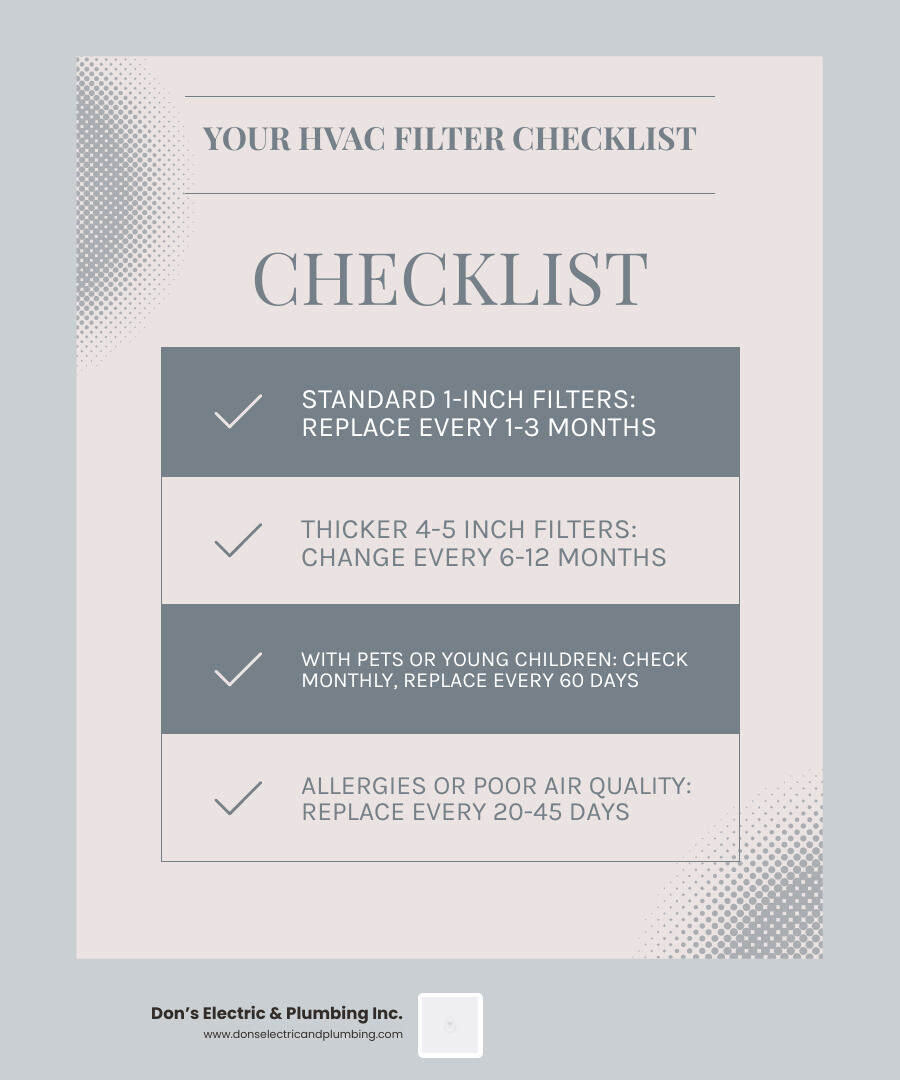
The thickness of your filter is one of the biggest predictors of its lifespan. Most standard homes use 1-inch filters, which typically need to be swapped out every one to three months. However, if your system is equipped to handle a 4-inch or 5-inch media filter, you might only need to think about it once or twice a year. For example, a high-capacity 5-inch filter can often last a full 12 months because it has significantly more surface area to trap dust without restricting airflow.
The material matters, too. Basic fiberglass filters are the most affordable option, but they are also the least efficient. They generally need to be changed every 30 days or less because they clog quickly and don’t hold much debris. On the other hand, pleated filters are designed with folds that increase their “holding capacity,” allowing them to last up to 90 days in a typical household.
If you’re unsure which filter your system uses or if it’s time for a professional eye to look at your setup, you can find more info about AC services on our specialized service page.
The Visual “Light Test” for Filter Inspection
Since every home in Schoharie and Fulton County is different, we recommend a “trust but verify” approach. Instead of just looking at the calendar, use the visual “light test” once a month.
- Turn off your HVAC system for safety.
- Slide the filter out of its housing.
- Hold the filter up to a bright light source, like a window or a lamp.
- The Verdict: If the light shines through clearly, your filter still has some life left. If the light is blocked by a thick layer of gray or brown dust, or if you see visible “mats” of pet hair and lint, it is time for a replacement.
This simple monthly check prevents you from throwing away a perfectly good filter too early while ensuring you don’t leave a clogged one in long enough to cause damage.
Factors Influencing Your Replacement Schedule
Why does your neighbor in Minden change their filter every month while your cousin in Sharon Springs waits six months? It usually comes down to the environment inside and outside the home.
- Home Size: Larger homes circulate a much higher volume of air. Because more air is moving through the ducts, the filter is exposed to more dust and particles, often requiring more frequent changes than a small apartment.
- Occupancy Levels: More people means more activity, more skin cells (yes, that’s a big part of dust!), and more opening and closing of doors that let in outdoor pollutants.
- Outdoor Air Quality: In our part of New York, we deal with high pollen counts in the spring and occasionally smoke from distant wildfires in the summer. If the air outside is “heavy,” your filter is working overtime to keep the air inside clean.
- Construction Dust: If you are remodeling your kitchen or if there is new construction down the street in Broadalbin, that fine drywall or silica dust will find its way into your return vents almost immediately.
If you notice your system struggling during these high-dust periods, it might be more than just a filter issue. You can find more info about furnace repair if your heating system seems to be lagging behind.
How often should you change your HVAC air filter with pets?
We love our furry friends, but they are “filter killers.” Pet hair and dander are heavy and sticky, meaning they clog up pleated filters much faster than standard household dust.
If you have one cat or dog, we generally recommend changing your filter every 60 days (2 months). However, if you have a “multi-pet” household—perhaps a couple of shedding Labradors or a few long-haired cats—you should move that schedule up to every 20 to 45 days. Ignoring this can lead to a “musty pet smell” circulating through your vents every time the AC kicks on.
How often should you change your HVAC air filter for allergy relief?
For those of us in Montgomery and Fulton counties who suffer from seasonal allergies or respiratory conditions like asthma, the air filter is your first line of defense. A standard filter might keep the system clean, but it won’t necessarily stop microscopic allergens.
For maximum relief, allergy sufferers should use high-quality pleated filters (specifically those with a higher MERV rating) and change them every 20 to 45 days. Frequent changes ensure that the filter is always at peak performance, capturing pollen, mold spores, and dust mites before they can trigger a reaction.
Understanding MERV Ratings and Filter Types
When you go to the store, you’ll see a “MERV” rating on the side of the box. MERV stands for Minimum Efficiency Reporting Value. It’s a scale from 1 to 16 for residential systems (17-20 are typically for hospitals).
- MERV 1-4: These are basic fiberglass filters. They protect the HVAC equipment from large dust bunnies but don’t do much for your lungs.
- MERV 5-8: Good for most residential homes. These trap most common household dust and lint.
- MERV 9-12: Excellent for homes with pets or mild allergies. They capture smaller particles like dander and some mold spores.
- MERV 13-16: These are high-efficiency filters that can even trap some bacteria and smoke particles.
A word of caution: Higher is not always better for your specific machine. A MERV 16 filter is very “dense,” and if your HVAC system wasn’t designed for it, it can act like a brick, suffocating your blower motor. We always recommend checking your owner’s manual or asking a professional before jumping to the highest rating. If you’ve noticed your system making strange noises after a filter change, check out more info about AC repair.
Consequences of a Clogged Filter
It might seem like a small thing, but neglecting that $15 filter can lead to thousands of dollars in headaches. Here is what happens when you let it go too long:
- Efficiency Loss: As we mentioned, a dirty filter can drop efficiency by up to 15%. That means for every $100 you spend on utilities, $15 is being wasted just trying to pull air through a wall of dust.
- Frozen Evaporator Coils: In the summer, your AC needs a steady flow of warm air to keep the coils from getting too cold. If the filter is clogged, the airflow stops, the coils freeze over, and your AC stops cooling entirely.
- Short-Cycling: If the system overheats because it can’t “breathe,” it will shut itself off prematurely to prevent a fire. This constant on-and-off (short-cycling) wears out the motor fast.
- Poor Air Quality: Eventually, the filter becomes so full that it can no longer hold more debris. At that point, dust starts bypassing the filter and settling directly on your furniture and in your lungs.
For more tips on keeping your system in top shape during the winter months, see more info about furnace service.
Conclusion
At Don’s Electric & Plumbing Inc., we’ve been helping families in Canajoharie and across Montgomery, Schoharie, and Fulton counties stay comfortable since 1984. As a family-owned and operated business, we know that the best way to avoid a 2:00 AM emergency call is simple, proactive maintenance.
Changing your air filter is the single most important thing you can do as a homeowner to protect your HVAC investment. Whether you are in Gloversville or Middleburgh, keeping your air clean ensures your system runs efficiently, your bills stay low, and your family breathes easy. We stand behind our work with a 100% satisfaction guarantee and are always here for your emergency needs.
If you’d rather have the pros handle your seasonal tune-ups, you can find more info about professional HVAC maintenance and how we can help you keep your home running like a dream.
Does home size affect how often I change my filter?
Yes, absolutely. A larger home has a larger volume of air that needs to be conditioned. To keep a 3,000-square-foot home at 70 degrees, the HVAC system has to move significantly more air than it would for a 1,200-square-foot home. More air movement means more dust, skin cells, and debris passing through the filter. If you live in a larger-than-average home, you should check your filter every 30 to 45 days, even if the box says it lasts for 90.
What happens if I never change my air filter?
If you never change your filter, it will eventually become a solid wall of debris. Your HVAC system’s blower motor will have to work exponentially harder to pull air through, which will lead to the motor burning out. Additionally, the lack of airflow can cause your furnace’s heat exchanger to crack from overheating or your AC’s compressor to fail. In short: neglecting a cheap filter will eventually lead to a total system breakdown and an expensive replacement.
Are washable filters better than disposable ones?
Washable filters are an eco-friendly choice because they can last for several years, but they come with a “maintenance tax.” They must be removed and cleaned with a hose or a specialized spray every 30 days. Most importantly, they must be completely dry before you put them back in; otherwise, you risk growing mold inside your ductwork. From a performance standpoint, many independent tests, including those by Consumer Reports, suggest that washable filters often have lower filtration efficiency for small particles compared to high-quality pleated disposables.