


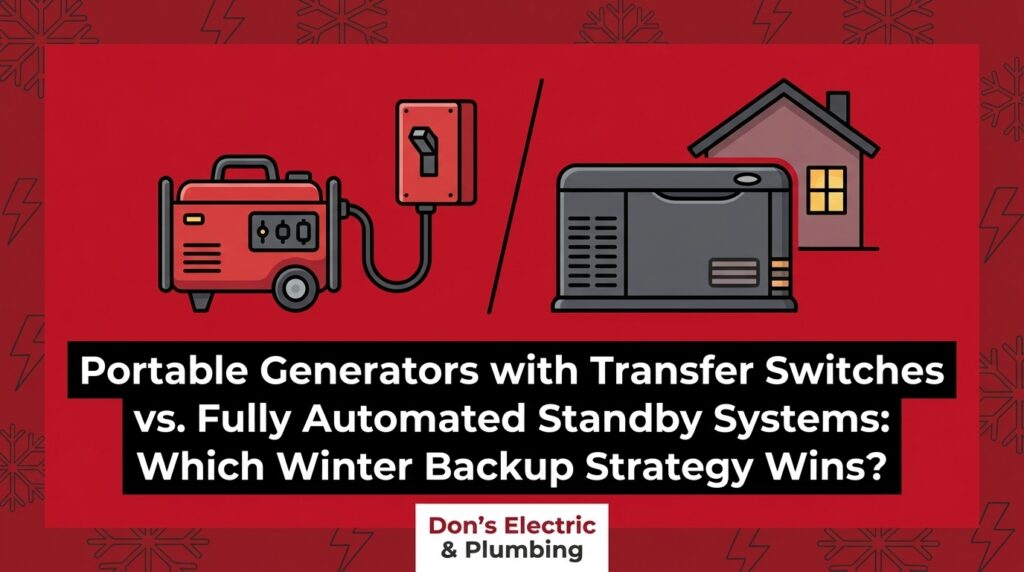
Preparing for the Dark: The Realities of Fall and Winter Power Outages
September is the critical window for early fall storm prep, making it the perfect time to evaluate portable generators with transfer switches vs. fully automated standby systems before the first freeze hits. Here at Don’s Electric & Plumbing, we often remind our Canajoharie neighbors that the days are getting shorter, the temperatures are dropping, and the window for proactive storm preparation is steadily closing. If you wait until the first major weather event knocks out the grid, your options for keeping the lights on and the heat running dwindle to whatever is left on the hardware store shelves. Deciding on your backup power strategy now is the only way to ensure your home remains safe and comfortable.
If you need guidance on integrating backup power safely into your home’s grid, reaching out for professional electric repair services in Canajoharie is the first step toward true storm readiness.
In our experience, the core decision every homeowner faces comes down to balancing the lower barrier of entry for manual backup setups against the seamless, hands-off reliability of permanent solutions. A manual setup requires you to be physically present, capable, and willing to brave the elements to restore your own power. A permanent system handles the crisis for you. Understanding the stark physical reality of a midnight power outage—where plunging temperatures quickly turn an inconvenience into a genuine hazard—is essential for making the right choice. Before committing to either path, having our professional team assess your home’s electrical capacity ensures that your chosen solution will actually support your household’s critical loads when the grid fails.
The Physical Demands of Portable Generators with Transfer Switches
When comparing a portable vs standby generator transfer switch, our team consistently sees that the most significant difference lies in the physical labor required to get the power flowing. A portable unit does not deploy itself. If the power drops at 2:00 AM during a blinding snowstorm, restoring your home’s electricity requires a very specific, manual sequence of events.
The deployment process typically involves:
- Navigating the elements: You must go outside, often dragging a heavy portable generator weighing upwards of 150 pounds through heavy snowfall or freezing ice storms in the middle of the night.
- Positioning for safety: The generator must be rolled to a safe, ventilated distance from the house—usually at least 20 feet away—to prevent deadly carbon monoxide from entering windows or doors.
- Connecting the heavy-duty cord: You have to unravel a thick, stiff generator cord in freezing temperatures and connect it from the unit to the inlet box on your home’s exterior.
- Starting the engine: Pulling a manual starter cord on a cold engine can be incredibly difficult when the temperature drops below freezing, requiring significant upper body strength and persistence.
- Flipping the switch: Finally, you must return indoors to the manual transfer switch and manually flip the breakers from utility power to generator power, selecting which specific circuits you want to energize.
The physical exertion required to manage this process in harsh weather cannot be overstated. Furthermore, the transfer switch itself must be professionally wired to your home’s panel. We always stress to our customers that this is absolutely not a DIY project. Integrating a manual switch often coincides with an electrical panel replacement or upgrade, as older panels may lack the necessary space or safety mechanisms to accept an interlock kit or sub-panel safely.
Fuel Storage and Safety Risks During Extended Outages
One of the most overlooked aspects of relying on a portable unit is the ongoing fuel requirement. Keeping a gasoline-powered engine running for days at a time presents significant logistical and safety challenges, especially for residents in Canajoharie and the Mohawk Valley, where historical ice storms have been known to cause multi-day outages.
The Reality of Gasoline Degradation
Gasoline is not a stable, long-term storage commodity. Untreated ethanol-blended gasoline begins to degrade in just three to six months. As it breaks down, it undergoes phase separation, where water is drawn into the fuel. If this stale gas sits in your portable generator’s tank or carburetor, it creates a sticky varnish that clogs the fuel lines. At Don’s Electric & Plumbing, a pattern our technicians see frequently is homeowners rolling out their portable generator during the first major winter storm, only to find the engine won’t start because last year’s fuel ruined the carburetor.
Logistical Nightmares of Extended Outages
During a severe Mohawk Valley winter outage, fuel rationing becomes a significant stressor. A typical portable generator can consume 12 to 20 gallons of gasoline per day under a heavy load. If an ice storm knocks out power for three days, you need up to 60 gallons of fuel to keep your heat and lights running continuously. Safely storing that volume of volatile fuel on your property is a massive logistical challenge and a fire hazard. If you don’t store it, you are forced to drive on dangerous, icy roads to find a gas station that actually has grid power to pump fuel.
Carbon Monoxide Hazards
Beyond the fuel logistics, safety remains a paramount concern. The Consumer Product Safety Commission (CPSC) repeatedly warns about the severe carbon monoxide risks associated with portable generators. Because homeowners want to keep the units out of the snow or rain, there is a dangerous temptation to run them in garages, under breezeways, or too close to windows. This invisible, odorless gas can build up rapidly, turning a power outage into a life-threatening emergency.
Hands-Off Reliability: How Fully Automated Standby Systems Work
In our years of serving the Mohawk Valley, we’ve found that if the manual labor and fuel storage of a portable unit sound overwhelming, a permanent solution offers a completely different experience. When you evaluate a portable vs standby generator transfer switch, the permanent system removes human intervention entirely. The activation is seamless, automatic, and requires zero physical effort from the homeowner.
The Automatic Sequence Explained
A fully automated standby system acts as a silent sentry for your home’s electrical grid. When a storm knocks out the utility power, the automatic transfer switch (ATS) detects the voltage drop immediately. Within seconds, the ATS signals the standby generator’s engine to start. Once the generator reaches the correct operating speed and frequency—usually within 10 to 15 seconds—the ATS automatically disconnects your home from the dead utility lines and connects it to the generator power. You do not have to step outside, pull a cord, or flip a single switch. The lights simply flicker, and then they return.
Continuous Fuel Supply
Unlike portable units that rely on volatile gasoline, standby systems are hard-piped directly into your home’s existing natural gas or liquid propane (LP) supply. This eliminates the need to store hazardous fuel, rotate gas cans, or brave icy roads to refuel. As long as the natural gas lines are flowing or your large propane tank has reserves, the generator can run continuously for days or even weeks during an extended winter crisis.
Adapting to Your Home’s Capacity
This hands-off reliability provides unparalleled peace of mind, particularly for homeowners who travel frequently during the winter, have mobility limitations, or rely on electrically powered medical equipment. Depending on your goals, these systems can be tailored to your needs. You can choose to back up just the essential circuits—like the furnace, refrigerator, and well pump—or you can opt for whole-home coverage. Understanding the electrical load is critical, which is why sizing whole-home standby generators requires professional calculation from our team rather than relying on guesswork. (It is also worth checking with your utility provider or tax professional, as generic energy rebates or home resiliency tax credits may apply to qualifying permanent standby installations.)
Streamlining Installation: Electrical and Gas Requirements
Transitioning to an automated standby system is a major home upgrade that requires strict adherence to local building codes and precise professional execution. The installation process bridges two highly regulated trades: electrical and plumbing. For homeowners in Canajoharie and the Mohawk Valley, our team knows firsthand that coordinating this installation can sometimes feel overwhelming if not managed correctly.
The Electrical Integration
The Problem: The automatic transfer switch must be safely and legally integrated into your home’s main breaker panel. If this is done incorrectly, backfeeding can occur, sending deadly voltage down the utility lines and endangering linemen working to restore grid power.
The Cause: Modern electrical panels require specific clearances, load shedding modules, and proper grounding to communicate with a standby generator’s computer board.
The Solution: A licensed professional must install the ATS between the utility meter and the main panel, ensuring that the mechanical interlocks and computer sensors are perfectly calibrated to manage the electrical load without overloading the generator.
The Natural Gas Plumbing
The Problem: A standby generator requires a massive volume of fuel delivered at a very specific pressure to operate correctly under a heavy load.
The Cause: Existing residential gas lines are often sized only for standard appliances like stoves and water heaters. Tapping into an undersized line will cause the generator to stall or run lean, potentially damaging the engine.
The Solution: The gas plumbing must be carefully calculated, often requiring a dedicated, hard-piped natural gas or propane line run directly from the meter or primary regulator to the generator location.
Traditionally, homeowners face the hassle of coordinating separate plumbing and electrical contractors for a single project, leading to scheduling delays and finger-pointing if the system doesn’t start up correctly. Working with Don’s Electric & Plumbing eliminates this friction entirely. Our multi-trade capability means we seamlessly handle both the complex electrical panel wiring and the precise natural gas plumbing in-house. You never have to sub out work or play middleman between different contractors; the entire installation is streamlined, code-compliant, and handled by one cohesive team.
Side-by-Side Comparison: Portable vs. Standby Readiness
To make the best decision for your household, it helps to see the operational differences laid out clearly. When our technicians compare a portable vs standby generator transfer switch with our customers, the contrast in user experience, safety, and readiness is stark.
| Feature | Portable with Manual Switch | Fully Automated Standby System |
|---|---|---|
| Fuel Source | Stored gasoline (requires constant refilling and chemical stabilization). | Continuous natural gas or large-capacity liquid propane (no manual refilling). |
| Activation Method | Manual pull-start in the elements, followed by manually flipping the transfer switch. | Automatic detection and switchover within 10 to 15 seconds of utility failure. |
| Weather Exposure | Requires going outside in storms, snow, or ice to deploy and refuel. | Zero weather exposure; the homeowner stays safely and warmly indoors. |
| Installation Complexity | Requires professional installation of a manual transfer switch or interlock kit. | Requires full professional integration of both electrical panels and gas plumbing. |
| Power Capacity | Typically limited to 8-12 essential circuits (lights, fridge, furnace fan). | Capable of powering the entire home, including heavy loads like well pumps and HVAC. |
The table above illustrates what we see in the field: while a portable unit has a lower initial barrier to entry, the physical toll and ongoing maintenance demands are significantly higher. A permanent standby system requires a larger upfront commitment but delivers absolute certainty when the grid fails.

Common Questions About Backup Generator Solutions
Making the leap to resilient home power often brings up technical questions. On our service calls throughout the region, whether you are looking for general guidance or specific electric repair in Benson, our team at Don’s Electric & Plumbing finds that understanding the mechanics of backup power in Canajoharie and the Mohawk Valley is vital for long-term safety.
What is the difference between a portable generator with a transfer switch and a standby generator?
The primary difference is human intervention and fuel type. A portable generator runs on gasoline, must be manually rolled outside, started by hand, and plugged into a professionally installed manual transfer switch. A standby generator is permanently installed outside your home, hardwired to your electrical panel, plumbed into your natural gas or propane line, and operates entirely automatically without any physical effort from you.
Does a standby generator turn on automatically during a power outage?
Yes, a standby generator activates automatically. The system uses an automatic transfer switch (ATS) that constantly monitors the utility lines. The moment it detects a drop in voltage, the ATS starts the generator engine, waits a few seconds for the power to stabilize, and then automatically shifts your home’s electrical load from the dead grid to the generator power.
Can a portable generator power a whole house through a manual transfer switch?
Generally, no. Most portable generators simply do not produce enough wattage to run an entire modern home simultaneously. Through a manual transfer switch, you are typically limited to powering 8 to 10 essential circuits, such as your refrigerator, a few lighting zones, and the blower motor on your gas furnace. Attempting to run heavy loads like an electric range or a central heat pump will overload and stall a portable unit.
Is a standby generator better than a portable with a transfer switch for winter storms?
For winter storms, our team strongly recommends a standby generator because it offers vastly superior safety and reliability. Since it runs on continuous natural gas or propane, you never have to trudge through snow and ice to refuel it in the dark. Furthermore, it eliminates the risk of carbon monoxide poisoning associated with improperly placed portable gasoline generators, keeping your family safe indoors while the storm rages outside.
How long can gasoline be stored for a portable generator before it goes bad?
Standard untreated gasoline begins to degrade in as little as three to six months. The ethanol in modern fuel attracts moisture from the air, causing phase separation and creating a gummy varnish that will clog a portable generator’s carburetor. If you rely on a portable unit, you must use fuel stabilizers and strictly rotate your stored gasoline supply several times a year to ensure the engine starts when you need it.
Do I need both a plumber and an electrician to install a standby generator?
Yes, a proper standby installation requires both advanced electrical panel integration and precise natural gas or propane plumbing. Traditionally, homeowners have to hire and coordinate two separate contractors. However, working with a multi-trade company like Don’s Electric & Plumbing allows the entire project—both the high-voltage wiring and the gas pipe fitting—to be completed seamlessly by one unified team, ensuring total code compliance without the scheduling headaches.
Secure Your Home’s Power Before the Ice Arrives
Deciding on your level of readiness is crucial before the ground freezes and the harsh winter weather takes hold. The September/early fall storm prep window is the ideal time to evaluate your options, rather than waiting for the first major blizzard to expose the vulnerabilities in your home’s power plan. True peace of mind comes from knowing exactly how your system will perform in the dark, and whether you will be outside pulling a starter cord or sitting warmly inside while your system does the work.
Don’t leave your family’s comfort and safety to chance this winter. Schedule a professional assessment with Don’s Electric & Plumbing for your backup power needs today, and ensure your home is fully prepared to weather the storm.