


Why Preventing Electrical Overloads During Summer Is a Real Safety Issue
Preventing electrical overloads during summer starts with understanding what puts your home at risk — and taking a few smart steps before the heat peaks. Here’s a quick overview of what you need to know:
How to prevent electrical overloads this summer:
- Spread out your appliance use — avoid running the AC, dryer, and microwave at the same time on the same circuit.
- Know your circuit limits — a 15-amp circuit handles up to 1,440 watts safely; a 20-amp handles up to 1,920 watts.
- Avoid daisy-chaining power strips — this is one of the fastest ways to overheat a circuit.
- Unplug devices you’re not using — standby power (phantom load) adds up quietly.
- Run heavy appliances during off-peak hours — typically before 4 p.m. or after 7 p.m.
- Watch for warning signs — flickering lights, warm outlets, buzzing sounds, or tripped breakers.
- Schedule a professional electrical inspection — especially if your home was built before the 1990s.
Picture this: it’s a sweltering July afternoon in Canajoharie. Your central air conditioner is running full blast, someone starts the dryer, and the moment the microwave kicks on — half the house goes dark. Sound familiar?
That’s an electrical overload, and it happens more often in summer than any other season. The combination of heat-driven cooling demand, more people home charging devices, and outdoor equipment all competing for power pushes home electrical systems to their limits. For older homes in Schoharie, Montgomery, and Fulton counties — many with panels designed for a simpler era — that strain can tip from inconvenient into genuinely dangerous.
This guide walks you through exactly what causes summer overloads, how to spot them early, and what you can do — right now and long-term — to keep your home safe all season.
Why Summer Heat Strains Your Home’s Power

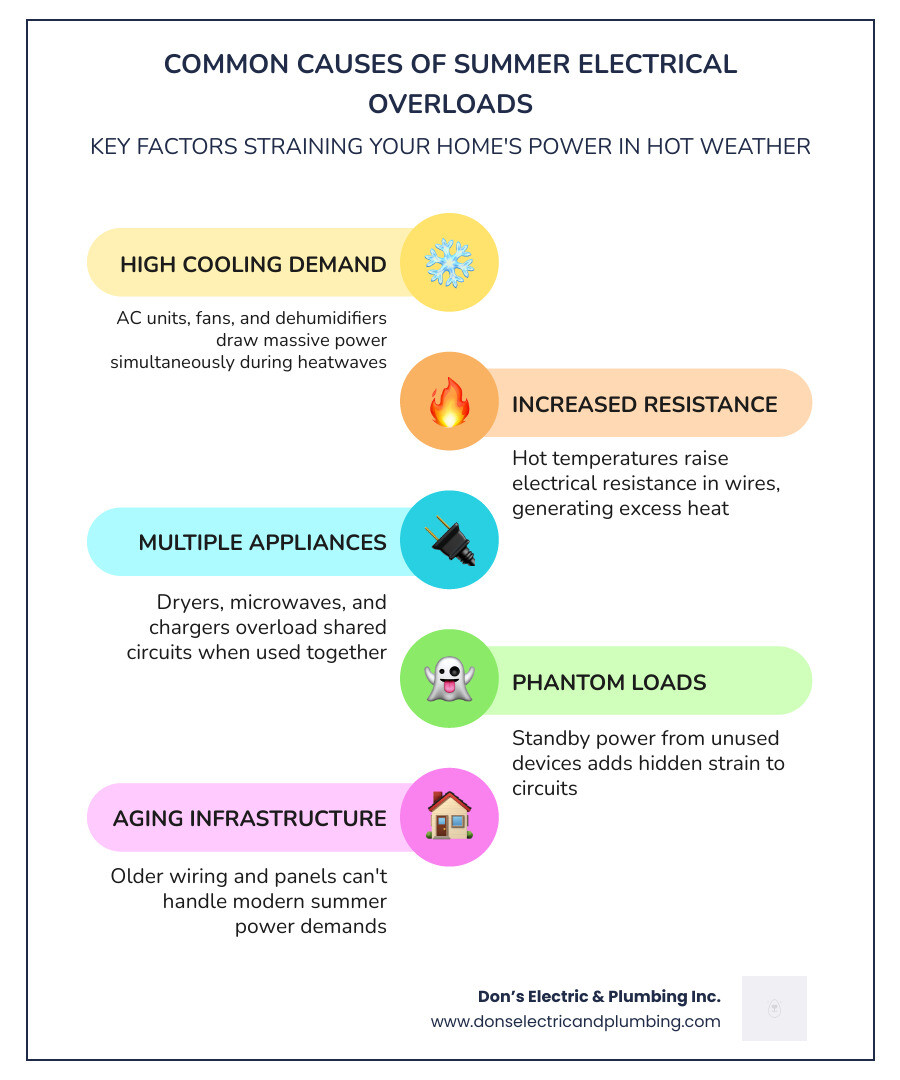
When the mercury rises in May 2026, your home’s electrical system isn’t just working harder because you’ve cranked the AC. There is a hidden scientific battle happening inside your walls. As temperatures climb, electrical resistance in your copper wiring increases. This means electricity has a harder time flowing through the wires, which generates even more internal heat.
If you add high humidity to the mix, you have a recipe for trouble. Moisture can find its way into outdoor outlets and even your main service panel, leading to corrosion and short circuits. Humidity also accelerates the degradation of wire insulation. When insulation becomes brittle or damp, the risk of Common Home Electrical Hazards And How To Avoid Them increases significantly.
Furthermore, the motors in your cooling systems—like your refrigerator and central air unit—have to work much harder to keep things cool in a hot environment. These overworked motors draw more current than they would on a mild day, pushing your circuits closer to their breaking point.
The Science of Preventing Electrical Overloads During Summer
It helps to think of your electrical system like a highway. In moderate weather, the traffic (electricity) flows smoothly. But during a New York summer heatwave, the “pavement” (the wires) expands and becomes less efficient. This thermal expansion can loosen terminal connections in your outlets or panel.
Passive cooling, which is how your electrical components naturally shed heat, becomes less effective when the ambient air is already 90 degrees. This is why we often suggest Sniffing Out Trouble How To Spot Dangerous Electrical Problems early; if your panel feels hot to the touch or smells like ozone, it’s a sign that the passive cooling has failed and the system is in distress.
Recognizing the Warning Signs of an Overloaded Circuit
An electrical overload isn’t always a “sudden darkness” event. Often, your home will try to tell you it’s struggling long before the breaker actually trips. If you notice your lights dimming or flickering when the AC kicks on, that is a classic sign of a system under stress.
Other red flags include:
- Buzzing or clicking sounds: These often come from outlets or switches when the load is too high.
- Warm outlet covers: If a wall plate feels warm to the touch, the wiring behind it is likely overheating.
- Burning odors: A faint smell of burning plastic or “fishy” odors are emergency signs of melting insulation.
- Discolored wall plates: Brown or charred marks around the plug slots are a major fire hazard.
If you see these signs, don’t ignore them. You should Dont Get Zapped By These Old Wiring Warning Signs and address them immediately to prevent a house fire.
Immediate Steps for Preventing Electrical Overloads During Summer Trips
When a breaker trips, it’s doing its job—protecting your home from a fire. Your first instinct might be to run to the panel and flip it back on, but if you don’t reduce the load first, it will just trip again.
- Unplug high-draw devices: Before resetting, unplug whatever was running when the power cut out (the toaster, the vacuum, or the portable AC).
- Locate the tripped breaker: It will usually be stuck in the middle position, between “On” and “Off.”
- Reset correctly: Flip the switch all the way to “Off” first, then back to “On.”
- Investigate: If you’re unsure why it happened, we have a guide for Troubleshooting Your Tripped Breaker Without Calling An Electrician.
If the same breaker trips repeatedly, stop resetting it. This is a safety mechanism telling you there is a deeper issue. Continually forcing a breaker to stay on can lead to permanent damage. You can read more about why this happens in Circuit Breaker Tripping Find The Cause And Keep The Lights On.
Practical Strategies for Preventing Electrical Overloads During Summer
To effectively manage your home’s power, you need to know the “speed limit” of your circuits. Most New York homes have 15-amp or 20-amp circuits for standard outlets.
| Circuit Type | Max Wattage | Safe Load (80% Rule) |
|---|---|---|
| 15-Amp Circuit | 1,800 Watts | 1,440 Watts |
| 20-Amp Circuit | 2,400 Watts | 1,920 Watts |
The “80% Rule” is critical. You should never plan to use more than 80% of a circuit’s capacity for more than three hours at a time. This prevents the wires from getting dangerously hot. Following The Ultimate Home Electrical Safety Checklist For Beginners is a great way to start auditing your home’s usage.
Daily Habits for a Safer Home:
- Shift your schedule: Run the dishwasher and laundry late at night or early in the morning to avoid the “Peak Demand” hours (usually 4 p.m. to 7 p.m.).
- Kill the vampires: “Phantom loads” are devices like TVs, game consoles, and chargers that draw power even when turned off. Unplug them or use an advanced power strip that cuts power to idle devices automatically.
- Coordinate kitchen use: Try not to use the microwave, air fryer, and coffee maker all at once if they share a circuit.
Managing High-Demand Appliances and Outdoor Equipment
Summer brings out the big energy hogs. One major thing to understand is startup vs. running watts. An air conditioner might only use 700 watts while running, but it could require 2,000 watts just to get the compressor started. If your circuit is already near its limit, that startup surge will trip the breaker every time.
Outdoor fun can also lead to indoor problems. Many homeowners don’t realize that their outdoor outlets often share a circuit with the kitchen or garage. Plugging in a high-powered pool pump or using an electric lawnmower can easily overload those shared lines.
Avoid “daisy-chaining”—the dangerous practice of plugging one power strip into another. This creates a massive concentrated load that power strips aren’t designed to handle. If you must use an extension cord for summer projects, ensure it is a heavy-duty, outdoor-rated cord that can handle the amperage of your tools. For those in older homes, these modern demands are often the Top Reasons Older Home Breakers Keep Tripping.
Long-Term Upgrades for a Safer Summer in Canajoharie
If your home was built before the 1990s, you likely have a 100-amp service panel. While that was plenty of power thirty years ago, today’s homes—with central AC, multiple computers, big-screen TVs, and maybe even an EV charger—need more. Upgrading to a 200-amp service is one of the best ways to ensure you never have to play the “outlet shuffle” again.
Recommended Upgrades:
- Dedicated Circuits: High-demand appliances like window AC units, refrigerators, and sump pumps should each have their own dedicated circuit. This ensures that a surge from one doesn’t kill the power to the others.
- Whole-Home Surge Protection: Summer thunderstorms in the Mohawk Valley can send massive voltage spikes through your lines. A whole-home surge protector installed at your main panel protects everything in your house, not just what’s plugged into a strip.
- GFCI and Weatherproof Outlets: For your patio and pool areas, ensure you have GFCI (Ground Fault Circuit Interrupter) protection. These outlets trip instantly if they detect moisture or a short, preventing electrocution.
Understanding the Safety First Understanding The Risks Of A Repeatedly Tripping Breaker is vital for long-term safety. While DIY is great for painting or gardening, electrical work is a different beast. There are Common Electrical Issues Why You Legally Cant Fix Everything, and for good reason—one wrong wire can lead to a fire or worse.
Frequently Asked Questions about Summer Electrical Safety
Why does my AC trip the breaker only when it’s very hot outside?
When it’s extremely hot, your AC compressor has to work much harder to move heat out of your home. This increases the amperage draw. Additionally, if your outdoor condenser coils are dirty, the unit can’t shed heat efficiently, causing the motor to draw even more power. The heat also makes the breaker itself more sensitive to tripping. Regular maintenance and cleaning your coils can help prevent this.
How can I tell which outlets are on the same circuit?
The easiest way is the “lamp test.” Plug a small lamp into an outlet and turn it on. Go to your panel and flip the breakers off one by one until the lamp goes out. Note which other lights or outlets in the room also went dark. Labeling your panel clearly after this exercise will save you a lot of headache during future trips. If you want to be more precise, you can use a digital circuit tracer available at most hardware stores.
Is it safe to use power strips for my portable air conditioner?
Generally, no. Portable and window AC units draw a significant amount of power. Most standard power strips are not rated for the sustained high-wattage load of a cooling unit. This can cause the power strip to melt or catch fire. These appliances should always be plugged directly into a wall outlet, preferably on a dedicated circuit.
Conclusion
At Don’s Electric & Plumbing Inc., we’ve been helping our neighbors in Canajoharie and throughout Schoharie, Montgomery, and Fulton counties stay safe since 1984. As a family-owned and operated business, we know exactly how the local New York climate can stress an older home’s electrical system.
Whether you are in Sharon Springs, Broadalbin, or Little Falls, you don’t have to spend your summer worrying about flickering lights or hot outlets. We offer a 100% satisfaction guarantee on all our work and provide 24/7 emergency services because we know electrical issues don’t always happen during business hours.
Don’t wait for a heatwave to find out your panel can’t handle the load. Schedule your professional summer electrical inspection today and let us help you keep your cool all season long.