


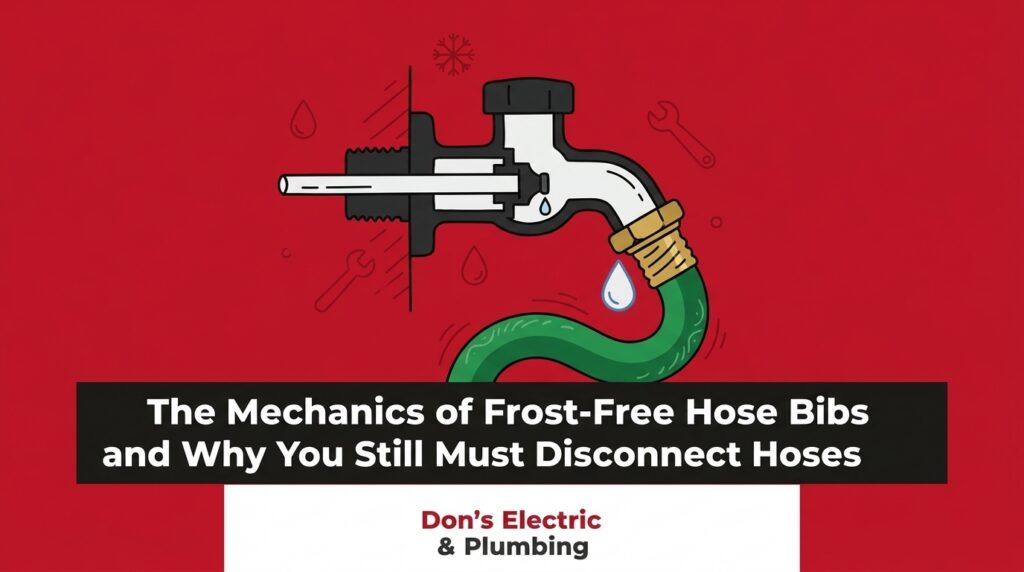
The Hidden Danger of the First Fall Freeze
Late September in Upstate NY brings a crisp shift to the air, signaling that the first hard frost is often only weeks away. As you prepare your property for the coming cold, understanding the mechanics of frost-free hose bibs and why you still must disconnect hoses is critical to preventing a winter plumbing disaster. Many homeowners trust the “frost-free” label completely, leaving garden hoses attached well into autumn under the assumption that their modern plumbing is immune to the dropping temperatures. This dangerous false sense of security is a pattern we see often. At Don’s Electric & Plumbing, our team responds to countless burst pipes every winter caused by this exact oversight, turning a simple fall yard-prep task into a major structural emergency.
If you need comprehensive plumbing repair services or find yourself facing a sudden burst pipe requiring emergency plumbing repair, our team is ready to help.
The False Security of ‘Frost-Free’ Plumbing Labels
The term “frost-free” sounds like a permanent, magical shield against winter weather. In reality, a frost-free plumbing fixture is highly conditional. It is designed to resist freezing only when operated under specific, correct conditions. The label does not mean the metal itself generates heat or repels ice; it simply means the mechanical design allows water to drain away from the danger zone.
During early fall, it is common to leave a garden hose attached to the side of the house. You might plan to wash the car one last time or water the autumn mums before the deep winter freeze sets in. Because the September/October first frost in Upstate NY often arrives overnight without warning, we constantly remind our customers that an attached hose becomes a severe liability. The protective design of your outdoor spigot relies 100 percent on proper drainage. When a hose is left threaded onto the nozzle, it acts like a plug, holding water right where the freezing air can reach it.
Comparing Outdoor Plumbing Types
| Feature | Standard Spigot | Frost-Free Sillcock |
|---|---|---|
| Valve Location | Right at the exterior handle | Deep inside the home’s interior |
| Drainage | Holds water up to the exterior wall | Drains completely empty when shut off |
| Freeze Risk | High; requires interior shut-off valve to be closed manually | Low; provided hoses are disconnected and pitch is correct |
| Winter Prep | Must isolate and drain line from inside | Simply unscrew the garden hose outside |
Understanding the difference between these fixtures is the first step in protecting your home, but knowing exactly how the modern version works reveals exactly why an attached hose is so destructive.
Anatomy of a Frost-Free Sillcock (Long-Stem Valve)
To understand why fall maintenance is non-negotiable, you have to look inside the wall. The fixture you see on the outside of your house is actually just the tip of a much larger mechanism known as a frost-free sillcock (long-stem valve).
The Long-Stem Mechanism
Unlike a traditional spigot where the water stops right behind the handle, a frost-free sillcock features a long copper or brass tube that extends anywhere from 4 to 14 inches into your home. When you turn the handle on the outside of your house, a long rod turns inside that tube. The actual washer and valve seat—the parts that stop the flow of water—are located at the very back of this long stem, deep inside your house.
The Heated Envelope Concept
The genius of this design relies on the “heated envelope” of your home. By placing the actual shut-off valve 10 inches inside your basement or crawlspace, the water is held back in a zone that stays warm, well above freezing temperatures. The portion of the pipe that extends through your exterior wall and out into the cold is designed to be completely empty when the valve is closed.
Gravity and Drainage
For the empty tube to stay empty, it must drain. A properly installed frost-free sillcock (long-stem valve) is pitched at a slight downward angle toward the outside. When you shut off the water, any remaining liquid in that 14-inch tube flows downhill and drips out of the spout. Once it is empty, there is nothing inside the exposed section of pipe to freeze. The system is elegant, effective, and entirely dependent on that water having a clear exit path.
The Physics of Freezing: Why an Attached Hose Causes Ruptures
The Problem: When you leave a garden hose attached to the spigot, you trap water inside the sillcock’s outer tube. Even if you turn off the handle and the water stops flowing from the deep interior valve, the water already sitting in the long stem cannot drain out. The hose creates a vacuum lock and a physical barrier, holding the liquid directly in the freeze zone.
The Cause: The laws of thermodynamics dictate that water expands by approximately 9 percent when it freezes into ice. If water is trapped inside the closed copper tube of your sillcock, the dropping overnight temperatures will cause that water to freeze from the outside in. As the ice forms, it expands backward toward the valve seat. Because water cannot be compressed, this expansion creates immense hydraulic pressure inside the pipe. The pressure has nowhere to go, eventually exceeding the structural limits of the copper or brass.
The Solution: The pipe splits open to relieve the pressure. The tricky part is that this rupture usually happens right behind the exterior wall, inside your home. Because the internal valve is still shut, no water sprays out immediately. Our team typically sees the real disaster strike in the spring: the moment you turn the handle to water your lawn, water rushes past the internal valve and sprays out of the cracked pipe directly into your wall cavity, soaking your insulation, drywall, and flooring. Knowing about plumbing issues you should never ignore can save you from extensive and costly water damage restoration.

Why Older Regional Homes Face Unique Vulnerabilities
The mechanical principles of a frost-free sillcock apply everywhere, but the reality of how they perform is heavily influenced by local construction. In our years of servicing the Mohawk Valley, our team has found that in many older Canajoharie area homes, the boundary of the “heated envelope” is not always well-defined. A frost-free spigot relies on the interior of your home actually being warm enough to prevent the internal valve from freezing.
Older farmhouses and historic properties in the region often feature uninsulated rim joists, drafty fieldstone basements, or vented crawlspaces. If the interior shut-off valve of your frost-free sillcock is sitting in a basement corner that drops below freezing during a harsh January wind, the frost-free design can still fail. The cold air bypassing your foundation can freeze the water right at the internal valve seat.
Furthermore, older homes tend to settle over the decades. A sillcock that was perfectly pitched downward when it was installed in 1995 might now be tilted slightly backward due to foundation settling. If the pipe angles upward toward the outside, gravity will keep water pooled near the internal valve, defeating the design entirely. As a local, family-owned team at Don’s Electric & Plumbing, we understand the specific structural quirks and insulation challenges of older Upstate NY homes. Our plumbers know exactly where to look for these hidden vulnerabilities. If you suspect your outdoor plumbing is compromised, fixing plumbing leaks early is the best way to protect your foundation and basement.
The Critical Fall Yard-Prep Checklist for Outdoor Plumbing
Preventing a burst pipe is incredibly simple if you take action at the right time. Our team highly recommends completing this checklist well before the September/October first frost in Upstate NY hits your neighborhood, rather than waiting for a freeze warning.
- Disconnect and Store Hoses: Physically unscrew all garden hoses, splitters, and timers from your outdoor spigots by late September. Drain the hoses completely by stretching them out on a slope, coil them loosely, and store them in a garage or shed.
- Inspect for Slow Drips: After shutting off the spigot, watch it for a few minutes. A frost-free sillcock (long-stem valve) should drain a small amount of water and then stop completely. If it continues to drip, the internal washer is failing, and the fixture needs to be rebuilt or replaced before winter.
- Check the Interior Drafts: Go into your basement or crawlspace and locate where the pipe comes through the wall. Ensure there are no open gaps letting cold air blow directly onto the pipe. Seal any drafts with spray foam or specialized insulation.
- Verify the Pitch: Place a small level on the pipe inside your basement. It should slope slightly down toward the outside wall. If it slopes inward, contact a professional to correct the alignment.
- Add a Secondary Cover: Consider installing an insulated foam faucet cover over the exterior spigot. While not strictly necessary for a properly functioning frost-free bib, it provides an inexpensive, secondary layer of protection against extreme wind chills in older, drafty homes.
Recognizing the Signs of a Ruptured Spigot
If a hose was left attached during a sudden freeze, the damage is likely already done. Because the rupture occurs inside the wall, you must be hyper-vigilant the first time you use the spigot in the spring or during a mid-winter thaw. When our emergency plumbers are called out for these issues, we immediately look for several telltale indicators.
Key signs of a burst sillcock include:
- Water leaking from the weep hole: Many frost-free models have a small drainage hole near the handle. If water aggressively sprays from this hole when you turn the handle on, the internal stem is cracked.
- Sudden loss of water pressure: If the hose is barely trickling but the handle is turned all the way open, the majority of the water is likely dumping inside your wall cavity.
- Hearing running water indoors: If you turn on the outside tap and hear a rushing or spraying sound coming from the wall behind it, shut the valve off immediately.
- Unexplained basement puddles: Finding water pooling near the rim joist or running down the foundation wall directly below the spigot location.
The most important rule: Do not attempt to patch or tape a cracked long-stem valve. Replacing a burst frost-free sillcock (long-stem valve) requires professional access to the interior plumbing, often involving cutting into drywall or soldering copper pipes in tight spaces near combustible wood framing. This is strictly a job for a licensed professional. If a burst pipe is causing interior flooding, fast emergency response from a trusted local team is required to minimize water damage. We provide same-day plumbing solutions to get your home secured quickly.
Frequently Asked Questions About Winterizing Outdoor Plumbing
Can a frost-free hose bib freeze?
Yes, a frost-free hose bib can freeze if water is trapped inside the outer tube because a hose is attached, or if the pipe lacks the proper downward pitch to drain completely. It can also freeze if the interior shut-off valve is exposed to freezing drafts in an uninsulated basement or crawlspace. The “frost-free” design relies entirely on the pipe remaining empty of water in the cold zone.
Why did my frost-proof spigot burst?
The most common cause of a burst frost-proof spigot is leaving a garden hose connected during freezing temperatures, which prevents the water from draining out of the freeze zone. When the trapped water turns to ice, it expands backward toward the house, creating immense pressure that cracks the metal tube. You typically won’t notice the burst until you turn the water on in the spring.
What happens if you leave a hose attached in winter?
Water stays trapped in both the hose and the spigot’s outer chamber. When the temperature drops, the water freezes and expands by approximately 9 percent. This expansion creates hydraulic pressure that easily splits the copper or brass pipe inside your wall, leading to severe interior water damage the next time the spigot is used.
Do I need to cover a frost-free hose bib?
While not strictly necessary if the bib is installed correctly and the hose is removed, an insulated cover provides extra protection against severe wind chills. In older, drafty homes where the “heated envelope” is less reliable, a foam cover acts as a cheap insurance policy to keep the extreme cold away from the exterior metal.
How can I tell if my sillcock is properly pitched?
A properly installed sillcock should angle slightly downward toward the exterior of the house to allow gravity to drain the water completely. You can check this by placing a small level on the pipe in your basement; the bubble should indicate a slight downward slope toward the outdoors. A professional plumber can verify and correct the pitch if it has shifted due to house settling.
Take Action Before the Freeze: Secure Your Home Today
The transition from late summer to the September/October first frost in Upstate NY happens faster than most homeowners expect. The core takeaway is simple but vital: disconnect your hoses now, before the temperature drops. Do not let the “frost-free” label lull you into a false sense of security. Taking five minutes to unscrew your hoses today can save you from devastating hidden water damage next spring.
If you have concerns about the insulation in your older home, suspect your outdoor plumbing is improperly pitched, or notice a slow drip that won’t stop, do not wait for the deep freeze. Schedule a pre-winter plumbing inspection to ensure your system is ready for the harsh months ahead. If you are already dealing with a frozen or burst pipe, contact us immediately for emergency plumbing repair to protect your property.