


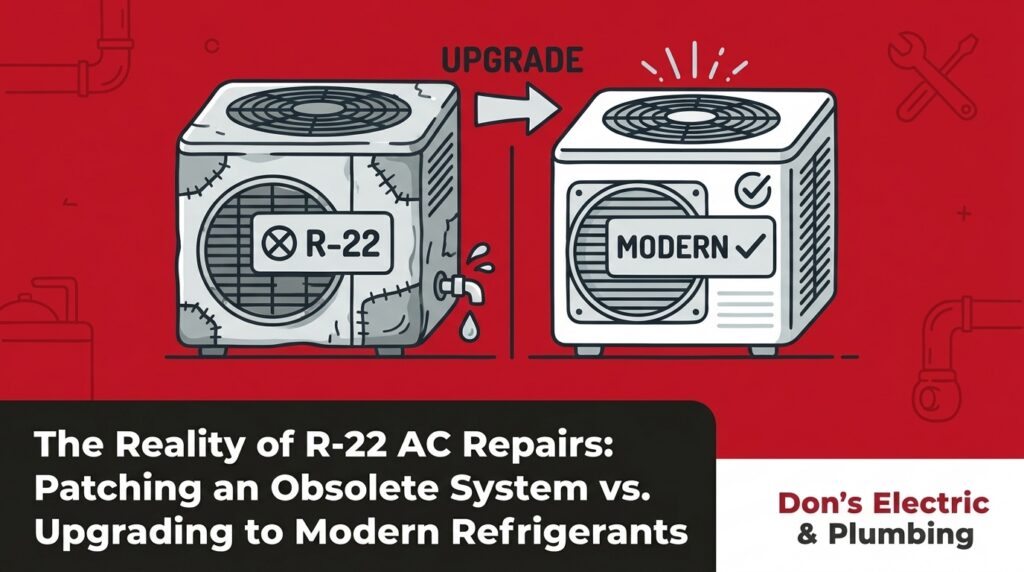
Is a Quick Freon Top-Off Still a Viable Option?
The biggest misconception in home cooling is that a struggling system just needs a quick top-off, but when you look at repairing an obsolete R-22 AC unit vs. upgrading to modern refrigerant standards, the reality is far more complex. Many homeowners assume that a warm breeze coming from their vents is a minor inconvenience that a technician can solve in twenty minutes with a fresh tank of gas. However, if your home relies on older cooling technology, that routine service call can quickly turn into a significant crossroads.
To help you navigate this decision, our comprehensive HVAC and plumbing services are designed to evaluate the true condition of your equipment. A typical pattern we see involves a homeowner discovering a leak right in the middle of a July peak summer heatwave. The air conditioner runs for hours, the indoor temperature refuses to drop, and the diagnosis reveals a compromised coil on a pre-2010 R-22 (Freon) central AC unit. Because this specific refrigerant is no longer manufactured, you are immediately faced with a difficult choice: sink substantial funds into a dwindling supply of reclaimed refrigerant, or invest that money into a reliable, modern cooling system.
The core dilemma: Refrigerant does not get “used up” like gas in a car. If your system is low, there is a physical hole in the copper lines or coils. Adding more R-22 without permanently sealing the leak is a temporary patch. Eventually, you will have to make a definitive choice about the future of your home’s climate control.
Understanding the R-22 Phaseout and Reclaimed Supply Scarcity
To understand why a simple recharge is no longer a straightforward option, you have to look at the massive shift that has taken place across the heating and cooling industry. For decades, R-22 (commonly known by the brand name Freon) was the standard for residential air conditioning. Today, it is an obsolete substance tightly regulated by environmental agencies.
The 2020 EPA Mandate
Because R-22 is a hydrochlorofluorocarbon (HCFC), it contains chlorine compounds that actively deplete the Earth’s ozone layer when released into the atmosphere. Recognizing this environmental impact, the Environmental Protection Agency (EPA) initiated a phased reduction of HCFCs years ago. On January 1, 2020, the final phase of this mandate took effect, completely banning the production and import of new R-22 in the United States. This means that the industry has officially moved on to eco-friendly cooling standards, leaving older systems entirely dependent on a finite, shrinking pool of existing refrigerant.
The Reality of Reclaimed Refrigerant
Because no new R-22 is entering the market, technicians must rely exclusively on reclaimed and recycled supplies. When an old pre-2010 R-22 (Freon) central AC unit is decommissioned, the remaining refrigerant is carefully extracted, sent to a specialized facility, filtered of impurities, and resold.
- Dwindling inventory: Every year, fewer R-22 systems exist to be recycled, meaning the available supply drops while demand from remaining older units spikes during the summer.
- Economic impact: This severe scarcity makes purchasing reclaimed R-22 an economically unsound long-term strategy, as the expense continues to climb.
- Compatibility limits: You cannot simply drop a modern refrigerant into an R-22 system. The internal pressures, compressor designs, and lubricating oils are entirely different. Attempting to mix them will result in catastrophic system failure.
The High-Risk Gamble of Patching Pre-2010 Systems
Choosing to patch a leak and recharge an obsolete system is often viewed as a way to buy time. In reality, it is a high-risk gamble that places immense stress on equipment that is already past its prime. Air conditioning systems are closed loops designed to operate with a very specific, exact volume of refrigerant. When that volume drops due to a leak, the entire mechanical process is thrown out of balance.
Compressor Strain Under Peak Load
The Problem: A leak in your AC coil rarely stays the same size; corrosion and pressure cause tiny pinholes to expand over time.
The Cause: The refrigerant in your system is responsible for more than just cooling the air inside your home—it also cools the compressor motor itself. When the system runs low on R-22, the returning gas isn’t cold enough to keep the compressor from overheating. The motor has to run twice as long to achieve the same cooling effect, generating excessive internal heat.
The Solution: Relying on a compromised system during a July peak summer heatwave drastically increases the likelihood of total compressor burnout. Once the compressor fails, the unit is entirely dead, and the money spent on the temporary refrigerant patch is completely lost.
Beyond the mechanical risks, an aging, patched system struggles severely with dehumidification. With the high summer humidity in Canajoharie, NY, an undercharged AC unit will fail to extract moisture from the air. The system might run constantly, but the indoor environment will feel sticky, clammy, and uncomfortable, leading to poor indoor air quality and potential moisture issues throughout the house.
How Modern Refrigerants Transform Home Comfort
Stepping away from obsolete technology opens the door to a completely different tier of home comfort. The transition away from R-22 has driven massive innovations in how air conditioners manage heat and humidity. Today’s systems utilize advanced refrigerants like R-410A, and the industry is currently transitioning to even more eco-friendly A2L options such as R-454B, which boast a significantly lower Global Warming Potential (GWP).
Modern refrigerants operate at higher pressures and absorb heat much more efficiently than older formulas. When paired with modern variable-speed compressor technology, these systems provide superior, precise temperature control. Instead of blasting on at 100% capacity and shutting off abruptly like a pre-2010 R-22 (Freon) central AC unit, variable-speed systems can adjust their output in tiny increments. They provide exactly the amount of cooling needed to maintain your thermostat setting.
This technological leap offers incredible advanced dehumidification capabilities. Variable-speed systems easily handle Upstate NY’s sticky, humid summers by running longer, continuous cycles at lower capacities. This constant air circulation wrings out excess moisture from your indoor air without overcooling the space, resulting in a crisp, dry, and deeply comfortable home environment.
Furthermore, upgrading removes the anxiety of sudden breakdowns. Instead of crossing your fingers during every heatwave, you gain the peace of mind that comes with a reliable, factory-fresh system backed by comprehensive warranties that protect your investment for years to come.
Head-to-Head: R-22 Repair vs. Modern System Replacement
When you are staring down a failing system, seeing the facts laid out clearly can help cut through the confusion. The choice between limping along with a pre-2010 R-22 (Freon) central AC unit and upgrading to a new system impacts your comfort, your energy consumption, and your peace of mind.
Here is how the two paths compare when evaluating the long-term viability of your home cooling strategy:
| Feature | Patching an R-22 System | Upgrading to a Modern System |
|---|---|---|
| Refrigerant Supply | Relies on scarce, reclaimed inventory that grows harder to source every year. | Uses abundant, standardized, and environmentally friendly modern refrigerants. |
| Efficiency (SEER Rating) | Poor energy efficiency (often 10 SEER or lower), resulting in high utility bills. | High SEER2 ratings that maximize cooling output while minimizing energy draw. |
| Dehumidification | Struggles to remove moisture, leaving indoor air feeling clammy and uncomfortable. | Advanced moisture control, often featuring variable-speed technology for crisp air. |
| Reliability & Warranty | High risk of sudden compressor failure; zero manufacturer warranty coverage. | Long-term reliability backed by comprehensive parts and labor warranties. |

Why Upgrading Requires a Multi-Trade Approach
One critical factor that many homeowners overlook when planning an AC replacement is the electrical infrastructure required to support modern technology. A pre-2010 R-22 (Freon) central AC unit operates on outdated electrical standards. When you upgrade to a high-efficiency system or a modern heat pump, the new equipment often has vastly different electrical requirements.
Installing a powerful new system isn’t just about swapping out the metal box in your yard. It requires inspecting and potentially upgrading the home’s electrical panel, resizing the circuit breakers, and ensuring the outdoor disconnect box meets current safety codes. Ignoring the electrical capacity of your home when installing new heavy-draw appliances can lead to tripped breakers, damaged equipment, or serious fire hazards.
This is where working with Don’s Electric & Plumbing makes a profound difference. Leveraging our multi-trade expertise means you receive honest, comprehensive assessments of both your electrical and HVAC requirements from day one. You don’t have to hire a separate electrician to upgrade your panel and a different HVAC contractor to install the unit. Having a single, qualified team handle the entire scope ensures a safe, seamless upgrade.
When the electrical and cooling installations are coordinated by one dedicated team, there are no communication gaps, no pointing fingers, and no delays. Your new system is integrated perfectly into your home’s infrastructure, guaranteeing optimal performance and uncompromised safety.
Long-Term Value and Energy Incentives
While the initial prospect of replacing an air conditioner can feel daunting, the long-term financial rationale heavily favors modern technology. Older R-22 systems were built to outdated efficiency standards. Today’s equipment is measured by SEER2 (Seasonal Energy Efficiency Ratio 2) standards, which mandate a much higher level of performance. A high SEER2 rating translates directly to reduced energy consumption over the system’s lifespan, allowing the unit to pay you back incrementally every time the cooling kicks on.
In addition to lower monthly utility bills, upgrading your equipment often unlocks valuable financial incentives. Generic federal tax credits and local utility rebates may apply to qualifying high-efficiency AC and heat pump installations. Because energy grids benefit when homeowners use less power, many programs exist to offset the initial investment of eco-friendly upgrades.
We always advise homeowners to consult with their installer and a qualified tax professional to maximize available incentives. If you are currently weighing your options during a July peak summer heatwave, taking the time to understand the full financial picture is essential. For further context on how efficiency and long-term operating expenses factor into your decision, we encourage you to explore our guide to HVAC repair vs replacement costs.
The Reality of Repairing an Obsolete R-22 AC Unit vs. Upgrading to Modern Refrigerant Standards
Ultimately, the numbers speak for themselves. The ongoing expense of maintaining a leaky, inefficient system quickly outpaces the predictable, manageable investment of a modern upgrade. When you factor in the energy savings, the elimination of costly breakdown repairs, and potential rebates, the value of a new system becomes undeniable.
Make an Informed Decision for Your Home’s Cooling
To summarize, patching a pre-2010 R-22 (Freon) central AC unit is a temporary gamble that leaves your home vulnerable to sudden breakdowns and poor air quality. Upgrading to a modern system offers lasting comfort, superior dehumidification, and the reliability you need to weather the hottest months of the year without worry.
Remember that a successful upgrade requires more than just new hardware; it requires a professional, multi-trade assessment to ensure the new system is installed safely and integrates flawlessly with your home’s electrical panel. Stop throwing money at obsolete technology. We invite you to contact our team for an AC replacement estimate and permanently resolve your cooling issues with a system built for the future. Repairing an obsolete R-22 AC unit vs. upgrading to modern refrigerant standards is a major decision, but with the right guidance, you can secure lasting comfort for your home.
Frequently Asked Questions
Can you still get R-22 for AC units?
Yes, but only from reclaimed and recycled supplies. The EPA banned the production and import of new R-22 on January 1, 2020. Because the industry relies entirely on existing stock recovered from old units, the supply is extremely limited and increasingly difficult to source for routine repairs.
Is it worth fixing an R-22 AC unit if it has a leak?
In most cases, fixing a leak on an older R-22 system is not a sound long-term investment. Leaks often indicate severe corrosion, meaning new holes are likely to form shortly after the repair. Furthermore, the scarcity of reclaimed refrigerant makes the recharge process exceptionally expensive for a temporary fix.
Can I put modern refrigerant in an R-22 system?
No, modern refrigerants cannot be used in a system designed for R-22. Newer eco-friendly refrigerants operate at much higher pressures and use different types of lubricating oils. Attempting to mix or substitute them will result in catastrophic failure of the compressor and the entire cooling system.
What happens if my AC uses R-22 and breaks down?
If an R-22 system breaks down due to an electrical or minor mechanical issue, standard parts can sometimes still be replaced. However, if the breakdown involves a refrigerant leak or a failed compressor, you will face the difficult choice of sourcing scarce reclaimed R-22 or replacing the entire unit with a modern, compliant system.
Do I need an electrical upgrade to install a modern AC system?
It is very possible that your home will require an electrical assessment before an upgrade. Modern high-efficiency systems and heat pumps often have different amperage and wiring requirements than older units. A qualified professional must inspect your electrical panel and disconnect boxes to ensure they can safely support the new equipment.