



Why Hiring a Licensed Contractor Matters Before You Sign Anything
Why hiring a licensed contractor matters comes down to one thing: protecting yourself. The wrong hire can cost you far more than the original project — through denied insurance claims, failed home inspections, legal liability, and work that has to be torn out and redone.
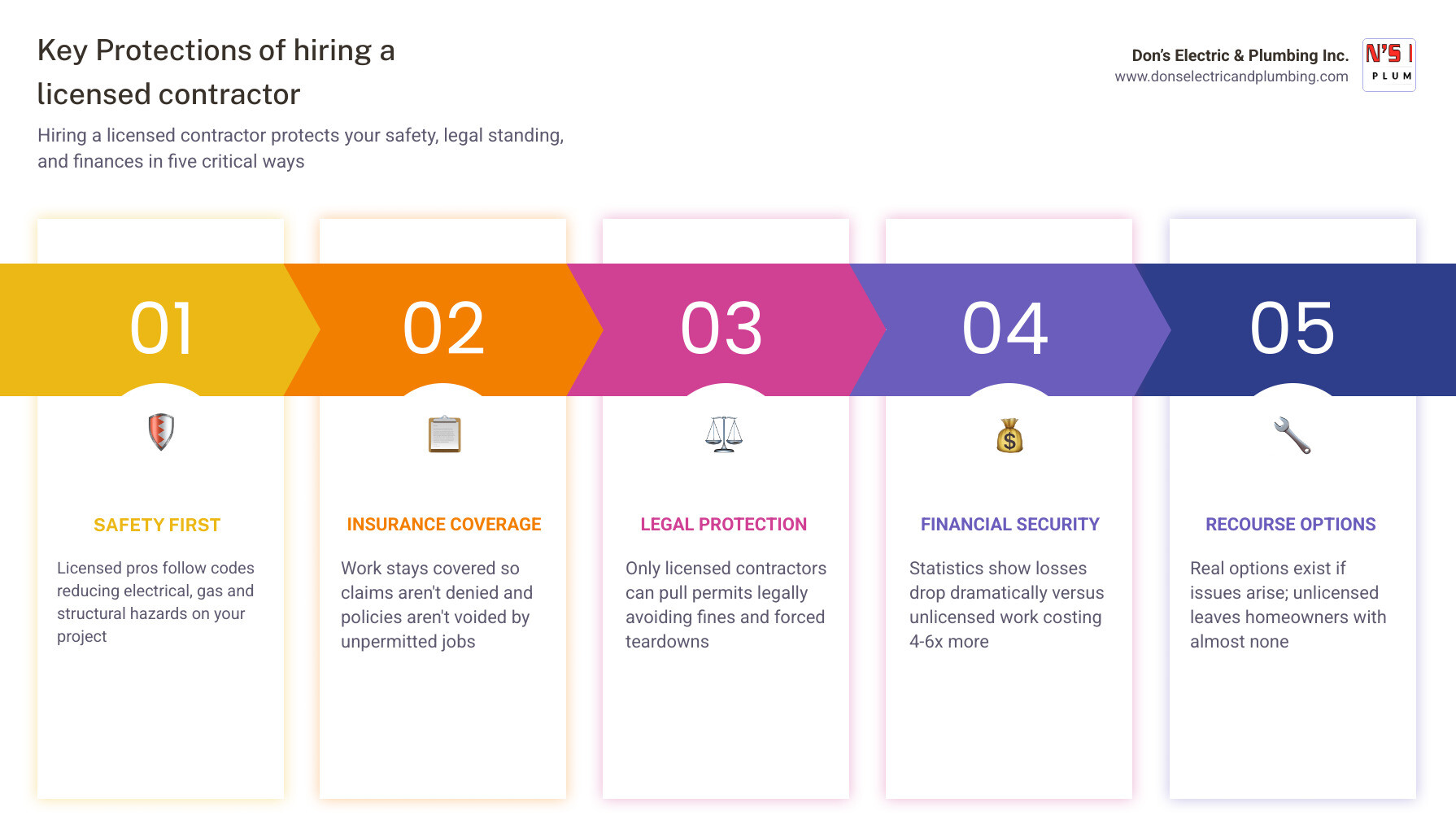
Here’s a quick summary of the key reasons:
- Safety — Licensed contractors know local building codes and how to do the work without creating electrical, gas, or structural hazards
- Legal protection — Unlicensed work can void your homeowner’s insurance and leave you personally liable if a worker gets hurt on your property
- Financial security — Homeowners who hire unlicensed contractors suffer losses estimated at 4–6 times higher than those who hire licensed professionals
- Permit compliance — Only licensed contractors can legally pull building permits, meaning unlicensed work often can’t pass inspection
- Recourse if something goes wrong — With a licensed contractor, you have real options; with an unlicensed one, you may have almost none
It’s tempting to go with the lowest bid — especially when a contractor seems knowledgeable and comes with good word-of-mouth. But as the research consistently shows, roughly 20–30% of residential contractors operating today are unlicensed, and the consequences of hiring one can follow you for years — including when you try to sell your home.
This guide walks you through everything you need to know: what licensing actually means, what’s at stake if you skip it, and how to protect yourself before any work begins.
What It Means to Be a Licensed Contractor
A license is not just a piece of paper or a tax registration; it is official, legal proof of professional competence. When a contractor is licensed, it means they have been vetted by a governing authority—such as a state board or local county municipality—to verify that they possess the necessary skills, experience, and knowledge to perform specialized trade work safely and legally.
To obtain and maintain a license, a professional contractor must meet rigorous standards, which typically include:
- Verifiable Field Experience: Most licensing jurisdictions require several years of hands-on, journey-level experience under the supervision of a licensed master before an individual can even apply to take a licensing exam.
- Passing Rigorous Trade Exams: Contractors must pass comprehensive examinations covering trade-specific skills, local and national building codes, and business law.
- Background Checks: Many licensing processes require criminal background checks and fingerprinting to protect consumer safety.
- Continuing Education: To maintain an active license, contractors must complete ongoing training to stay current on changing building codes, safety technologies, and industry standards.
When you hire a licensed tradesperson, such as the Best Electrician Broadalbin, you are hiring someone who has proven to regulatory boards that they understand the precise technical demands of the trade and the strict safety codes designed to protect your household.
State and Local Licensing Standards
In New York, contractor licensing is heavily decentralized. Unlike some states that issue a single statewide general contractor license, New York leaves licensing up to individual counties and municipalities. This means that a contractor operating in Montgomery County, Fulton County, or Schoharie County must comply with the specific localized rules, competency tests, and registration procedures of those exact jurisdictions.
Because standards vary from one town to the next, local licensing ensures that the contractor is intimately familiar with the unique regional requirements. For instance, municipal codes in Gloversville or Sharon Springs might have specific structural or environmental rules that a non-local or unlicensed operator would completely overlook. Licensed professionals maintain the proper local registrations, pay municipal fees, and carry the necessary local bonds required to protect consumers in these communities.
How to Verify a Contractor’s Credentials
You should never take a contractor’s word at face value when they claim to be licensed and insured. Verifying their credentials only takes a few minutes, but it can save you tens of thousands of dollars.
To verify a contractor’s credentials:
- Ask for their License Number: A legitimate contractor will gladly provide their license number on their business cards, estimates, and vehicles.
- Check the Local Database: Visit your county or city’s official website (such as the Fulton County or Montgomery County clerk’s office or local building department databases) to look up the license number and verify that its status is “Active.”
- Request Certificates of Insurance (COI): Ask the contractor to have their insurance broker send certificates of general liability and workers’ compensation insurance directly to you. Do not accept a photocopied paper certificate from the contractor’s hands, as these can easily be expired or altered.
- Require a Written Contract: A licensed contractor will always provide a detailed, written contract outlining the scope of work, materials, timeline, and payment milestones.
Using multi-trade companies can simplify this vetting process immensely. Working with an established team means you only have to verify one reputable company for all your heating, cooling, plumbing, and electrical needs. You can learn more about how this simplifies your home care in our guide on One Call Does It All: Benefits of Multi-Trade Contractors.
Red Flags of Unlicensed Operators
Unlicensed contractors are skilled at presenting themselves as affordable, friendly local handymen who “can do it all.” However, they often display clear warning signs that should make you pause. Watch out for these red flags:
- Demanding Large Upfront Payments or Cash Only: Legitimate contractors operate on structured payment milestones and rarely demand more than a standard deposit before starting. If they insist on cash-only payments, they are likely trying to avoid a paper trail.
- No Physical Business Address: If their only contact info is a cell phone number and a generic email address, they can easily disappear if something goes wrong.
- High-Pressure Sales Tactics: They press you to sign or agree immediately, claiming the “special price” is only good for today.
- Reluctance to Discuss Permits: If they ask you to pull the building permit in your own name as an “owner-builder,” or if they claim “permits aren’t necessary for this kind of job,” this is a massive red flag. They are trying to hide their unlicensed status from local building inspectors.
- Lack of Professional Branding: Operating out of unmarked personal vehicles with no visible license numbers, or lacking a professional website and references, indicates an informal, high-risk operation.
Why Hiring a Licensed Contractor Matters

When you hire a contractor, you are inviting someone to alter the core systems of your home—your electrical wiring, your pressurized plumbing lines, or your heating and cooling equipment. Why hiring a licensed contractor matters is rooted in the immense legal and financial protections that licensing provides to you as a property owner.
| Feature / Protection | Licensed Contractors | Unlicensed Operators |
|---|---|---|
| Vetted Trade Competency | Yes (exams, experience, background checks) | No proof of skill or safety knowledge |
| General Liability Insurance | Yes (mandated by licensing authorities) | Highly unlikely; homeowner absorbs damage costs |
| Workers’ Compensation | Yes (protects you from injury lawsuits) | No; you can be sued as the primary employer |
| Ability to Pull Permits | Yes (legally recognized by municipalities) | No; forces homeowner to lie on permit forms |
| Home Insurance Alignment | Yes (fully covered under standard policies) | High risk of claim denial for faulty work |
| Consumer Recourse Options | Yes (state boards, local bonds, arbitration) | None (civil lawsuit or small claims court only) |
Why Hiring a Licensed Contractor Matters for Your Safety
The primary purpose of building codes and contractor licensing is public safety. Professional work in electrical, plumbing, and HVAC systems involves managing highly volatile forces: high-voltage electricity, natural gas, pressurized water, and combustion byproducts like carbon monoxide.
If an unlicensed technician makes a mistake, the results can be catastrophic:
- Electrical Fires: Overloaded circuits, improper grounding, and loose connections behind drywall are leading causes of devastating residential fires.
- Gas Leaks and Carbon Monoxide: Incorrectly installed furnaces, boilers, or gas water heaters can leak lethal, odorless carbon monoxide gas into your living spaces or trigger gas line explosions.
- Structural and Water Damage: Faulty plumbing repairs hidden behind walls can slowly leak, causing toxic mold growth, rotted floor joists, and compromised structural integrity.
By choosing a licensed professional, you ensure that the technician working on your home understands these hazards and follows the National Electrical Code (NEC) and local plumbing and mechanical regulations to the letter. For example, if you reside in Palatine, NY, keeping your electrical systems safe requires regular professional oversight. Check out our advice on Who Can I Call for Routine Electrical Maintenance in Palatine? to keep your family safe.
Why Hiring a Licensed Contractor Matters for Home Insurance
Many homeowners believe that their standard homeowner’s insurance policy will protect them from any disaster that occurs on their property. This is a dangerous misconception.
Insurance policies are legal contracts built on risk mitigation. Nearly all standard homeowner’s insurance policies contain explicit exclusions for:
- Faulty Workmanship: If your home suffers water damage because an unlicensed handyman installed a shower pan incorrectly, your insurer will likely deny the claim, citing negligent or non-professional work.
- Unpermitted Modifications: If an electrical fire occurs and the investigation reveals the wiring was updated without a permit by an unlicensed operator, your insurer may void your entire property coverage for that incident.
If a major disaster strikes—such as a whole-house fire caused by unlicensed electrical work—you could face a total loss of your property with absolutely zero financial help from your insurance carrier. Hiring a licensed contractor ensures that all work is fully documented, permitted, and performed to professional standards, keeping your insurance policy valid and fully protective.
The Financial and Legal Risks of Unlicensed Work
The initial appeal of hiring an unlicensed contractor is almost always the lower price. Because they do not pay for licensing fees, continuing education, proper business taxes, or expensive liability and workers’ compensation insurance, unlicensed operators can underbid legitimate companies.
However, this upfront discount is a financial illusion. Homeowners who hire unlicensed contractors face losses that are, on average, 4 to 6 times higher than the cost of hiring a licensed professional right from the start. If you want to avoid these costly pitfalls, take a look at our guide on Don’t Get Hammered by Choosing the Wrong Home Service Company.
The Nightmare of Unpermitted Work During a Home Sale
Unlicensed work often remains a hidden secret—until you decide to sell your home. During the closing process, buyers hire professional home inspectors, and title companies perform thorough searches of local municipal records.
If the inspector discovers major renovations, electrical panel upgrades, or plumbing additions that do not have matching municipal permits on file, your home sale can quickly fall apart:
- Mandatory Retroactive Permitting: You may be forced to hire a licensed contractor to inspect the hidden work, which often requires tearing open drywall to expose wiring or plumbing.
- Mandatory Teardowns: If the unlicensed work cannot be brought up to current building codes, local building inspectors can order a complete teardown of the addition or renovation at your expense.
- Severe Price Reductions: Buyers will demand steep discounts on the purchase price to cover the cost of correcting the unpermitted work themselves.
- Escrow and Financing Delays: Mortgage lenders will refuse to finance a home with active building code violations or unpermitted structural, electrical, or plumbing modifications, causing the sale to collapse entirely.
Liability and Worker Injury Risks
What happens if an unlicensed worker falls off a ladder or suffers an electrical shock while working on your home?
If the contractor is licensed, they are legally required to carry workers’ compensation insurance. If an injury occurs, the worker’s medical bills and lost wages are covered by that policy.
If the contractor is unlicensed, they almost certainly do not carry workers’ compensation. Under New York law, if an uninsured worker is injured on your property, you can be legally classified as their employer. This shifts the entire burden of liability directly to you. You could be held personally responsible for:
- The worker’s emergency room and ongoing medical bills
- Lost wages and long-term disability costs
- Personal injury lawsuits that put your savings, investments, and your home itself at risk
Standard homeowner’s liability insurance rarely covers injuries to commercial workers if they were hired illegally or if the work was performed without proper permits.
Frequently Asked Questions About Contractor Licensing
Can an unlicensed contractor pull building permits?
No. Local building departments in Montgomery, Fulton, and Schoharie counties will only issue building permits to licensed, registered contractors who can prove they carry active liability and workers’ compensation insurance.
If an unlicensed contractor tells you to pull the permit under your own name as the “owner-builder” to save money, they are trying to avoid legal accountability. By pulling the permit yourself, you legally declare that you are personally supervising the work and acting as the general contractor. If the work fails inspection, violates code, or causes an accident, you bear 100% of the legal and financial responsibility.
What is the difference between a licensed and a bonded contractor?
While “licensed” and “bonded” are often grouped together, they refer to two completely different forms of protection:
- Licensed: Means the contractor has met the government’s standards of competency, passed exams, undergone background checks, and is legally authorized to perform the trade.
- Bonded: Means the contractor has purchased a surety bond. A surety bond is a financial guarantee from a third-party bonding company. If the contractor fails to complete the project, abandons the job, fails to pay their subcontractors or material suppliers, or performs work that causes damage, you can file a claim against the bond to recover your financial losses.
What should I do if I accidentally hired an unlicensed contractor?
If you realize that the contractor currently working on your home is unlicensed, you must act quickly to limit your liability:
- Stop Work Immediately: Instruct the contractor to halt all work on your property.
- Review Your Payments: Do not hand over any more money, regardless of what they claim is owed.
- Assess the Work: Contact a licensed professional to inspect the work that has already been completed. They can identify code violations, safety hazards, or structural issues that need to be corrected.
- Document Everything: Take photographs of all completed work, keep copies of all written communications, receipts, and estimates, and file a report with your local building department or consumer protection agency to prevent them from taking advantage of other homeowners.
Conclusion
Your home is your most valuable asset, and your family’s safety is your highest priority. Cutting corners by hiring unlicensed labor might seem like an easy way to save a few dollars upfront, but the long-term legal, financial, and safety risks are simply never worth it.
Since 1984, Don’s Electric & Plumbing Inc. has served as the trusted, family-owned multi-trade partner for homeowners across Montgomery, Fulton, Schoharie, Herkimer, and Hamilton counties—including Canajoharie, Palatine, Minden, Broadalbin, Gloversville, and Sharon Springs. We bring over four decades of local expertise to every single job, backed by a 100% satisfaction guarantee, reliable financing options, and 24/7 emergency services.
We take immense pride in our deep community roots and our commitment to doing things the right way. To learn more about our values and why working with a local, multi-generation family business makes all the difference, explore our stories on:
- Why Family-Owned Companies Just Care More
- The Secret Sauce of Family-Owned Multi-Trade Companies
- Learning from the Best: The Second Gen Advantage
Don’t leave your home’s safety and value to chance. If you are planning an electrical, plumbing, or heating project, protect your property by partnering with a fully licensed, insured, and guaranteed professional team.
Ready to start your next project with a team you can trust? Visit our guide on Don’t Get Hammered by Choosing the Wrong Home Service Company to learn how we protect your home, or contact us today to schedule your service.