



Why Knowing the Red Flags When Hiring a Contractor Could Save You Thousands
Knowing the red flags when hiring a contractor before you sign anything is one of the most important steps you can take as a homeowner. Contractor fraud costs American homeowners an estimated $3 billion every year, and the Federal Trade Commission receives hundreds of thousands of related complaints annually. Home improvement is one of the most consistently reported consumer fraud categories in the country — and most of it starts with warning signs that homeowners explain away too quickly.
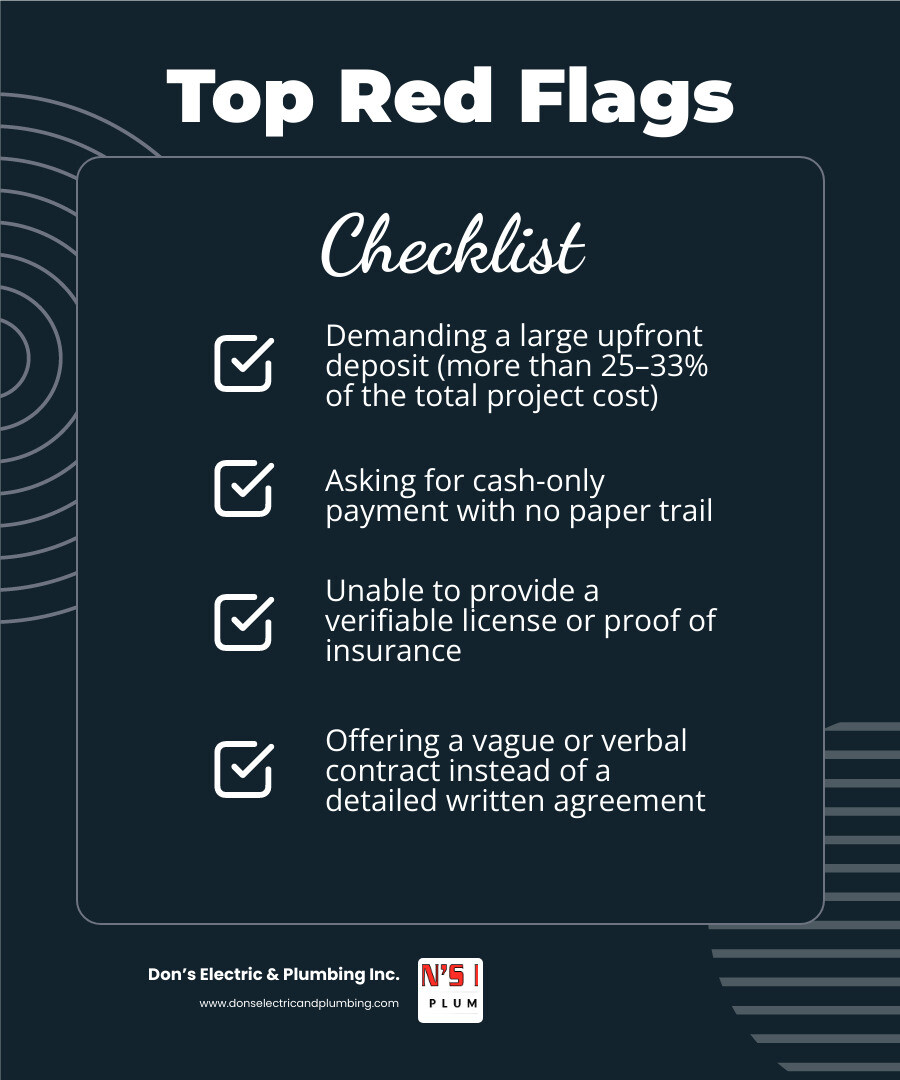
The most common red flags when hiring a contractor include:
- Demanding a large upfront deposit (more than 25–33% of the total project cost)
- Asking for cash-only payment with no paper trail
- Unable to provide a verifiable license or proof of insurance
- Offering a vague or verbal contract instead of a detailed written agreement
- Pressuring you to sign immediately or offering “today only” pricing
- Suggesting you pull the permits yourself instead of handling them
- Unusually low bids that are 30% or more below other quotes
- No verifiable reviews, references, or physical business address
- Changing company names frequently to escape a poor track record
- Poor communication before the job even starts
Most contractor disputes don’t begin with obvious fraud. They begin with small warning signs — a vague estimate here, a cash request there — that slowly add up to a costly mistake. As one industry perspective puts it, roughly 20% of contractors are reliable professionals, about 70% fall short in some way, and around 10% are outright dishonest. That means the odds are not automatically in your favor.
Before you hand over a deposit or pick up a pen, it’s worth reading The Ultimate Guide When Your DIY Skills Aren’t Enough to understand when and how to bring in a professional you can actually trust.
The Most Common Red Flags When Hiring a Contractor

When you are planning a home improvement project, your home is your most valued investment. Whether you are upgrading your electrical system, installing a new energy-efficient furnace, or remodeling a bathroom, the team you hire will be working inside your living space.
Unfortunately, bad contractors reveal themselves not through formal announcements, but through the absence of professional, disciplined behaviors. Spotting these behaviors early serves as a probabilistic risk assessment. While a single minor issue might be a simple oversight, a cluster of three or more warning signs indicates a materially higher risk of financial harm, property damage, or legal headaches.
When you notice these signs, it is vital to protect yourself. To prevent making a costly mistake on your next home project, check out our guide on how to avoid getting burned: Don’t Get Hammered by Choosing the Wrong Home Service Company.
Let’s dive deep into the specific warning signs you should watch for during the hiring process.
Red Flags When Hiring a Contractor: Payment and Contract Warning Signs
The financial and legal terms of your project are where the most severe red flags occur. If a contractor tries to manipulate how or when they are paid, or refuses to put their promises in writing, you should proceed with extreme caution.
- Cash-Only Demands: If a contractor insists on cash payments or offers a discount for cash with no receipt, this is an immediate walk-away signal. Cash leaves no paper trail. If they take your money and vanish, you have no proof of payment. Cash-only requests are also a common practice for unlicensed operations trying to avoid taxes or bypass consumer protection laws. Always pay by check, credit card, or electronic transfer.
- Large Upfront Deposits: Demanding more than 25% to 33% of the total project cost upfront is a major red flag. Legitimate contractors maintain active commercial supplier accounts and have the financial stability to start a job without using your deposit to fund their day-to-day business. A contractor’s cash-flow problem should never become your financing obligation.
- Vague or Missing Contracts: The days of handshake deals are over. A vague contract that lacks a detailed scope of work, material list, or payment schedule is a recipe for disaster. For example, a bad contractor might assume paint or trim is not included in a project unless it is explicitly written down, leaving you with unexpected change orders. A detailed, written contract protects both parties. If you are hiring for specialized work, you must ensure you have a highly qualified team on your side. Learn more about why cutting corners on complex installations never pays off by reading Why You Should Always Hire Professional Plumbers: Here’s Why.
- High-Pressure Sales Tactics: If a contractor pressures you to sign a contract immediately, claims a special price is “for today only,” or uses scare tactics to force a quick decision, walk away. Reputable contractors with a healthy pipeline of local work do not need to pressure clients into same-day decisions. You deserve time to review, compare, and verify any offer.
Red Flags When Hiring a Contractor: Licensing and Permit Avoidance
Working without proper credentials or ignoring local building codes is not just unprofessional — it is illegal and dangerous.
- Evasiveness About Licensing and Insurance: A legitimate contractor will proactively provide their license number and proof of insurance. If they hesitate, give excuses, or provide a license number where the name does not match their business, they may be operating illegally. Working with an unlicensed contractor can render your contract void and leave you completely unprotected if something goes wrong.
- Refusing to Pull Permits: Most major structural, electrical, plumbing, and HVAC projects require local permits. If a contractor suggests skipping permits to “save money” or asks you to pull the permits as the homeowner, this is a massive red flag.
- The Danger of “Owner-Builder” Permits: When you pull a permit as the homeowner, you are legally signing as the general contractor. This means you assume 100% of the liability for building code violations, safety issues, and any injuries that occur on your property. If a contractor cannot or will not pull a permit, it is usually because they are unlicensed, have had their license revoked, or are trying to avoid municipal inspections.
- No General Liability or Workers’ Compensation Insurance: If a contractor lacks proper insurance, any injury on your property becomes your financial responsibility. If a worker falls off a ladder or cuts themselves while working on your home, your homeowner’s insurance may have to cover the claim.
- Improper PPE and Job Site Safety: Professional contractors prioritize safety. If you see workers on your roof without fall protection (which OSHA requires for heights above six feet) or handling electrical components with no safety gear, they are cutting dangerous corners. For high-risk tasks, you should always trust certified professionals. Read our article Don’t Be a Hero and Call an Electrician for These Jobs to see why safety should always come first.
How to Verify Credentials and Handle Scams
Protecting your home means doing your homework before anyone picks up a hammer or screwdriver. Verifying a contractor’s credentials takes only a few minutes, but it can save you months of legal and financial stress.
When you hire a multi-trade provider, you get the benefit of streamlined, highly organized operations where licensing and insurance are managed under one reputable roof. To understand how this makes your life easier, take a look at One Call Does It All: Benefits of Multi-Trade Contractors.
To help you quickly evaluate potential hires, keep this comparison table in mind:
| Feature / Standard | Licensed & Insured Professional | Unlicensed / Uninsured Contractor |
|---|---|---|
| State & Local Licensing | Verifiable through state databases; active and matches business name. | Missing, expired, or registered under a different name. |
| Liability Insurance | Carries active general liability to protect your property. | None, or relies on the homeowner’s insurance policy. |
| Workers’ Compensation | Covers all workers on site; certificate sent directly from insurer. | None; homeowner is liable for on-site injuries. |
| Permits & Inspections | Handles all municipal filings, coordinates inspections proactively. | Asks homeowner to pull permits or suggests skipping them. |
| Written Contracts | Detailed scope, line-item materials, milestones, and warranties. | Vague, verbal, or written on a basic notepad with no details. |
| Business Address | Verifiable physical office or shop location. | Uses a P.O. Box, unmarked vehicle, or has no physical address. |
Steps to Take If You Suspect a Scam
If you realize you have hired a fraudulent contractor, or if they have stopped communicating after taking your money, you must act quickly to limit the damage. Do not let embarrassment prevent you from taking action.
- Document Everything: Create a thorough paper trail. Take photos and videos of all work performed (or left uncompleted). Gather all written estimates, text messages, emails, signed contracts, and receipts. Keep a detailed log of dates, times, and what was discussed.
- Stop Further Payments: If you paid by credit card, immediately contact your bank to dispute the charges. If you paid by check, call your bank to request a stop-payment if the check has not cleared. Never hand over more money to “fix” a bad situation.
- File a Complaint with the State Licensing Board: Report the contractor to your state’s licensing authority. They have the power to investigate violations, issue fines, and suspend or revoke licenses.
- Contact the State Attorney General: The Consumer Protection Division of your state’s Attorney General’s office handles home improvement fraud and can take legal action against predatory businesses.
- Report the Fraud to the FTC: File an official complaint with the Federal Trade Commission (FTC). While the FTC does not resolve individual disputes, your report helps law enforcement spot patterns of fraud and shut down scammers nationwide.
- Leave Honest Reviews: Warn your neighbors by posting factual, objective reviews on Google, Yelp, and the Better Business Bureau (BBB). Stick to verifiable facts (e.g., “Contractor did not complete the work and stopped answering calls after receiving deposit”) to avoid defamation issues.
Safe Payment Terms vs. Risky Deposit Demands
A contractor’s payment schedule should always be tied to clear, physical milestones rather than specific calendar dates. This keeps the project moving forward and ensures you never pay for work that hasn’t been completed.
- The Golden Standard for Deposits: The industry standard deposit is typically 10% to 25% of the total cost. Some states legally cap upfront deposits to protect consumers (for example, California limits deposits to 10% or $1,000, whichever is less). Any demand for more than 33% upfront is a major red flag that indicates the contractor is using your money to fund their previous projects.
- Milestone-Based Progress Draws: For larger projects, structure your payments in stages. For example, a safe schedule might look like this:
- Deposit: 10% to 15% to secure your spot on the schedule.
- Milestone 1: 25% paid after demolition and rough-in work is completed and inspected.
- Milestone 2: 25% paid after drywall, major installations, or primary equipment is in place.
- Final Payment: Hold back the final 15% to 20% until the entire project is completed, passes final municipal inspection, and you have completed a final walkthrough.
- The Importance of Lien Waivers: On larger projects where subcontractors or third-party suppliers are used, always demand a lien waiver with each progress payment. If a general contractor fails to pay their suppliers or subcontractors, those parties can legally place a mechanic’s lien on your home — even if you paid the general contractor in full. A signed lien waiver proves that the suppliers and workers have been paid, protecting you from double-payment scenarios.
Working with an established, family-owned multi-trade business means you don’t have to worry about these risky payment games. To learn more about how a structured, professional team operates, read about The Secret Sauce of Family-Owned Multi-Trade Companies.
Frequently Asked Questions About Contractor Red Flags
What is a normal down payment for a home renovation project?
A normal down payment ranges between 10% and 25% of the total project cost. For smaller, material-heavy projects, some contractors may request up to 30% to cover custom orders. You should never agree to pay more than 33% upfront. A professional contractor should have sufficient credit lines and cash flow to order standard materials and begin work without relying entirely on your deposit.
What happens if a contractor refuses to pull permits?
If a contractor refuses to pull permits, it is a sign of serious trouble. Working without a permit can lead to:
- Safety Violations: Uninspected electrical, plumbing, or HVAC work can lead to fires, leaks, or carbon monoxide hazards.
- Fines and Delays: If local code enforcement discovers unpermitted work, they can issue a “stop work” order, fine you, and force you to tear down completed work to allow for inspections.
- Home Insurance Issues: If unpermitted work causes a fire or water damage, your insurance company may deny your claim.
- Resale Problems: When you sell your home, home inspectors and buyers’ agents will check municipal records. Unpermitted additions or major system upgrades can ruin a sale.
How can I spot a “storm chaser” contractor scam?
“Storm chasers” are predatory, out-of-state contractors who travel to areas recently impacted by severe weather (like heavy storms, wind, or flooding). You can spot them by these warning signs:
- Door-to-Door Solicitation: They show up uninvited offering “free roof inspections” or “immediate repairs.”
- Out-of-State Plates: Their trucks have out-of-state license plates or lack permanent company branding.
- Insurance Check Scams: They pressure you to sign an “Assignment of Benefits” (AOB) form, which gives them direct control over your insurance payout.
- High-Pressure Tactics: They claim they have a limited supply of materials and you must sign a contract immediately to get on their schedule.
Conclusion
Your home deserves the highest level of care, safety, and professionalism. When you are looking to upgrade or repair your home’s essential systems, you do not have to settle for vague contracts, high-pressure sales, or risky payment demands.
Since 1984, Don’s Electric & Plumbing Inc. has been the trusted, family-owned and operated partner for homeowners throughout Montgomery County, Schoharie County, Fulton County, Herkimer County, and Hamilton County, NY. From our main office in Canajoharie, NY, we proudly serve local communities including Charleston, Palatine, Minden, Broadalbin, Dolgeville, Bleecker, Ephratah, Sharon Springs, Middleburgh, Summit, Esperance, Little Falls, Jordanville, Salsbury, Starkville, Wells, Benson, Hope, and Arreta.
We specialize in high-quality electrical repairs, panel upgrades, plumbing systems, water heaters, sump pumps, HVAC maintenance, and indoor air quality solutions. We back all of our work with a 100% satisfaction guarantee, offer convenient financing options, and provide same-day, 24/7 emergency services when you need us most.
Choosing a contractor shouldn’t feel like a gamble. To learn more about why choosing a local, family-owned provider makes all the difference for your peace of mind, read Why Family-Owned Companies Just Care More.
Ready to experience professional, stress-free home services? Keep your home safe and comfortable by visiting Don’t Get Hammered by Choosing the Wrong Home Service Company to connect with our team today!