


Why Knowing How to Choose a Reliable HVAC Contractor Could Save You Years of Headaches
Knowing how to choose a reliable HVAC contractor is one of the most important decisions you’ll make as a homeowner. Your heating and cooling system is a major investment — and who installs or services it matters just as much as the equipment itself. In fact, research shows that roughly half of all homeowners end up with an improperly installed HVAC system. That means higher energy bills, more frequent breakdowns, and repairs that could have been avoided entirely.
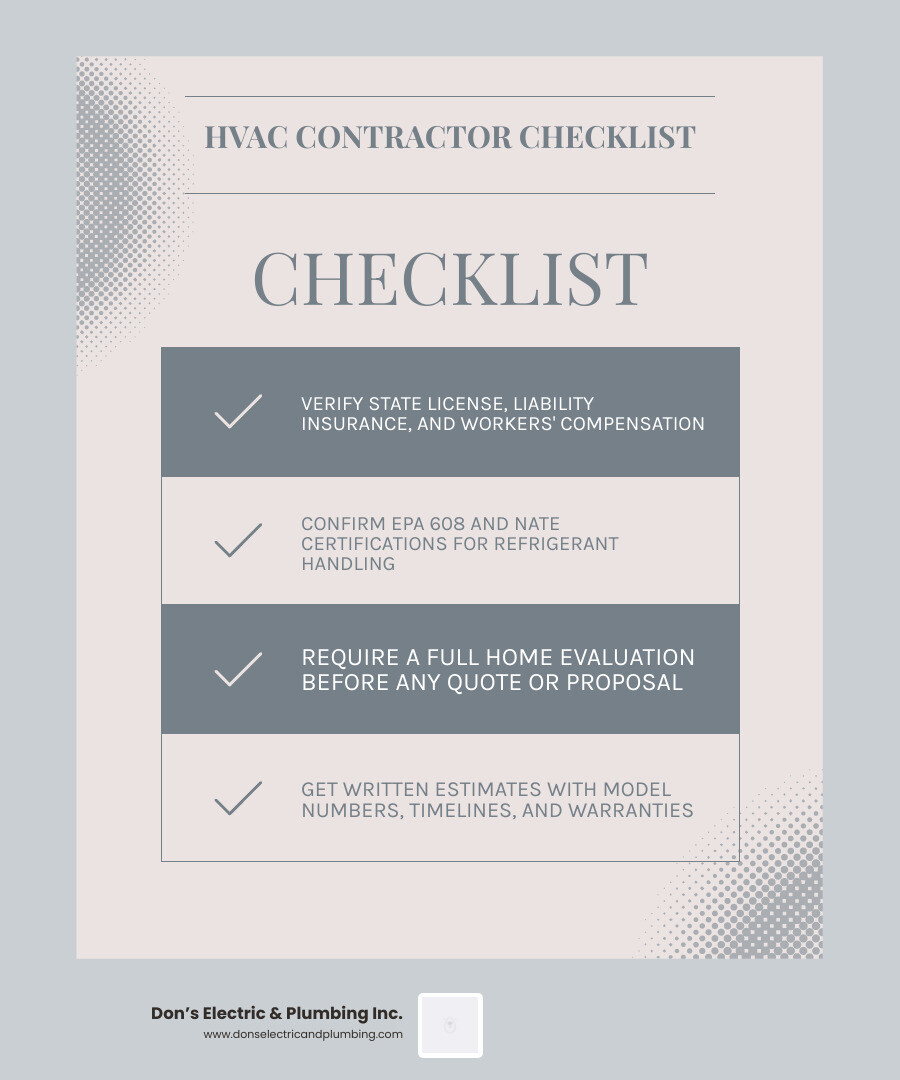
Here’s a quick checklist to help you choose a reliable HVAC contractor:
- Verify licensing and insurance — Confirm the contractor holds a valid state license, general liability insurance, and workers’ compensation coverage.
- Check certifications — Look for EPA Section 608 certification and NATE certification on their technicians.
- Ask for referrals and read reviews — Get recommendations from neighbors, friends, or community groups, and check Google, BBB, and Facebook ratings.
- Require a home evaluation first — No reputable contractor should give you a quote without inspecting your home, ductwork, insulation, and current system.
- Get written, itemized estimates — Compare multiple bids on cost, equipment efficiency, and warranty terms — not just price.
- Review the contract carefully — It should include model numbers, project timeline, payment terms, and warranty details.
- Watch for red flags — Pressure tactics, vague estimates, no physical address, or reluctance to provide license numbers are serious warning signs.
- Ask about emergency availability — A trustworthy contractor should offer 24/7 support, especially during harsh winters or summer heat waves.
Whether you’re dealing with a failing furnace in January or shopping for a new central air system before summer hits, the contractor you hire will determine whether that system runs efficiently for 15+ years — or becomes a costly regret within a few. This guide walks you through every step of the vetting process so you can hire with confidence.
How to Choose a Reliable HVAC Contractor: Essential Credentials
When you begin searching for a professional to handle your home’s climate control, you should treat the process like a job interview. Your heating and cooling systems are highly complex, involving high-voltage electricity, combustible fuels, and pressurized refrigerants. Hiring someone who “does side work” or lacks proper credentials is a recipe for disaster.

To protect your home and your family, any contractor you consider must possess the following foundational credentials:
- State and Local Licensing: New York requires specific local and municipal licensing depending on the county. Always ask a contractor for their active license number and verify it with the appropriate local authority in Montgomery, Fulton, or Schoharie County.
- General Liability Insurance: This coverage protects your property in the event of accidental damage during installation or repair. Never work with a contractor who cannot provide a current certificate of insurance showing at least $1 million in liability coverage.
- Workers’ Compensation Insurance: If an installer is injured while working on your property, workers’ comp ensures you aren’t held legally or financially liable for their medical expenses.
- Surety Bonds: A bond provides financial protection for the homeowner if the contractor fails to complete the job or meet local building codes.
Verifying these documents up front filters out fly-by-night operations and ensures you are working with a legitimate business. If a company is hesitant to provide proof of insurance or their license number, consider it an immediate stop sign. When dealing with complex systems, you can also utilize a structured HVAC Troubleshooting System to understand your equipment’s behavior before the technician even arrives.
Verifying EPA 608 and NATE Certifications
Beyond basic business licenses, the technicians working inside your home must hold specialized industry certifications. These credentials guarantee that the individuals performing the work have been tested on modern technical standards and environmental regulations.
- EPA Section 608 Certification: Federal law requires anyone who maintains, services, repairs, or disposes of equipment containing regulated refrigerants to be certified under Section 608 of the Clean Air Act. This ensures refrigerants are handled safely without damaging the ozone layer or violating environmental laws.
- NATE Certification: North American Technician Excellence (NATE) is the gold standard of third-party certifications in the heating and cooling industry. Technicians who hold NATE certification have passed rigorous, real-world exams testing their knowledge of system installation, diagnostics, and repair.
When a contractor employs NATE-certified technicians, it tells you they prioritize ongoing education and high workmanship standards. If you have questions about what these certifications mean for your home’s safety, reviewing a comprehensive HVAC System FAQ can help demystify the terms and standards used by professionals.
Why a Comprehensive Home Evaluation is Non-Negotiable
A major mistake many homeowners make is accepting an HVAC quote over the phone or agreeing to a system replacement after a five-minute glance at their outdoor unit. A reliable contractor will never offer a bid without performing a detailed, in-home evaluation.
Every house is an interconnected system. The heating and cooling load of your home depends on a variety of structural factors, including:
- Total Square Footage and Layout: The physical size and shape of your living spaces dictate the baseline capacity your system needs.
- Insulation Levels (R-Value): Poorly insulated attics or walls require larger heating and cooling outputs to maintain comfortable temperatures.
- Window Count, Quality, and Orientation: Large south-facing windows let in substantial solar heat during the summer, while older single-pane windows allow heat to escape during cold upstate New York winters.
- Ductwork Integrity: If your ducts are leaking air into unconditioned spaces like crawlspaces or attics, even the most efficient furnace or air conditioner will struggle to keep you comfortable.
If a contractor skips these assessments and simply replaces your old unit with one of the exact same size, they may be repeating a past mistake. If the original unit was improperly sized, or if you have upgraded your insulation and windows since then, you could end up with an oversized or undersized system. To avoid these issues, review some of the most common mistakes to watch out for in this guide to HVAC Don’t: Common Mistakes to Avoid.
How to Choose a Reliable HVAC Contractor Who Measures Airflow
Proper system performance is entirely dependent on balanced airflow. A qualified contractor will measure the airflow through your existing duct system before recommending new equipment. If your ducts are too small or have restrictive bends, a new, high-efficiency system will suffer from restricted airflow, leading to premature compressor failure or a cracked heat exchanger.
During the home evaluation, the contractor should perform a load calculation (often referred to as a Manual J calculation) to determine the exact heating and cooling requirements of your home. This scientific approach prevents “short-cycling”—a destructive cycle where an oversized system turns on and off rapidly, wasting energy and wearing out components. For homeowners wanting to keep their heating systems in peak condition, scheduling Routine Furnace Service: Why It Matters is the best way to ensure your airflow and heat exchange remain safe and efficient year after year.
Evaluating Written Proposals and Equipment Options
Once the home evaluation is complete, you should receive a written, itemized proposal. When comparing proposals from different contractors, do not simply jump to the bottom line to find the lowest price. A lower bid often indicates that a contractor is cutting corners, skipping permits, using subpar materials, or lacking proper insurance.
Instead, compare the proposals based on equipment efficiency, long-term energy savings, and warranty protection.
| Evaluation Factor | Standard-Efficiency Systems | High-Efficiency Systems (ENERGY STAR) |
|---|---|---|
| Energy Efficiency Ratings | Baseline SEER2 / AFUE ratings | High SEER2 / AFUE ratings (ENERGY STAR certified) |
| Long-Term Operating Costs | Standard energy consumption | Significantly reduced monthly energy bills |
| Environmental Impact | Standard carbon footprint | Lower emissions and reduced energy waste |
| Home Comfort Features | Single-stage operation (on/off) | Variable-speed motors for precise temperature control |
| Rebate & Incentive Eligibility | Rarely eligible for local incentives | Highly eligible for federal, state, and utility rebates |
Purchasing energy-efficient equipment is a smart long-term investment. In fact, almost one-quarter of households knowingly purchased at least one ENERGY STAR qualified product last year, and 71% of those consumers say they would recommend ENERGY STAR to a friend.
Additionally, look for flexible financing options that allow you to spread the investment over manageable monthly payments, making a high-efficiency system upgrade much easier on your household budget.
Key Details in a Professional HVAC Proposal
A professional proposal should leave no room for guesswork. It serves as a blueprint for the entire project and protects you from unexpected changes. Ensure that the written contract contains the following details:
- Exact Model and Serial Numbers: The proposal must specify the exact indoor and outdoor units, coils, or air handlers being installed, rather than generic brand names.
- Detailed Scope of Work: This outlines what is included in the installation, such as duct modifications, new thermostat installation, electrical upgrades, and the removal and disposal of old equipment.
- Project Timeline: It should state when the work will begin and the estimated completion date.
- Manufacturer and Labor Warranties: The proposal must clarify the length of the manufacturer’s parts warranty and, crucially, the contractor’s labor warranty.
- Payment Schedule: A clear payment structure should be outlined, indicating what is due upfront and what is due upon successful completion of the job.
Understanding these details ensures there are no surprises once the technicians arrive at your home. For a closer look at how a professional team manages this process, explore how a dedicated How HVAC Company Ensures Home Comfort to keep your project running smoothly from start to finish.
Red Flags of an Unreliable Contractor
Protecting yourself from poor workmanship means knowing how to spot an untrustworthy operator early in the process. While many contractors take pride in their craft, others rely on pressure tactics and shortcuts to secure business.
Watch out for these common warning signs during your initial conversations:
- High-Pressure Sales Tactics: If a representative pressures you to sign a contract immediately or claims a “special discount” is only valid if you buy today, walk away. Reliable companies allow you time to review your options.
- Vague or Verbal Agreements: A promise that isn’t written down is incredibly difficult to enforce. If a contractor hesitates to put their guarantees, warranties, or scope of work in writing, they cannot be trusted.
- No Physical Business Address: Be wary of companies that only list a P.O. Box or a mobile phone number. A reliable contractor should have an established physical office, reflecting their stability and long-term commitment to the community.
- Extremely Low Bids: If one estimate is significantly lower than all others, it usually means the contractor is unlicensed, uninsured, or using uncertified helpers to perform the installation.
How to Choose a Reliable HVAC Contractor Without Falling for Scams
To avoid falling victim to unlicensed workers or bait-and-switch schemes, always verify the company’s background. Check online review platforms like Google, Yelp, and the Better Business Bureau (BBB). Look for patterns in the feedback. A company with hundreds of reviews and a 4.8-star rating is generally far more dependable than one with a perfect 5.0 rating based on only three reviews.
Pay attention to how the company responds to negative reviews. A professional contractor who addresses complaints politely and works to resolve issues demonstrates accountability. For more tips on maintaining your home comfort systems and avoiding common pitfalls, check out our updated HVAC Blog.
Frequently Asked Questions about Selecting an HVAC Professional
What emergency service capabilities should I look for?
When your heating fails during a sub-zero winter freeze in upstate New York, you cannot afford to wait days for a callback. Look for a local contractor that offers true 24/7 emergency service with rapid response times. A reliable company keeps fully stocked service trucks ready to handle urgent repairs on the spot, ensuring your home and pipes don’t freeze.
How do online reviews help me find a trustworthy contractor?
Online reviews provide a transparent look at a contractor’s real-world performance. Look for consistent praise regarding punctuality, cleanliness, polite communication, and fair billing practices. Be cautious of companies with numerous complaints regarding unreturned phone calls, unfinished work, or sudden price changes after the job has started.
Why is proper system sizing so critical?
An improperly sized system will severely impact your comfort and wallet. If a system is too large, it will short-cycle, causing high energy consumption and uneven temperatures. If it is too small, it will run constantly without ever reaching your thermostat’s set temperature, leading to high utility bills and premature system failure.
Conclusion
Choosing a heating and cooling partner is about finding a team that treats your home with the same care and respect they would show their own. At Don’s Electric & Plumbing Inc., we have been serving Canajoharie, NY, and the surrounding areas since 1984. As a family-owned and operated company, we believe in building long-term relationships with our neighbors in Montgomery, Fulton, Schoharie, Herkimer, and Hamilton counties.
Working with a local, multi-trade family business brings a unique level of accountability and care. To learn more about why our approach is different, read about Why Family-Owned Companies Just Care More.
By hiring a multi-trade provider, you gain access to a team that can seamlessly manage your heating, cooling, plumbing, and electrical needs all at once. Discover the convenience of this approach in One Call Does It All: Benefits of Multi-Trade Contractors.
When we replace or service an HVAC system, we often need to coordinate electrical upgrades or plumbing adjustments. Having these skills under one roof ensures your project is completed safely and efficiently. Read more about Why Your HVAC and Electrical Needs a Family Touch and explore The Secret Sauce of Family-Owned Multi-Trade Companies to see how our unified team delivers exceptional results.
Don’t leave your home comfort to chance or cut-rate operations. Protect your investment, your safety, and your peace of mind by choosing a certified, licensed, and highly rated local professional. To make sure you make the right choice for your next home project, read our guide on how to Don’t Get Hammered by Choosing the Wrong Home Service Company.
Ready to experience reliable home comfort? Contact our friendly, expert team at Don’s Electric & Plumbing Inc. today to schedule your comprehensive home evaluation!